
Crisis management is not a last-minute reaction. It’s a decision-making system. When a crisis escalates, what’s at stake is not only a company’s public image, but also its operational credibility, the trust of its stakeholders, and how its digital identity is presented to third parties.
Today, that exposure isn’t just about media or social networks: it also affects how a brand appears in search engines and in AI experiences within Search.
Google has reiterated in 2025 that its AI features continue to rely on useful, reliable, and people-oriented content, while the European Union has strengthened the responsibility of platforms against illicit content and systemic risks under the Digital Services Act.
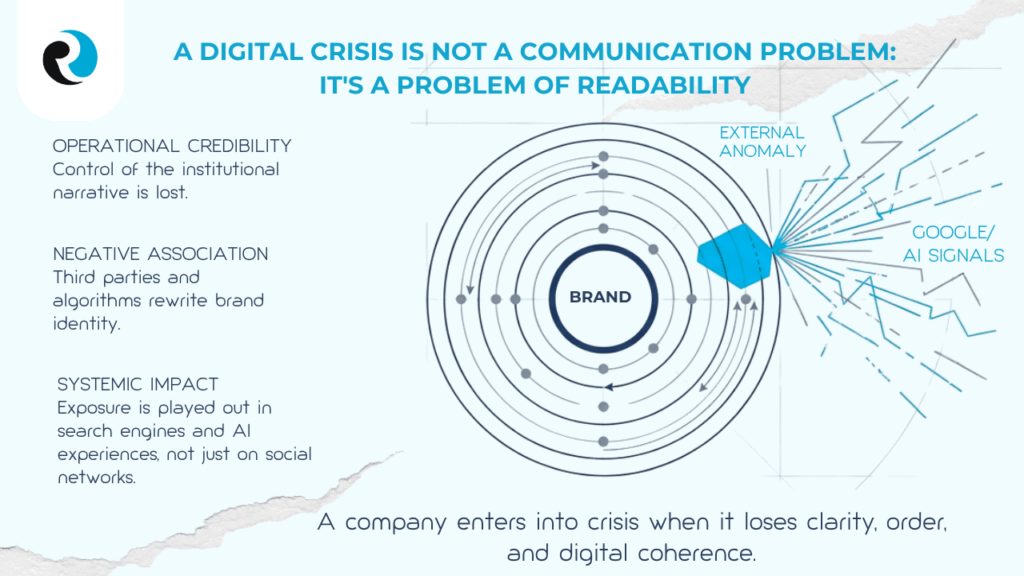
Therefore, an organization doesn’t enter a crisis only when it receives public pressure. It enters a crisis when it loses the ability to clearly explain what is happening, prioritize internal issues, and maintain a consistent digital presence.
This logic is also present in ReputationUP content such as Digital Reputation Laws and Political Reputation and AI: today reputation is contested on several fronts at once, and crisis management can no longer be separated from visibility.
What truly puts a digital crisis at risk
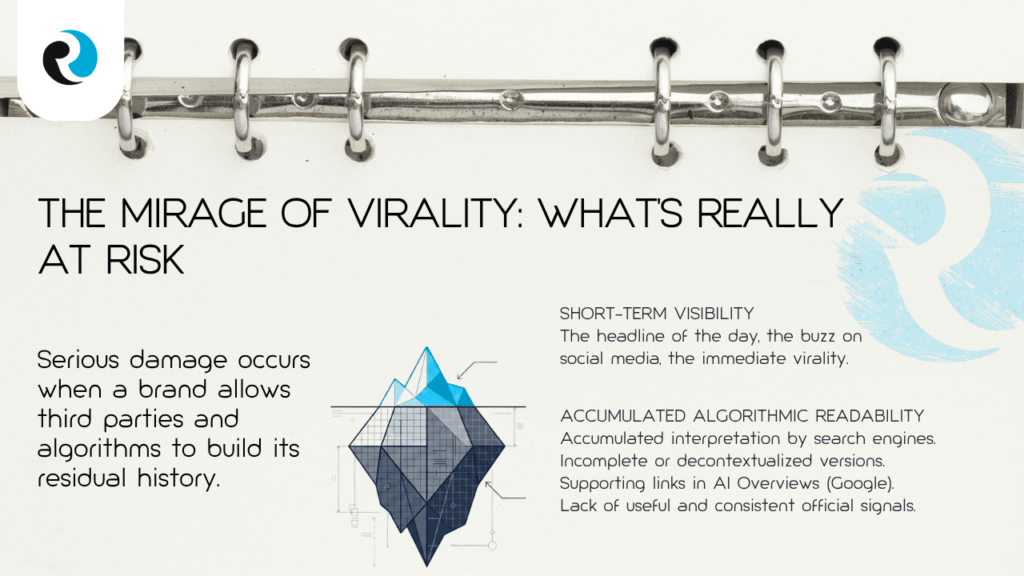
A digital crisis doesn’t just affect the day’s headline. Above all, it affects the cumulative interpretation that others make of a brand. If customers, partners, journalists, or search engines start finding incomplete versions, negative associations, or decontextualized content in prominent positions, the problem is no longer merely one of communication. It becomes a problem of public readability.
This explains why many companies react late. They believe the damage only occurs when a post goes viral. In reality, serious damage occurs when an organization loses the ability to shape its own institutional narrative and lets others do it for them.
In environments where Google displays supporting links in AI Overviews and where content must be truly useful to perform well in Search, a crisis can solidify faster if the brand does not have enough clear, useful, and consistent signals.
Crisis management begins with governance, not the press release.
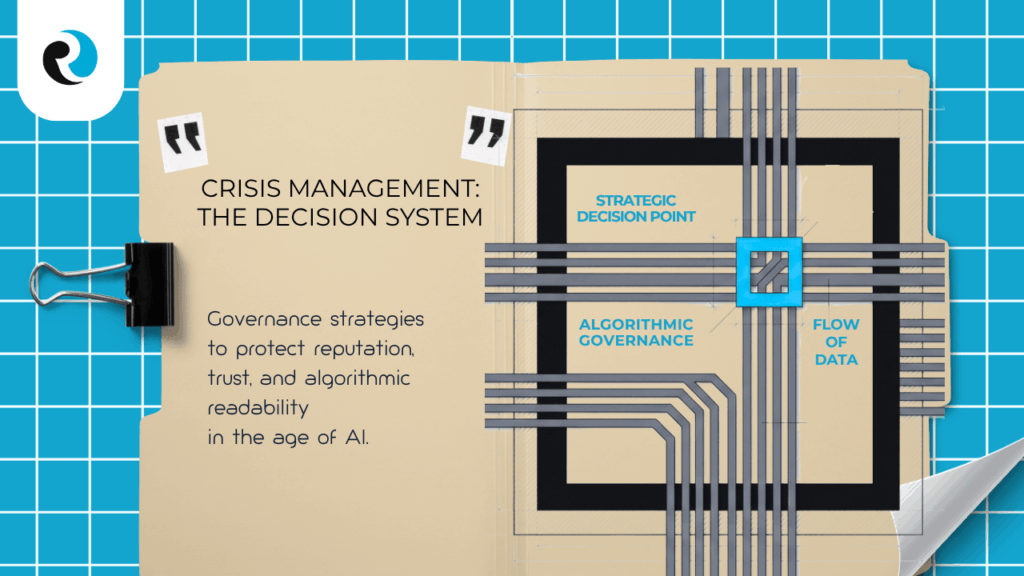
The most common mistake in a crisis is confusing visibility with response. A company can react quickly and still react poorly if it hasn’t defined who makes the decisions, what is prioritized, and what information is considered valid. The core of crisis management lies in governance : who gathers facts, who validates risks, who authorizes the official position, and who can speak.
This is where many organizations fail. Management, legal, marketing, and communications operate in silos and produce inconsistent messages. A well-managed crisis requires the exact opposite: a single line of reasoning.
In practice, that means working with three simultaneous layers:
- A layer of verifiable facts,
- A layer of institutional decision-making,
- A layer of public exposure.
If one of those three layers becomes disordered, the crisis is prolonged.
What decisions should be made before issuing a public position?
Before publishing a position, a brand should answer four questions.
The first is what type of incident you are facing. False information, an aggressive opinion, the exposure of personal data, truthful but biased coverage, and a coordinated defamation campaign are not handled in the same way.
The second question is what the response aims to achieve. Sometimes it’s best to clarify. Other times it’s best to correct. In some cases, documentation is necessary for legal purposes. And in others, the sensible approach is to limit dissemination without unnecessarily amplifying the content.
The third is what needs to be protected immediately. This could be business trust, a spokesperson’s position, legal clarity, or the visibility of certain digital assets.
The fourth point is what not to do. In a crisis, some responses worsen the problem: improvising, contradicting oneself, raising one’s voice without evidence, or turning a minor correction into an excessive statement.
When the problem involves inaccurate data, the Spanish Data Protection Agency (AEPD) maintains the framework of the right to rectification , which allows for the correction of inaccurate personal data and the completion of incomplete data.
The Agency also reminds that the exercise of rights should first be directed to the relevant responsible party.
The difference between a visible reaction and an effective strategy
A statement may be necessary. But a crisis is not resolved simply by publishing a response.
Effective intervention requires a broader approach: incident follow-up, review of search results, organization of official assets, coordination between reputation and legality, and monitoring of evolving public perception. Therefore, modern crisis management is less about a press response and more about a coordinated reputation operation.
That’s where specialized work adds value. Not because it “erase” problems, but because it can:
- Prioritize risks,
- Identify which pieces are most affecting perception,
- Strengthen official signals,
- Improve the brand’s explanatory power,
- Properly activate the right to erasure when appropriate and sustain the strategy while the crisis remains active.
Where does Google end and a reputational strategy begin?
Google can be part of the solution, but it’s not the complete solution. It can review specific requests related to privacy, sensitive personal information, or certain situations linked to the right to be forgotten.
It also clearly distinguishes between forms and action plans based on the type of request. But Google doesn’t determine the internal architecture of a crisis, doesn’t assign stakeholders, doesn’t set reputational priorities, and doesn’t reorganize a brand’s digital presence.
Furthermore, the Spanish Data Protection Agency (AEPD) and Google themselves place the right to be forgotten within the scope of personal data and searches by name of people, not as a general “cleaning” tool for corporate brands.
In December 2025, the Spanish Data Protection Agency (AEPD) published a specific legal criterion reminding that the so-called right to be forgotten does not protect the elimination of truthful information related to a person’s public activity, nor does it allow for the rewriting of careers.
That completely changes how we interpret the problem. When a crisis affects a company, the solution rarely involves waiting for a magical recovery. What usually makes the difference is the ability to restore public understanding, reinforce institutional signals, and sustain a coherent response over time.
What should a brand sustain while the crisis remains open?
During a crisis, an organization must not only “defend itself.” It must maintain three things simultaneously: authority, consistency, and usefulness.
Authority means that the brand remains a credible source about itself.
Consistency means that there are no contradictions between channels, spokespeople, or documents.
Usefulness means that official content truly helps to understand the case, rather than adding noise.
Google has reinforced this in 2025: the content that works best in its AI experiences is not generic or interchangeable, but rather content that provides specific value and answers clearly.
That criterion is especially important in reputation, because in a crisis it is not enough to be present: you have to be understandable and useful.
This logic is also better understood from Strategic PR in the age of AI: it’s not just about competing for attention, but also for context and interpretation.
How to measure if the crisis is starting to lose steam
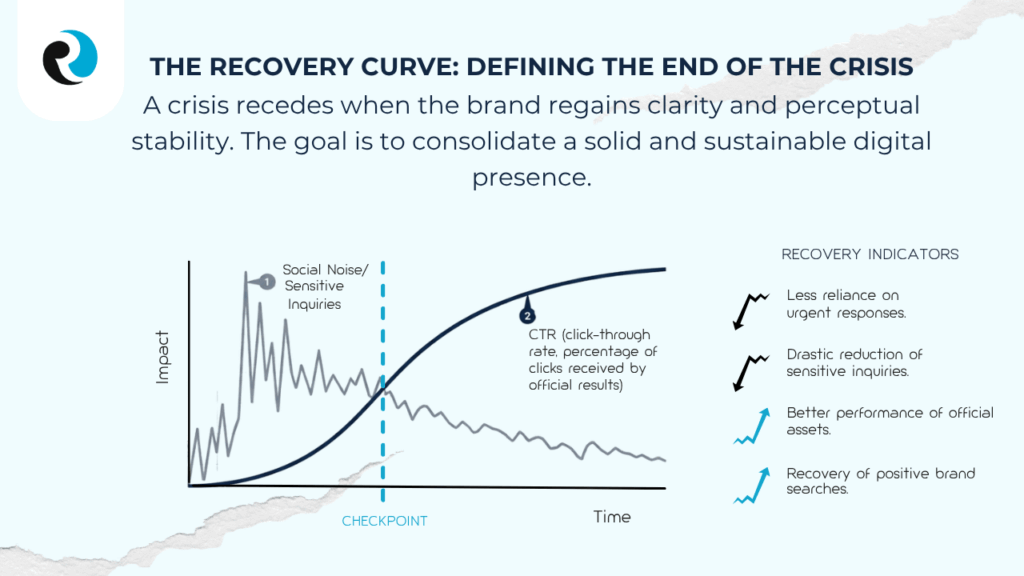
A crisis doesn’t disappear just because there’s less noise for a few days. It begins to recede when the company regains its ability to explain things and its perceptual stability .
This can be observed in signs such as:
- Less reliance on urgent responses,
- Reduction of sensitive queries,
- Better performance of official assets,
- Less traction of adverse content,
- And recovery of brand searches with better context.
Search Console remains the official benchmark for analyzing clicks, impressions, CTR, and average search position. It doesn’t explain the entire crisis on its own, but it does help verify whether the brand’s assets are regaining valuable visibility.
The goal is not just to “get out of the spotlight.” The goal is to regain a legible, defensible, and sustainable digital presence .
Conclusion
Crisis management is not improvisation with good writing. It’s a command structure. A company that wants to navigate a crisis successfully needs to make sound decisions, communicate coherently, and protect its digital presence while others try to oversimplify what happened.
The difference between a crisis that subsides and one that becomes chronic is not usually the initial impact. It’s usually the quality of the response system. When a brand combines governance, evidence, monitoring, visibility, and public utility, it greatly increases its chances of preserving its reputation and regaining authority.
Frequently Asked Questions (FAQ)
Crisis communication is one part of the process. Crisis management also includes internal governance, prioritization, monitoring, digital exposure, risk analysis, and restoring trust.
It’s advisable to correct yourself when there’s verifiably incorrect information that can be proven. If the problem is a hostile opinion or a debatable interpretation, responding without a clear strategy can amplify the conflict.
You can review certain assumptions, but that does not equate to a comprehensive solution, and the right to be forgotten framework is primarily intended for individuals and searches by name.
The appropriate retraction procedure must be activated as soon as possible, evidence must be preserved, and replication must be controlled. The problem is not only what was published, but where it reappears and in what format it circulates.
A combination of protocol, testing, monitoring, a strong digital presence, and a strategy capable of improving how the brand is understood again in search engines, media, and platforms.
ReputationUP doesn’t just respond to a single post or handle a one-off request. Their work combines reputational diagnosis, digital environment monitoring, search engine results analysis, strengthening of owned assets, reputation SEO, narrative reconstruction, and the design of a strategy to recover context, visibility, and credibility when a crisis affects the brand.