
Reputation repair is a high-trust service. It sits between search visibility, legal exposure, platform rules, personal data and executive risk, so the language used to describe outcomes matters.
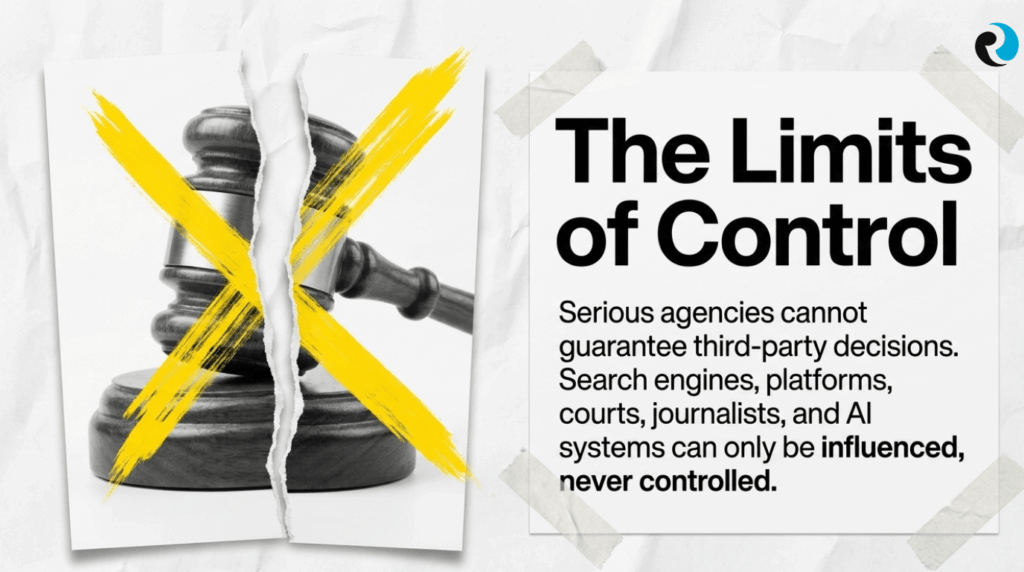
A serious provider should distinguish what it controls from what it can only request or influence. It should not convert decisions by publishers, search engines, platforms, courts or regulators into sales guarantees.
The 2026 Amway case offers a current comparison. It is not a reputation-repair dispute, but it shows how outcome claims can create regulatory and reputational risk when certainty exceeds the available evidence.
For executives choosing a provider, the question is not who promises the fastest result. It is whether the provider can separate method from outcome before action begins.
“In reputation repair, trust begins with limits. A provider that guarantees what it does not control is transferring reputational risk back to the client.”
Juan Ricardo Palacio, CEO America ReputationUP
The direct answer
A reputation repair company should never guarantee universal removal, permanent internet deletion, deindexing by a fixed date, publisher cooperation, control over AI answers or a specific due-diligence outcome. Those results depend on third parties.
What can be promised is the process: evidence review, confidentiality, realistic classification, structured escalation, monitoring and transparent reporting.
A credible engagement should define the likely route – correction, removal, deindexing, suppression or containment – and state where external review or public-interest limits may change the outcome.
Amway in 2026: when outcome promises become a regulatory risk
On September 17, 2026, the Federal Trade Commission and Washington announced a proposed $225 million settlement with Amway and two affiliates over allegations of deceptive recruiting practices, including earnings-related claims.
The Washington State Attorney General’s Office said the complaint alleged that affiliates promoted earnings above $40,000 a year although only about 1% reached that amount, and that many post-2020 participants spent more than they received in company income.
The comparison is about governance, not the reputation industry. When a result depends on variables outside the seller’s control, a promise should not present uncertainty as certainty.
From reassurance to governance risk
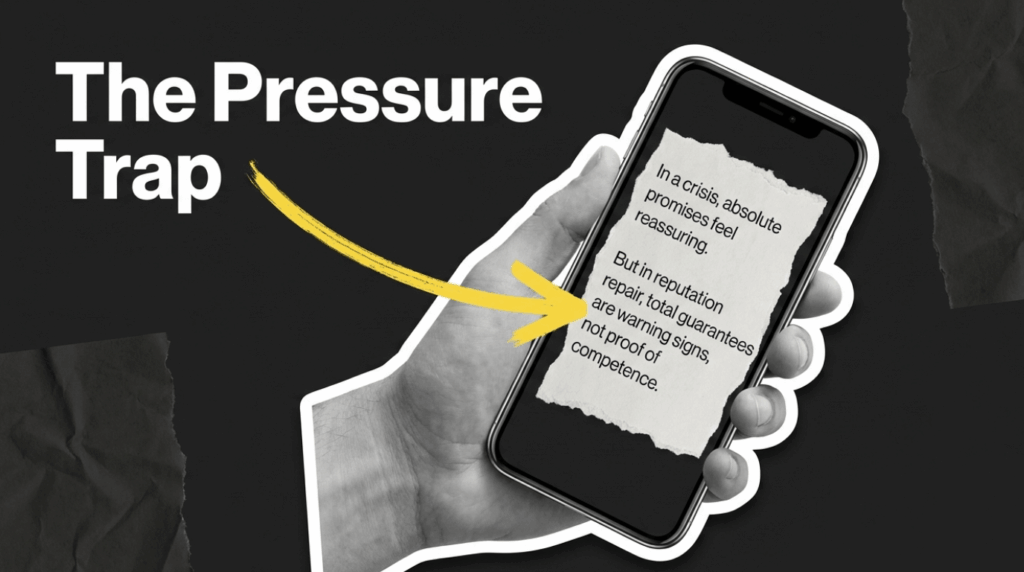
Clients often seek help under pressure. The first risk is misclassification: not every harmful result is a removal case; some require correction, deindexing, suppression or containment.
The second risk is internal expectation. Executives may report certainty before external review is complete. A disciplined Online Reputation Management process should narrow uncertainty, not disguise it.
The third risk is amplification; the fourth is trust. Aggressive takedowns can trigger reposts or follow-up coverage, while a failed guarantee leaves the original problem and creates a second governance issue.
A provider should reduce uncertainty through evidence and sequencing. It should never sell uncertainty as certainty.
What a provider can control
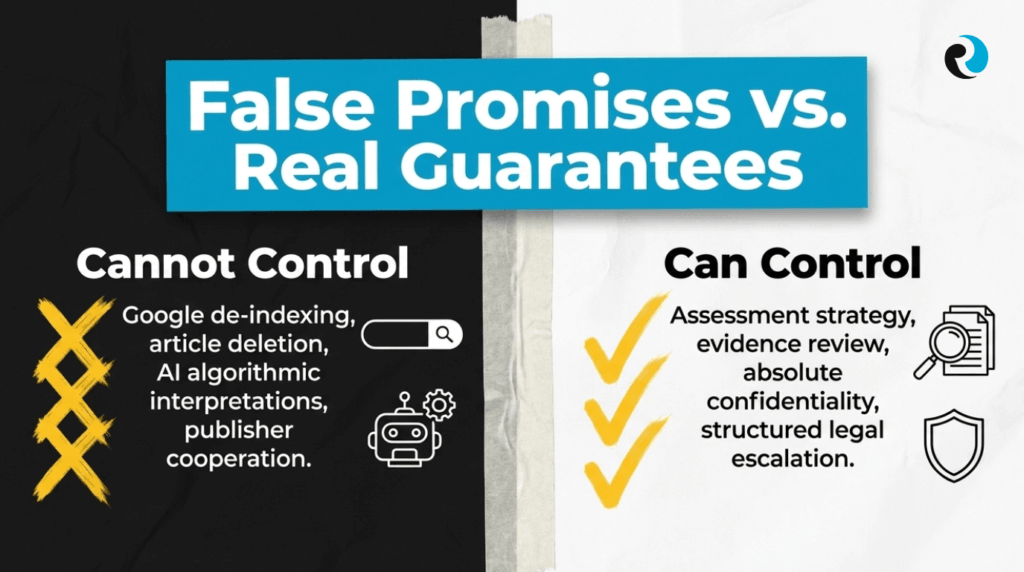
A provider can control its own process. That includes assessment quality, URL mapping, evidence collection, legal and reputational classification, monitoring, confidentiality and reporting.
It can determine whether the evidence supports source removal, correction, privacy action, defamation review, deindexing, platform reporting, suppression or containment.
It can also sequence those routes, identify missing documentation and assess escalation risk. That is where professional judgment creates value.
The guarantee should concern method and scope, not a decision controlled by someone else.
What a provider does not control
A provider does not control whether a publisher deletes an article, a court changes a public record, a platform accepts a report or a search engine deindexes a URL.
The same limit applies to archives, anonymous sites, reposted screenshots, AI interpretations and due-diligence conclusions. Influence is possible; control is not.
Evidence can still be prepared, requests filed and technical errors corrected, but third-party decisions should not be sold as guaranteed outcomes.
Guarantees that should raise a red flag
Certain phrases reveal whether a provider understands the limits of the work. The following claims turn distinct legal and technical routes into outcomes no private provider can unilaterally deliver.
“We remove every negative link”
A negative result may involve journalism, public records, protected opinion, outdated personal data or potentially defamatory material. Each category requires a different remedy.
Some results can be removed or deindexed; others may remain accessible. Remove Negative Information From Google therefore requires assessing source control, search visibility and residual exposure.
A responsible provider should say: “We will assess whether this link can be removed, corrected, deindexed, suppressed or contained.”
“We permanently delete it from the internet”
Permanent deletion is rarely a responsible promise. Even after source removal, screenshots, archives, syndicated pages, social posts, stale snippets or AI-mediated references may remain.
A provider can address residual exposure, but it cannot guarantee that every copy or derivative reference will disappear forever.
“Google will deindex this”
Deindexing is not deletion, and the decision is not controlled by a reputation provider. A provider can prepare evidence and submit a request, but it cannot decide the outcome.
The European Commission notes that the right to erasure is not absolute, including where processing is necessary for freedom of expression, legal obligations or legal claims.
The responsible language is “this may support a deindexing assessment,” not “this will be deindexed.”
“Suppression will push everything down”
Suppression is a visibility-management strategy, not a ranking guarantee. It can strengthen accurate content so that one negative result does not dominate the search environment.
Rankings still depend on authority, relevance, query intent, competition, language, jurisdiction and algorithms. A provider can define the strategy, not a fixed movement by a fixed date.
Suppression should also not replace a direct challenge when unlawful content has a credible removal route.
“We control AI answers”
No provider can guarantee how every AI system will interpret an entity. The controllable task is the source environment: correcting false sources, addressing eligible harmful content and strengthening authoritative assets.
The objective is to reduce ambiguity and reputational risk, not to promise a specific machine-generated answer.
“This will solve due diligence”
Reputation repair can support due diligence by improving the public record, but it cannot guarantee approval.
Banks, investors, regulators and compliance teams may consider litigation, sanctions, corporate records, jurisdictional risk and their own risk appetite.
What trustworthy providers should guarantee instead
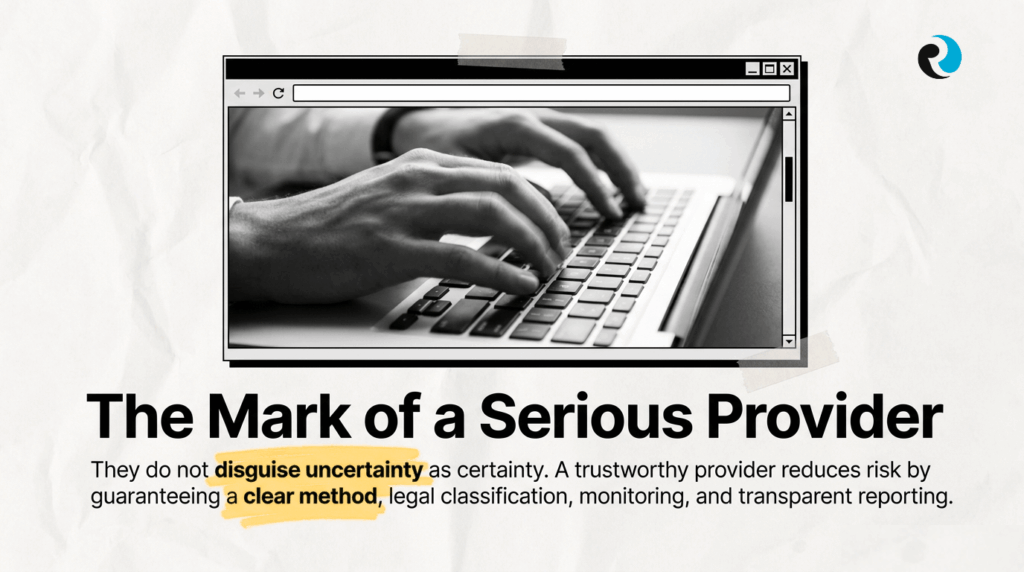
The safest guarantees are process guarantees. A provider can commit to confidentiality, documented assessment, clear scope, evidence-based strategy and transparent reporting.
It can also distinguish removal, deindexing and suppression, report what actually changed and continue monitoring after intervention.
The practical test is simple: ask not only what a provider promises, but what it refuses to promise.
The provider-selection test
Before hiring a reputation repair company, executives and legal counsel should test the provider’s language against the limits of the work.
- What can you control directly?
- What depends on third parties?
- What evidence do you need before acting?
- Are you proposing removal, deindexing, correction, suppression or containment?
- What could go wrong?
- What will remain visible after the first action?
- What do you not guarantee?
A clear answer to these questions is easier to govern than a promise of certainty. The assessment should remain case-specific where privacy rights, public interest or third-party decisions limit the remedy.
The Right to erasure in the digital environment: how to exercise the right to be forgotten and protect your online identity shows why deletion and deindexing must be assessed against legal limits rather than treated as automatic outcomes.
How to evaluate a provider
Look for precision. A trustworthy provider distinguishes source removal, deindexing, correction, suppression and containment before committing to a route.
Ask for the evidence plan and risk disclosure. A serious process begins with URLs, context, applicable rules and an explanation of where escalation may backfire.
Require realistic reporting. A request is not a completed outcome, and a ranking movement is not permanent deletion.
Avoid providers that guarantee complete internet deletion, treat deindexing as deletion or promise fixed rankings. Absolute language is a risk signal when third parties control the result.
Also avoid escalation before evidence review and promises about banking, investment, licensing or compliance outcomes.
The executive decision
The most credible provider is not the one that promises the most. It is the one that classifies the problem accurately and explains what is genuinely controllable.
Some content can be removed, corrected, deindexed or suppressed; other material may remain because legal, editorial or public-interest limits apply.
A provider should guarantee disciplined assessment, evidence-based action and transparent reporting. It should never guarantee a third-party decision.
In reputation repair, unrealistic certainty is not a service feature. It is a risk signal.