
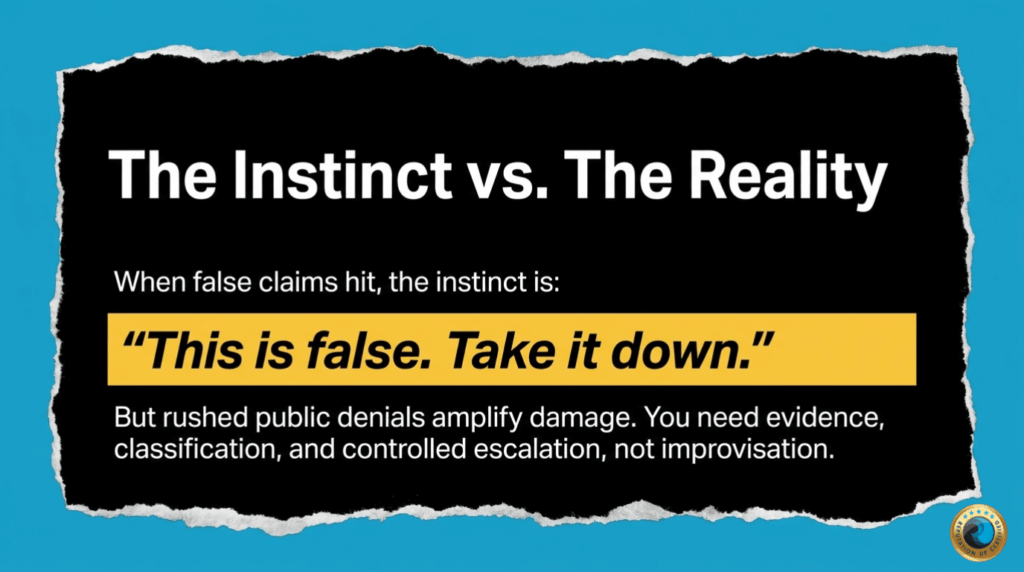
False allegations against an executive can become a governance problem before they become a legal one. Investors, banks, clients and journalists may encounter the claim before the executive has a meaningful opportunity to respond.The instinct is immediate: “This is false. Take it down.” Sometimes removal is possible, but a safer response begins by preserving evidence, classifying the claim and identifying who can act.
In June 2026, West Ham United co-chairman David Sullivan publicly denied allegations concerning his personal conduct. He stepped down from club roles while preparing a legal response, separating the personal dispute from the organisation’s day-to-day management.
Companies House records show that Sullivan ceased to be a director of WH Holding Limited on 6 June 2026. The episode illustrates how a disputed personal allegation can create governance and continuity risk before the underlying dispute is resolved.
“False allegations require speed, but not improvisation. The first step is to transform reputational pressure into evidence, legal analysis and controlled action.”
Andrea Baggio, CEO EMEA ReputationUP
The direct answer
When false allegations appear online, executives should preserve the evidence, identify the exact statement and document why it is false or misleading.
The response then has to match the source and the evidence, whether the appropriate route is correction, removal, deindexing, suppression or containment.
The response must also anticipate what escalation could trigger. A legally plausible action can still be reputationally damaging if it gives a low-visibility allegation a larger audience or creates a second wave of coverage.
False allegations can move from articles into social posts, screenshots, search snippets, due diligence files and AI-mediated summaries.
The central risk is that a disputed claim becomes the easiest version of the story to retrieve for stakeholders who encounter it without the surrounding evidence.
West Ham in 2026: when an executive allegation becomes a governance risk
Sullivan denied the allegations and said he intended to challenge them legally. West Ham stated that they did not concern the club’s operations, while his departure created a clearer separation between the personal dispute and day-to-day management.
The case does not establish whether the allegations were true or false. It shows why an Online Defamation Guide must begin with evidence and classification: a denial is not proof, and publication does not turn an allegation into an established fact.
A rushed denial can repeat the allegation to a wider audience, while an aggressive legal threat can generate follow-up coverage. Silence carries its own risk if it allows a claim to consolidate, so the response should be sequenced, not improvised.
Step 1: Preserve evidence before acting
Before contacting a publisher, platform or author, capture exact URLs, dated screenshots, publication details, search snippets, relevant queries and copied versions. Online material can be edited, reposted or moved, so the evidence file should be built before the first intervention.
The proof file should also contain contracts, filings, judgments, correspondence or other reliable records that contradict the allegation. The evidence must be understandable outside the organisation so that a publisher, platform, lawyer or regulator can assess it without relying on internal assertions.
Step 2: Identify the exact false statement
Do not challenge an entire article when the dispute concerns one sentence, implication, image or association.
Precision makes the response more credible and makes it easier to connect the disputed statement with a proportionate remedy.
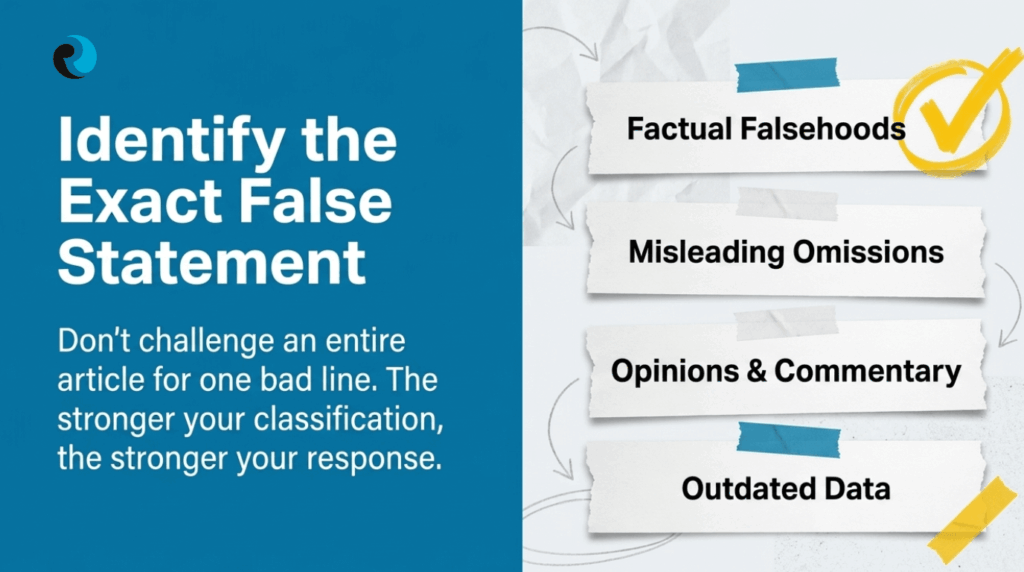
Facts, omissions and opinion require different treatment
False factual claims can be tested against evidence, while misleading omissions may exclude later outcomes or material context.
Outdated information can create a similar distortion when it no longer describes the executive’s current position.
Opinion and commentary require a different analysis because criticism is not automatically a factual allegation. Public records and accurately reported allegations also cannot be treated as established falsehoods simply because they are damaging.
Step 3: Decide who can actually act
A publisher may correct an article, a platform may enforce its rules and a court may provide formal remedies. Search engines can address visibility only through the procedures and criteria available to them, which is why the same allegation can require different routes in different places.
For Google services, Google’s legal-removal process asks the requester to identify the product, specific URLs and legal basis. That process concerns Google’s services and search visibility; it does not by itself remove the material from the original publisher.
Source control changes the remedy
A company cannot technically delete a third-party page. If the source belongs to a publisher, regulator, court or platform, the organisation must use that actor’s procedures or an applicable legal route.
Authority determines the remedy, so the practical question is often who can lawfully change the content rather than how quickly it can disappear.
Step 4: Choose the correct remedy
False allegations do not produce one standard response. The remedy should match the type of error, the source and the residual visibility that is likely to remain after the first intervention.
Correction may be the most proportionate outcome when a legitimate source contains a factual mistake, missing context or outdated reference. Removal is stronger and requires a valid legal, editorial or platform basis.
A takedown demand that exceeds the evidence can weaken credibility and complicate later escalation. The objective is to repair the record with the strongest justified remedy, not to overstate what the organisation can compel.
Deindexing, suppression and containment
Deindexing addresses search visibility rather than the source, while suppression strengthens accurate information when disputed content cannot be removed quickly or has spread across the wider search environment. These remedies solve different layers of the same reputational problem.
Efforts to Remove Negative Information From Google should distinguish source removal, search visibility and reputational containment.
Containment becomes especially relevant when the issue reaches media, investors, employees or compliance teams and can no longer be treated as a search-only problem.
Step 5: Assess privacy and personal-data exposure
False allegations may wrongly associate an executive with an investigation, sanction, address, financial issue or criminal matter.
Privacy routes may therefore overlap with defamation, correction or search-removal options when personal data is part of the disputed claim.
The European Commission states that the right to erasure is not absolute where freedom of expression, legal obligations, public interest or legal claims apply.
Reputational harm alone does not create an automatic right to deletion, even when the information is uncomfortable or highly visible.
Step 6: Control escalation risk
Legal escalation may be necessary, but it should be calibrated against the strength of the evidence and the visibility the intervention could generate.
The decision should consider not only whether a claim can be challenged, but what the challenge is likely to trigger.
Before escalating, assess whether the statement is fact or opinion, whether falsity can be proven, which jurisdiction applies and the potential public-interest or media consequences.
The legal route should create more control than attention, since a technically available remedy may still revive content that was losing visibility.
Stakeholder communication needs timing
Boards, investors, banks and employees may need information before the public does.
A concise private briefing can preserve confidence without unnecessarily amplifying the allegation, while any communication should separate verified facts, disputed claims, actions already taken and what remains unresolved.
Step 7: Prepare for crisis impact
False allegations can trigger board questions, banking friction, investor concerns, employee uncertainty and media follow-ups. Search remediation alone may not resolve those consequences because the reputational issue can move quickly into governance, communications and due diligence.
That is why the response should be coordinated with Crisis Management. Legal, communications and reputation teams should work from the same factual record, define who communicates with each stakeholder group and agree on the escalation threshold before taking public action.
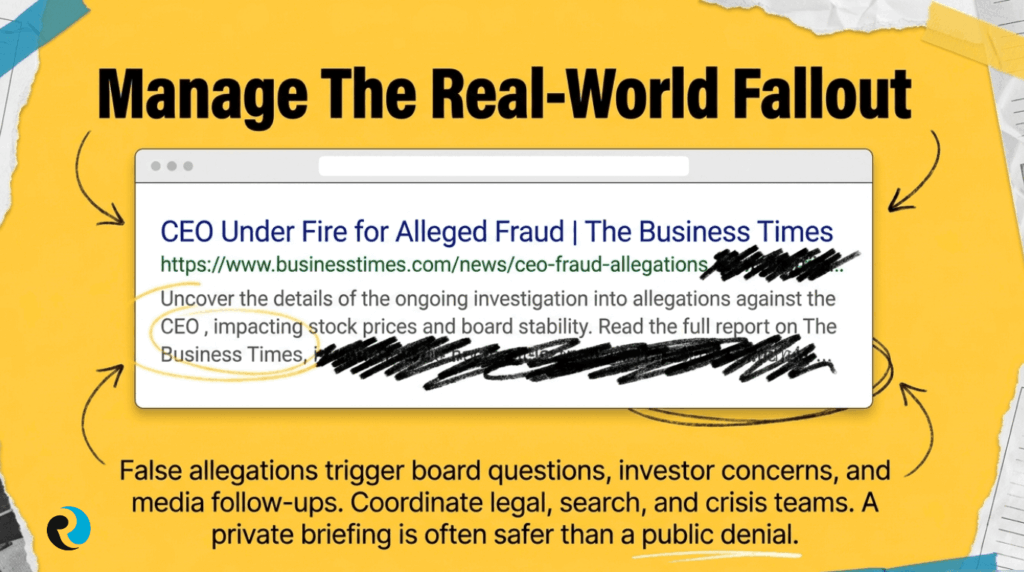
The goal is to manage both the disputed content and its consequences, using the response that creates the least additional exposure, whether a private briefing or a targeted factual correction.
What to do
Start by preserving and classifying the material before it changes. Capture the URLs, screenshots and search context, then distinguish factual falsehood from opinion, public records and outdated information so that the response begins from a defined problem.
Build a proof file that an external reviewer can understand, then select the remedy that fits the source and the evidence.
Legal, communications and reputation teams should coordinate escalation and assess amplification risk before any public response.
What to avoid
Do not promise guaranteed removal or respond publicly before preserving the evidence. Defamation allegations require legal review, and opinion and factual falsehood should never be treated as the same category.
Do not confuse source removal with deindexing, and do not stop monitoring after one page changes. A response that generates more visibility than control can become a second reputational problem, especially when screenshots, reposts or stakeholder questions remain active.
The executive decision framework
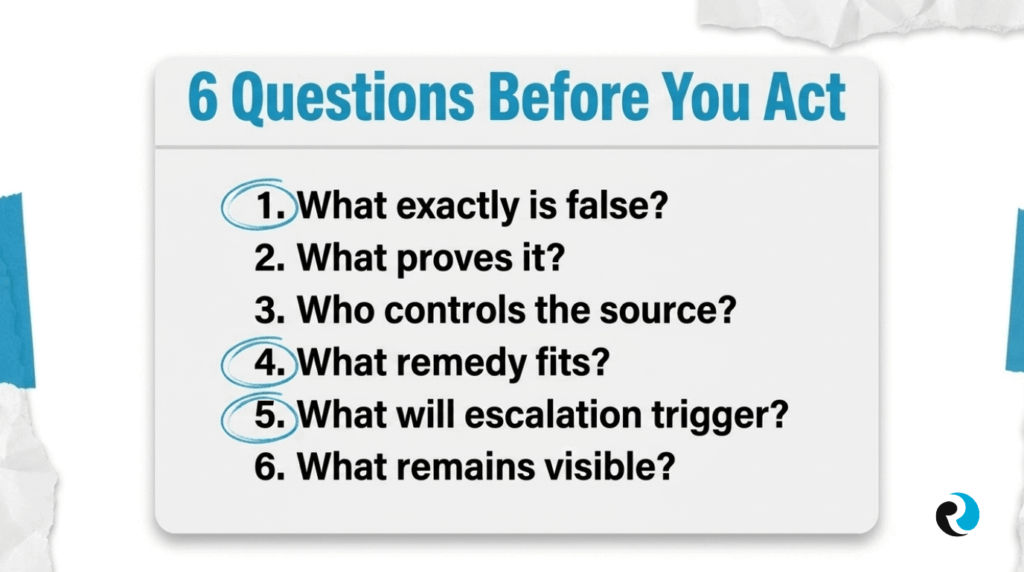
Before acting, leadership should answer six questions: what exactly is false, what proves it, who controls the source, which remedy fits, what escalation could trigger and what remains visible afterward.
Together, these questions test whether the response is evidence-led, proportionate and likely to reduce rather than expand the risk.
A successful response addresses both the original content and residual visibility across search results, screenshots, reposts and stakeholder conversations. The first intervention is therefore a milestone, not the end of the response.
The controlled response
False allegations against executives should not be met with panic. The sequence should move from evidence and classification to route selection, controlled escalation and monitoring.
Depending on the facts, the allegation may be corrected or removed; in other cases, visibility must be limited, suppressed or contained while the dispute continues.
The risk of acting too late is that the allegation spreads. The risk of overreacting is that the response becomes part of the story.
A controlled strategy protects both the executive and the organisation by matching the evidence, timing and remedy to the actual level of risk.