
When a harmful link appears on the first page of Google, the pressure to act is immediate. For an executive, founder, legal counsel or reputation-sensitive company, that result can affect trust before a meeting, a funding round, a banking review, a client decision, a media inquiry or a due diligence process.
The most common mistake is to treat every harmful link as if it can simply be removed from Google. It cannot. Some links can be removed at the source; others may be deindexed from specific search results, corrected, updated or restricted.
In many cases, the only realistic response is suppression through stronger and more authoritative information, or a combination of legal, technical, editorial and reputational measures.
The relevant question is therefore not only, “How do we remove this from page one?” It is also: “Which layer of the problem can be lawfully, technically and reputationally addressed?”
“In high-risk reputation cases, the first error is not acting late. It is acting before the problem has been correctly classified.”
Andrea Baggio, CEO EMEA ReputationUP
The direct answer
To address harmful links on the first page of Google, the first step is to identify the exact URLs, classify the source, assess whether the content can be removed, corrected or deindexed, and determine whether suppression is necessary when removal is unavailable or incomplete.
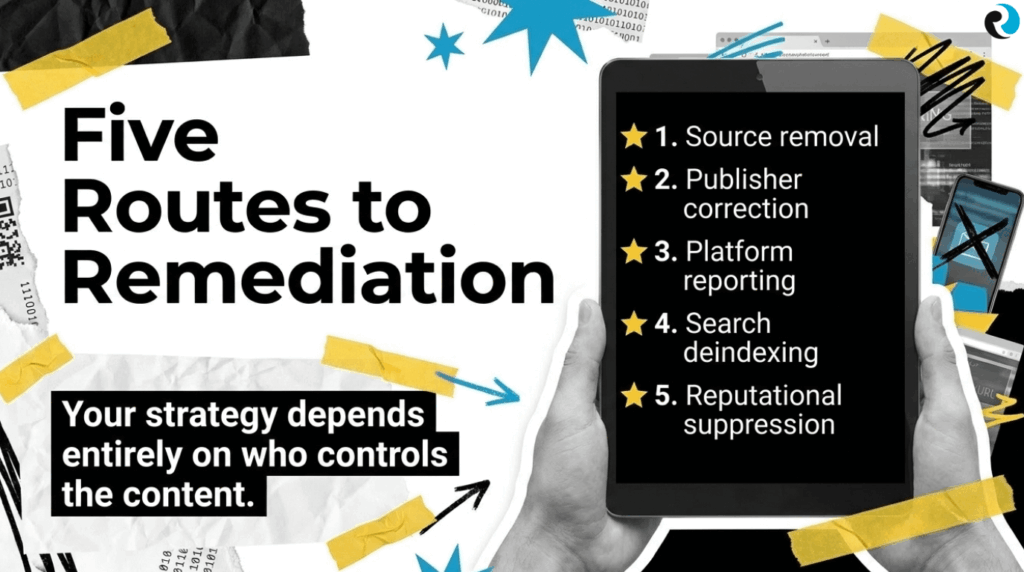
There is no universal removal button. A serious assessment normally considers five routes: source removal, publisher correction, platform reporting, search deindexing and reputational suppression.
The appropriate route depends on the content, the source, the legal basis, platform rules, jurisdiction and the evidence available.
Recent media case: Canada’s Google de-listing dispute
A current Canadian dispute illustrates the distinction. In August 2026, the Office of the Privacy Commissioner of Canada asked the Federal Court to enforce its recommendation that Google de-list specific articles when an individual’s name is searched. The underlying criminal proceedings had been stayed, but the articles remained available online.
The regulator’s position does not seek source removal. It distinguishes de-listing — breaking the association between a person’s name and specific results — from de-indexing, which would remove the material from Google’s index more broadly.
Google has argued that the dispute also raises freedom-of-expression issues. The case shows why source removal, search visibility and reputational impact must be analysed as separate layers of the same problem.
These limits are central to any assessment of Right to erasure in the digital environment: how to exercise the right to be forgotten and protect your online identity, particularly when outdated or excessive personal data remains visible in search but competing rights or public-interest considerations may still apply.
The Canadian case shows that the continued presence of a negative result in search engines can continue to have consequences even if the content isn’t removed. Its impact also depends on who finds it, in what context, and what decisions it might influence, so appearing on the first page goes beyond a strictly SEO issue.
Page-one exposure is not only an SEO problem
A harmful result on page one is often treated as a visibility problem. In practice, it is also a decision-risk problem because the people searching a name, company or executive profile are often doing so for a reason.
They may be investors, banks, journalists, clients, partners, board members, regulators, recruiters, counterparties, family offices or compliance teams.
For these audiences, the first page of Google can function as an informal reputational audit before a commercial, financial or professional decision is made.
Speed matters, but speed without classification can create additional risk. A rushed request may be rejected; a poorly framed legal complaint can weaken credibility; an aggressive approach to a publisher may revive a dormant story; and a vague platform report may fail because it does not identify a specific policy violation.
A public dispute can also generate more indexed material than the original link. Before any intervention, the exposure should therefore be mapped in detail.
Step 1: Identify the exact harmful links
A page-one result is not a single object. It is a combination of a URL, title, snippet, publisher, publication date, image, query, search location, search language, related results and, in some cases, copied or syndicated versions.
The first operational task is to collect evidence: the exact Google search query, the country and language of the search, the affected URLs, dated screenshots, ranking positions, and the title and snippet shown in the results.
The assessment should also establish whether the result appears for a personal name, a company name or another branded query; whether images, videos, PDFs or news results are involved; whether copies appear on other domains; and whether the same narrative is being repeated in AI-generated summaries or other search environments.
Without this evidence, the instruction to “remove the harmful link” is too broad to support a precise intervention. Effective Harmful Links Removal begins by identifying the source, the exact URL and the type of content involved before selecting a legal, technical or reputational response.
Step 2: Determine who controls the source
The remedy changes according to who controls the content. A harmful result may point to a company website, a news publisher, a blog, a forum, a social platform, a court or public-record site, a regulator, a data broker, a review platform, an archive, an anonymous or compromised site, or a copied version of another article.
If the affected person or company controls the source, the available technical options may include deleting or updating the page, restricting access, password-protecting content or applying a noindex directive.
Google Search Central explains that, for pages hosted on a site you control, temporary removals can be requested through its Removals tool. More durable outcomes generally require changing the content at the source, restricting access or using indexing controls where appropriate.
When a third party controls the page, the position is different. The affected party does not control the source and may only be able to request removal, correction, deindexing, a limitation on visibility or reputational containment. That distinction determines which actions are actually available.
Step 3: Separate removal from deindexing
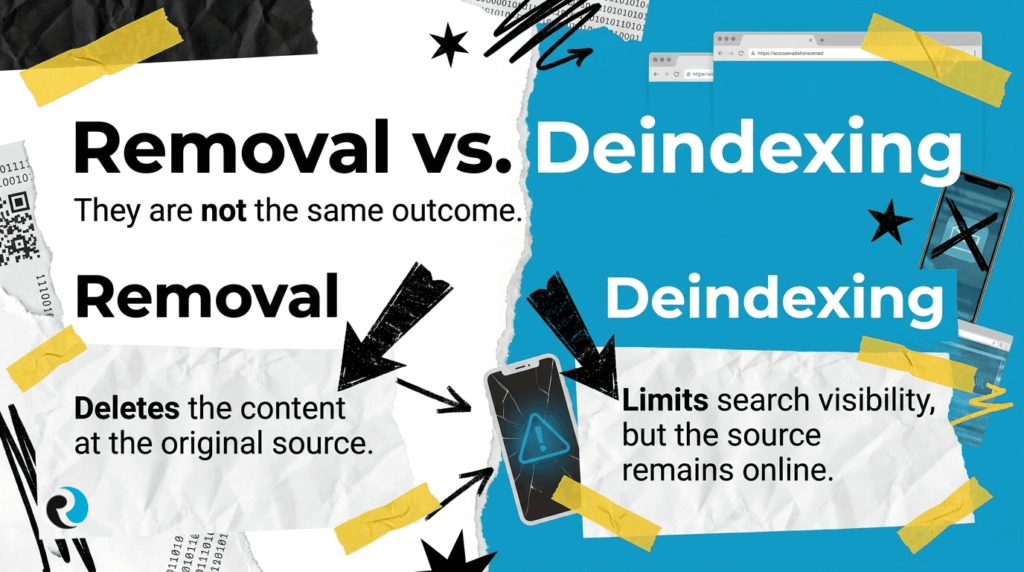
Removal addresses the content at the source. The page, article, post, document, image or specific element is deleted, corrected, redacted, anonymised or made inaccessible where it was originally published.
Deindexing addresses search visibility. The source may remain online, but the URL may stop appearing for certain queries, in certain contexts or under defined legal or policy conditions. These are different outcomes and should not be reported as if they were interchangeable.
A deindexed article may still be accessible through the direct URL, the publisher’s own site, another search engine, social media, an archive, a screenshot, a copied version or the publisher’s internal search function.
For executive decision-making, the implication is straightforward: deindexing is not deletion, and deletion at the source does not guarantee complete disappearance from the internet. Understanding How To Remove Google Search Results therefore requires separate analysis of source control and search visibility.
Step 4: Assess whether the content has a valid removal basis
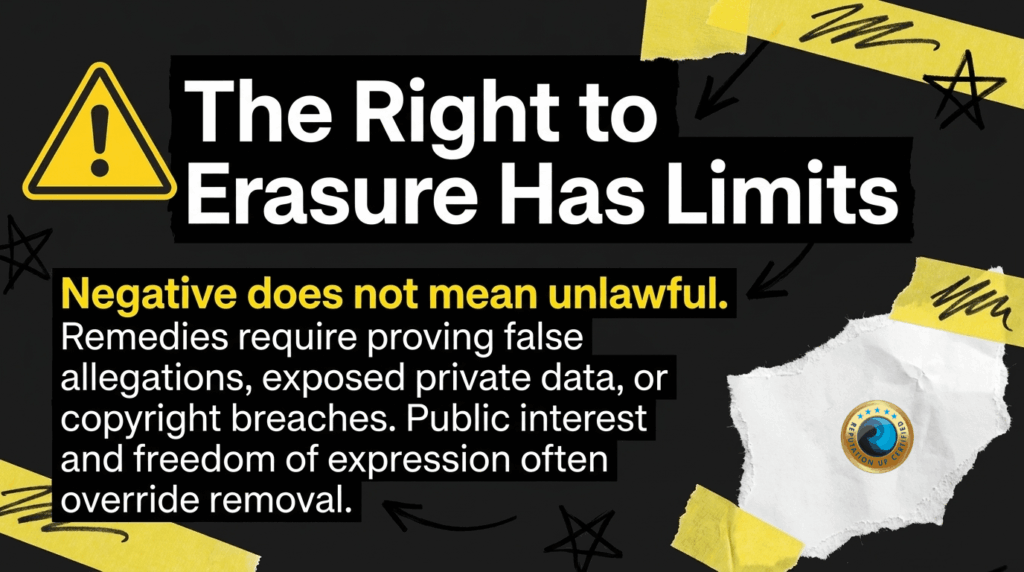
A harmful link is not automatically removable because it is negative. The strongest cases generally involve a defined legal, privacy, technical or platform-policy basis, supported by evidence.
Potential grounds may include false factual allegations, defamatory statements, exposed private information, confidential documents, impersonation, doxxing, non-consensual publication, copyright infringement, outdated personal data, unlawful processing of personal data, platform-policy violations, copied or scraped content, compromised websites or obsolete material whose continued visibility is no longer justified by context.
Each category requires its own evidentiary analysis. A defamation complaint requires examination of the specific statements, jurisdiction and factual basis. A privacy request must identify the personal data and explain why continued publication may no longer be justified.
A copyright complaint requires proof of rights and infringement, while a platform report must point to a specific rule or policy category.
The same principle applies to search limitations. A request to deindex content requires a valid basis; a desire to reduce reputational harm on its own is not enough.
Google notes that individuals may request the removal of certain private personally identifiable information from Search, but the existence of a request process does not mean every harmful result qualifies.
Step 5: Consider data protection and right-to-erasure limits
Some harmful links contain personal data that may be outdated, excessive, unlawfully processed or no longer justified. In those circumstances, privacy and data-protection remedies may be relevant, but those rights are not absolute.
The European Commission explains that personal data does not always have to be deleted, including where processing is necessary for freedom of expression, compliance with legal obligations or reasons of public interest. See its guidance on when personal data must or need not be deleted.
This balance is particularly important in cases involving news coverage, public figures, regulatory information, litigation history, public records, financial misconduct allegations, political exposure or matters of continuing public interest.
A legitimate reputational concern does not automatically override freedom of expression, official-record functions, legal retention duties or the public interest. Each case therefore requires a proportionality assessment rather than an assumption that negative visibility creates a right to deletion.
Step 6: Evaluate suppression when removal is unavailable or incomplete
Suppression is often misunderstood. In professional reputation work, it does not mean inventing positive information, flooding Google with low-quality pages or attempting to hide lawful facts.
It means building a more accurate, authoritative and relevant digital environment around the affected person or organisation. Suppression may be necessary when the harmful link cannot be removed, the legal basis is weak, a publisher refuses correction, deindexing is unavailable, the content is lawful but disproportionate in impact, or the issue has already spread across multiple URLs.
It may also be relevant when old material dominates current perception or when AI search systems continue to retrieve or summarise an outdated negative narrative.
A suppression strategy can include stronger executive profiles, institutional pages, credible media coverage, updated corporate information, legal or technical explainers, thought leadership, interviews, public statements, multilingual assets and structured content that addresses the search intent behind the harmful result.
The objective is not to deny the existence of the negative source. It is to prevent one old, incomplete or disproportionate result from becoming the dominant interpretation of a person or company.
Why AI Search changes the risk
The first page of Google remains important, but it is no longer the only reputational surface. Search results, snippets, entity associations and AI-mediated answers can all influence how a person or organisation is interpreted online.
For reputation-sensitive entities, a public and crawlable link may affect more than rankings if it is repeatedly cited or semantically reinforced across authoritative sources. That does not mean every negative URL will appear in an AI-generated answer, but it changes what a complete remediation assessment must consider.
The analysis should therefore ask what is indexed, what is authoritative, what is repeated across sources, what is outdated, what is legally challengeable and what accurate information is missing from the public record.
A page-one strategy that addresses only conventional rankings may reduce one visibility problem while leaving the wider interpretation environment unchanged.
The executive risk framework
Before taking action, leadership teams should answer seven questions. The answers determine whether a request is legally grounded, technically feasible and proportionate to the reputational risk.
1. What exactly is harmful? Is the issue the article itself, the title, the snippet, an image, a specific allegation, the date, the public record, personal data, a query association or the broader narrative?
2. Which URL is the target? Every request should identify the exact URL. Screenshots are useful evidence, but they do not replace a precise target.
3. Who controls the content? The publisher, platform, search engine and archive are different actors, each with different powers, procedures and limits.
4. What is the strongest basis for action? The basis may be legal, privacy-related, editorial, technical, platform-policy-based or reputational. The strongest route is the one that matches the facts and evidence.
5. What outcome is realistic? Removal, correction, deindexing, suppression and containment are different outcomes. The strategy should define which one is being pursued.
6. What could go wrong? A weak or disproportionate approach can lead to rejection, escalation, renewed attention, screenshots, copycat posts or additional indexed material.
7. What remains after the first intervention? Even a successful request may leave duplicates, archives, snippets, social shares, translated versions or exposure in AI-mediated search environments.
What to do
Effective action begins with a clear understanding of the exposure, the responsible parties and the most appropriate remedy. The process should be documented so that legal, communications and executive teams are working from the same evidence.
- Map the exposure before acting. Collect URLs, screenshots, timestamps, ranking positions, search queries, countries, languages and duplicate versions.
- Classify the source. Determine whether the content is controlled by the affected entity, a publisher, platform, search engine, regulator, archive or anonymous website.
- Separate the remedies. Define whether the objective is removal, correction, deindexing, suppression or containment.
- Assess legal and policy grounds. Establish whether the content is defamatory, privacy-invasive, outdated, unlawful, copied, policy-violating or simply damaging.
- Prepare evidence. A stronger documentary record makes the request more specific and easier to assess.
- Use precise language. Avoid emotional or excessive claims; requests should be proportionate, specific and supported.
- Monitor after action. Check whether the URL disappears, snippets update, copies remain or the same narrative persists elsewhere.
What to avoid
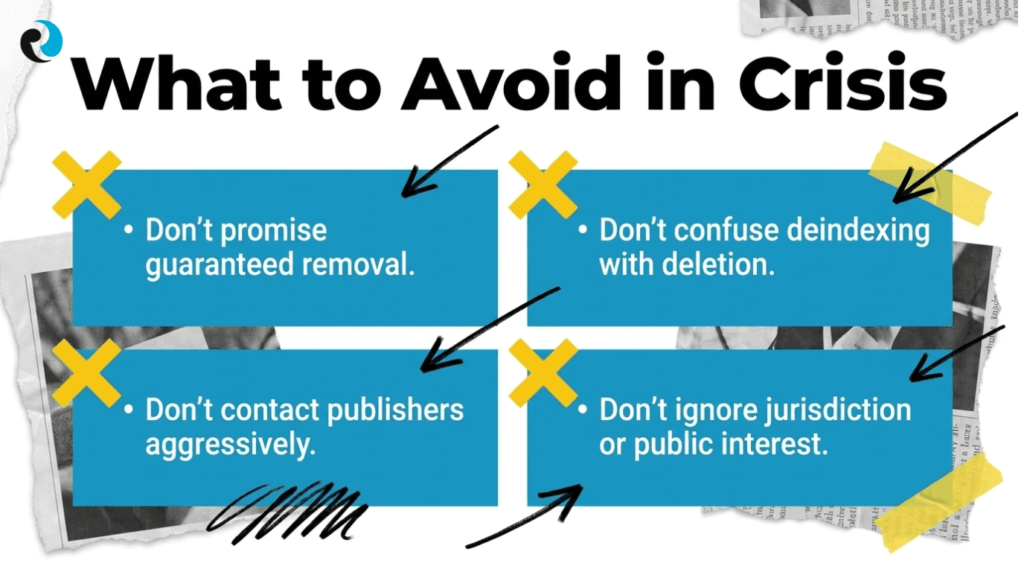
Page-one visibility does not by itself mean that content is unlawful, and Google deindexing should not be confused with deletion from the internet. Both assumptions can produce unrealistic expectations and weak remediation requests.
Publishers should not be contacted aggressively before escalation risk has been assessed, and generic complaints should not be sent without URLs, evidence and a legal or policy basis. Where content is unlawful, suppression should not be used as a substitute for challenging the source when a stronger remedy is available.
The opposite problem also matters: weak positive content may not compete with an authoritative harmful source. A strategy should not stop after one link disappears if copies, archives or the broader narrative remain visible, and it should not ignore jurisdiction, public interest or freedom-of-expression limits.
The real decision
A harmful link on page one of Google is not only a search result. It is a reputational signal that may be encountered by decision-makers at moments of evaluation, but the appropriate response is not always removal.
Depending on the facts, the correct route may be deletion at the source, correction, deindexing, legal escalation, suppression or a sequenced combination of several measures. The decision should follow the evidence rather than the urgency created by the ranking position.
Reputational damage can be compounded by acting too late, but it can also be worsened by overstating what a remedy can achieve. A defensible strategy begins with classification, evidence and proportional action.
The first task is to determine whether the harmful link can be removed at the source, limited in search, corrected in context or contained through a broader reputational strategy.
Digital reputation is not repaired through shortcuts; it is managed through legal precision, technical discipline and reputational judgment.