
The relationship between media and reputation has never been a secondary matter. In a crisis, it becomes one of the variables that most influence public perception, institutional credibility, and a brand’s ability to regain control. Simply responding is not enough. The response must be judicious, coherent, and strategic.
When an organization enters a critical situation, the pressure doesn’t just come from the facts. It also comes from how those facts are narrated, interpreted, and amplified.
Therefore, managing media during a crisis is not about speaking out as quickly as possible. It’s about structuring the message, protecting the brand’s legitimacy, and minimizing the space for damaging interpretations.
The crisis doesn’t start in the media, but it can worsen there.
Many companies make a fundamental mistake: thinking that media management begins when a journalist calls. In reality, by the time that moment arrives, the crisis has already entered a critical phase. What’s at stake isn’t just a one-off response. What’s at stake is which narrative framework will dominate the public conversation.
Adverse media coverage doesn’t always destroy a reputation on its own. It does so when it encounters a brand that is disorganized, reactive, contradictory, or unable to clearly explain what’s happening.
That’s where the crisis ceases to be merely operational and becomes a crisis of confidence. This logic connects naturally with reputation crisis management, because the real problem is usually not just the initial event, but the loss of control over its interpretation.
What should a brand do before speaking to the media?
Before issuing any statement, the organization needs to build a minimum control base. That base doesn’t depend on catchy phrases, but on structure.
First, you must define what actually happened, what can be confirmed, and what cannot. Then, you have to determine who is speaking, with what authority, and under what criteria.
Then it needs to align the legal, operational, and reputational dimensions to avoid internal contradictions. And finally, it must identify which perception it wants to correct, contain, or reinforce.
Without that preparation, any interaction with the media risks worsening the situation.
Managing media is not about improvising spokespeople
In a crisis, not every executive should become the public voice. The spokesperson isn’t simply the highest-ranking person. It’s the person who can maintain clarity, composure, accuracy, and credibility under pressure.
A poor spokesperson might overshare, sound evasive, or adopt a defensive tone that worsens public perception. When this happens, attention shifts from the issue at hand to the communication blunder, further damaging the spokesperson’s reputation.
Therefore, a professional strategy requires preparing spokespeople with central messages, clear thematic boundaries, and the ability to maintain a stable narrative line.
What does a media outlet really expect in a critical situation?
The media doesn’t operate according to a company’s internal logic. It operates according to the logic of news. It seeks confirmation, context, accountability, impact, and reaction. If a brand doesn’t understand this, it often responds poorly: it speaks as if it were writing a corporate statement when, in reality, it’s being evaluated in a highly charged narrative environment.
This requires adapting the message without sacrificing rigor. It’s not about sugarcoating the crisis. It’s about making it explainable without exacerbating it.
A useful response for the media usually acknowledges the situation without artificial drama, provides verifiable facts, shows criteria for action, and projects a clear will to correct or contain the situation.
The real risk: surrendering the interpretive framework
Not all crises destroy reputations due to the severity of the initial event. Many do so because the brand leaves a void in its explanation, which is then filled by third parties. In that void emerge biased versions, hostile interpretations, simplistic headlines, or associations that later prove very difficult to correct.
Therefore, reputation management in the media should not focus solely on putting out fires. It should focus on preserving the framework from which the brand will be perceived.
This framework is supported by consistent messaging, reasonable response times, information traceability, and the ability to maintain a stable institutional line even when external pressure increases. This work is also part of a broader strategy to digital reputation, because today public perception is not defined in a single channel.
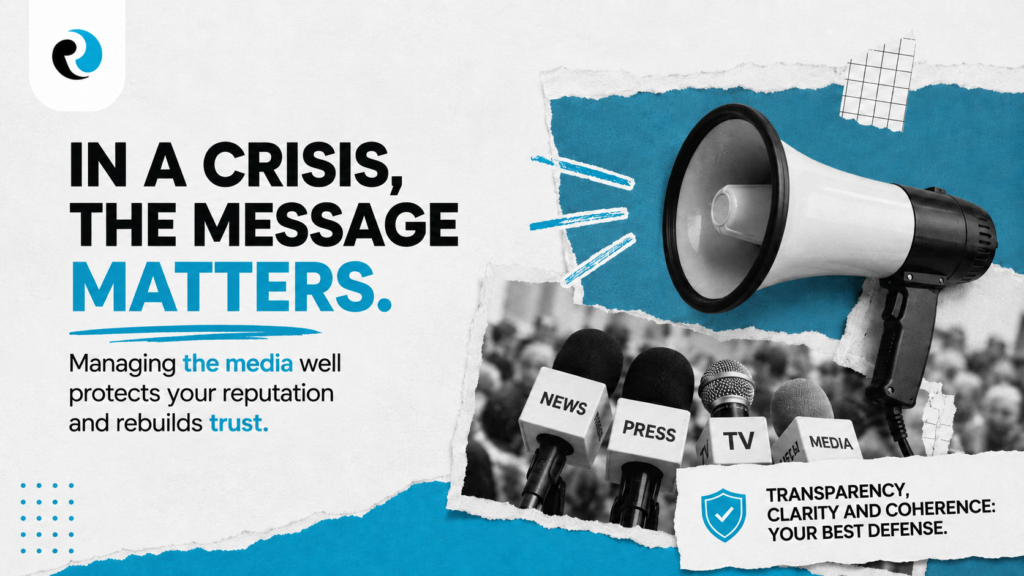
How to improve brand image during a crisis
It may seem contradictory, but a well-managed crisis can improve an organization’s image. Not because the problem disappears, but because the brand demonstrates something very valuable: responsiveness, institutional maturity, and sound judgment under pressure.
Reputational improvement during a crisis doesn’t come from superficial fixes. It comes from clarity, consistency across channels, a proportionate response, taking responsibility when appropriate, and subsequent follow-through. A brand improves its image when it doesn’t appear to be improvising, when it doesn’t contradict itself, and when it manages to be understood without losing its composure.
Mistakes that worsen the relationship with the media in the midst of a crisis
There are mistakes that keep being repeated and that almost always worsen reputational damage. One of the most frequent is confusing silence with prudence. Sometimes not speaking for a few hours can be a reasonable decision. But prolonging the information blackout without a clear plan usually weakens the brand.
Another mistake is responding with cold, corporate language when the situation calls for humanity, responsibility, or context. Arguing with the media in public is also very damaging. A brand can correct facts or reject unfair interpretations, but doing so with hostility usually reinforces the perception of being out of control.
And there’s an even more serious mistake: believing the crisis ends when the noise subsides. Often, the problem persists in search engines, related results, replicated content, and digital memory. In that scenario, the dimension of Fake news and online reputation become especially relevant, because a harmful narrative doesn’t need to be new to continue affecting trust.
Media, search engines and reputation: a single front
Today, a media crisis doesn’t end with a news story. It continues on Google, in related results, in brand searches, on social media, in generative systems, and in environments where information is summarized and rearranged. Therefore, a modern strategy doesn’t separate media, visibility, and digital reputation.
A brand can manage an interview reasonably well and still end up poorly positioned if it doesn’t subsequently organize its own assets, improve its visible context, or correct the gaps that others exploit. In this environment, regulatory frameworks are also becoming increasingly relevant. The European Commission explains in the The Digital Services Act requires platforms to mitigate systemic risks and strengthen security and trust in the digital ecosystem.
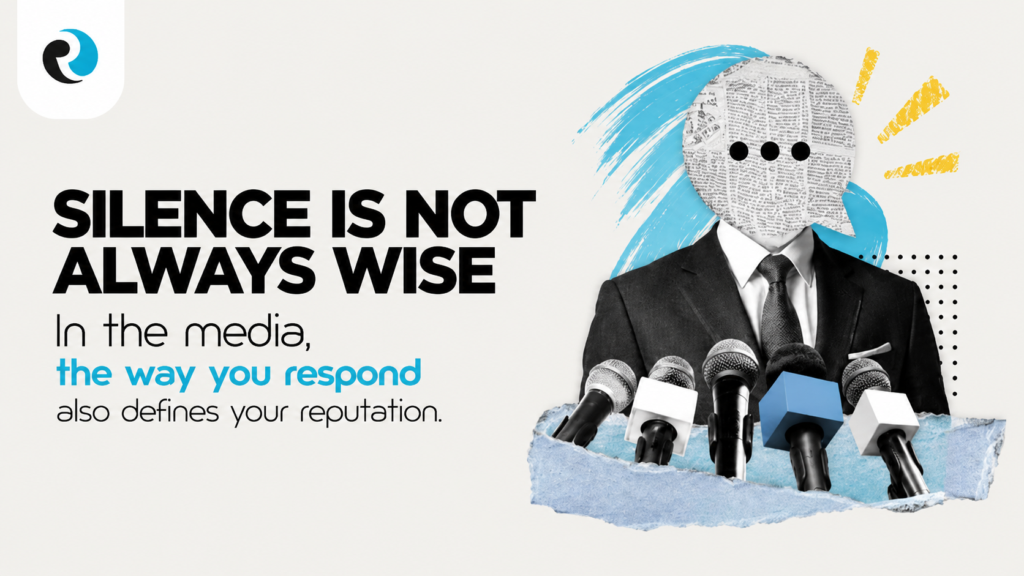
The reputational impact is no longer limited to the headline
The current media crisis is also extending to search systems and AI experiences. Google explains this in its official documentation. AI features and your website that these functions continue to rely on SEO fundamentals and crawlable, useful content suitable for displaying correctly in Search.
This means that reputation no longer depends solely on what a media outlet says, but also on how a brand is represented, summarized, or associated on platforms where users don’t always open a full news story. This is where strategic PR work in the AI era becomes crucial , because institutional visibility no longer competes only with other media outlets, but also with systems that reorganize and synthesize information.
What does professional media reputation management do?
Serious management goes beyond simply drafting press releases. It works on several layers simultaneously: diagnosing narrative risk, prioritizing critical messages, preparing spokespeople, coordinating between communications, legal, and management, monitoring media coverage, and subsequently reinforcing the brand’s visible context.
This monitoring shouldn’t be done solely on intuition. The Search Console Performance report remains a useful tool for reviewing clicks, impressions, CTR, and average position.
But, from a reputational standpoint, its value lies not only in the metrics themselves: it also helps detect whether official assets are gaining visibility with explanatory power or if they continue to appear without generating sufficient trust.
That’s where reputation stops depending on chance and starts to be based on method, criteria, and response architecture.
Conclusion
Reputation management in the media is not about simply getting through a crisis. It’s about protecting your image, maintaining credibility, and preventing your brand from losing control of its public perception when it’s most vulnerable.
Organizations that understand this don’t just react to journalists or headlines. They prepare their framework, structure their narrative, rehearse their response, and work on reputational continuity beyond the peak of exposure.
In a crisis, the question is not just what happened. The crucial question is who can best explain what happened, with what authority, and with what impact on future trust.
Frequently Asked Questions (FAQ)
No. Public relations can be part of the strategy, but in a crisis the priority is not just visibility. It’s narrative control, institutional consistency, and protecting credibility .
Not necessarily. Relevance, focus, risk, and opportunity must be evaluated. A professional strategy is not driven by impulse, but by reputational priority.
You should avoid improvising, speculating, sounding defensive, and contradicting information already released by the organization. You should also avoid responding emotionally.
It starts to improve when the brand regains explanatory power, public coherence, and perceptual stability . Not just when the headlines disappear.
Sometimes the noise subsides, but that doesn’t mean the impact disappears. If the information remains indexed, associated with brand searches, or reused by other channels, the damage can continue.
ReputationUP can work on exposure diagnosis, response strategy, the relationship between media and digital reputation, prioritization of critical messages, reinforcement of owned assets and recovery of the visible context of the brand.