
Online defamation is not proven by saying that a statement is unfair, damaging or offensive. It is proven by evidence. For companies, executives, legal counsel and crisis teams, that distinction is critical. A defamatory article, post, video or search result can influence investors, clients, banks, journalists and due diligence teams before any legal finding exists.
The 2026 litigation between Blake Lively and Justin Baldoni shows why the evidentiary record matters. Despite intense public attention and a large digital record, the court still had to test each legal claim against a specific standard.
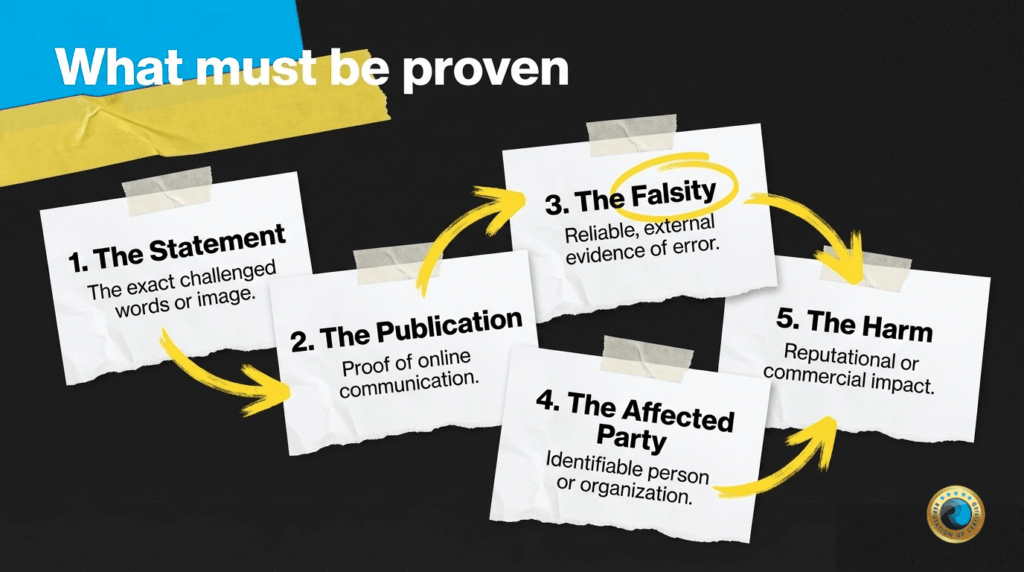
The first question is therefore not simply, “How do we remove this?” It is whether the team can prove the challenged statement, publication, falsity, affected party and harm — and then choose a proportionate remedy.
“In online defamation cases, evidence is the difference between reputational pressure and a credible remediation strategy.”
Andrea Baggio, CEO EMEA ReputationUP
The direct answer
To prove online defamation, an executive or company must identify the exact statement, preserve publication evidence, show why it is false or misleading and establish who is affected. The file must also support the claimed harm and requested remedy.
Legal standards vary by jurisdiction, but a credible assessment asks what was said, where it appeared, what disproves it and what harm followed.
An online defamation guide framework separates reputational pressure from the evidence needed for correction, removal, deindexing or litigation.
The key distinction is simple: damage is not proof. A harmful statement may still fall short if the team cannot preserve publication, establish falsity or connect the claim to reputational harm.
Evidence comes before escalation
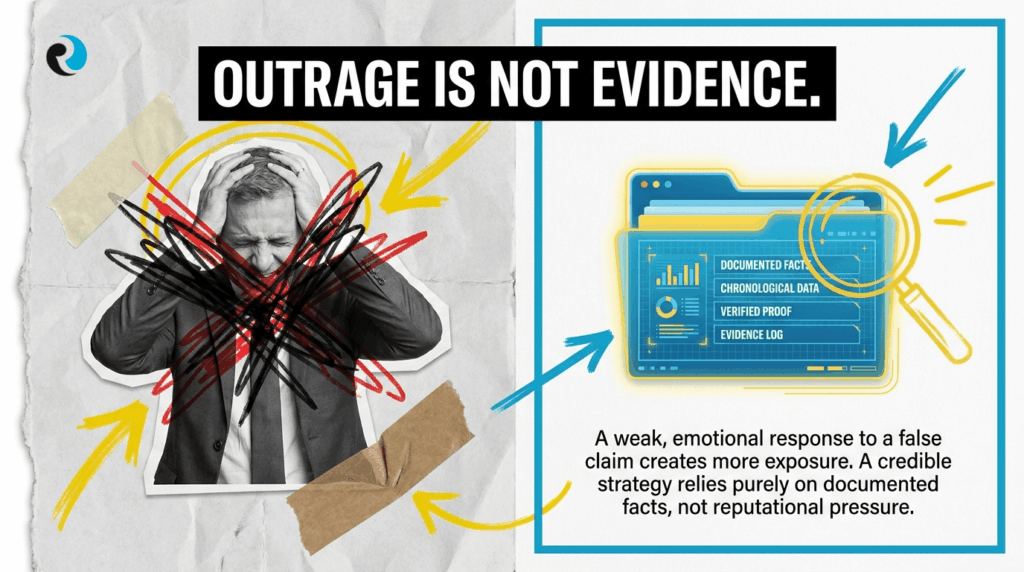
Online defamation cases often become harder when the first move is emotional. A rushed denial can amplify the allegation, while an aggressive takedown demand may trigger follow-up coverage or make a later legal position more difficult to explain.
The first operational task is therefore evidence preservation. Exact URLs, dated screenshots, publication details, author or account information, copies and search queries should be captured before the content is edited, deleted, reposted or moved.
Lively–Baldoni in 2026: when the record matters more than the narrative
On April 2, 2026, the Southern District of New York issued a 152-page opinion and order in the It Ends With Us litigation. The court reviewed declarations, text messages, exhibits and expert analysis of online activity.
The record included expert analysis of TikTok and Reddit activity for signs of artificial content manipulation. Even so, each claim still had to be tested against its own legal standard.
The court granted summary judgment to the Wayfarer Parties on Lively’s defamation claim while certain retaliation-related claims continued. For reputation work, the lesson is that different claims rise or fall on different evidence.
For teams trying to remove negative information from Google, the same discipline applies. Search visibility can intensify the reputational impact, but visibility alone does not establish falsity, defamation or entitlement to removal.
What must usually be proven
Defamation law is jurisdiction-specific, but digital reputation cases repeatedly turn on a small group of evidentiary questions. Each document should be tied to the element it is supposed to prove.
This helps distinguish relevant evidence from material that adds little legal value. It also creates a clearer record for legal review, platform requests, negotiations, or litigation.
The statement and the publication
The file should isolate the exact words, headline, image, video, caption, snippet or implication being challenged. Identifying the specific sentence or visual is stronger than labelling an entire article defamatory.
Publication must also be documented. Preserve where the statement appeared, when it was accessible and how third parties could encounter it, including copied or cached versions.
Falsity and the affected party
Falsity requires evidence an external reviewer can understand. Contracts, judgments, filings, emails, corporate records and regulatory documents are stronger than an internal assertion that the allegation is wrong.
The statement must identify the affected person or organisation. That can be direct through a name or image, or indirect when the surrounding context makes the subject clear.
Harm and the legal threshold
Harm may appear through investor concern, client loss, banking friction, media escalation or due diligence consequences. The evidence should separate documented effects from assumptions.
The threshold can be explicit in law. Under the UK Defamation Act 2013, publication must have caused or be likely to cause serious reputational harm; for a body trading for profit, serious financial loss is part of the test.
Fact, opinion and implication must be separated
Classification determines what can realistically be challenged. A false factual allegation differs from opinion, while a misleading implication differs from an accurate public record or an allegation reported as an allegation.
Headlines, snippets and old material need separate analysis. A headline may overstate an article, a snippet may distort context, and an old but accurate publication may create a visibility problem without becoming false.
The classification determines the route. Correction fits factual error; removal requires a stronger basis; deindexing may address search visibility; and lawful opinion may need monitoring or reputational containment instead of a takedown demand.
The source determines the route
The same statement may require a different response depending on where it appears. Publishers, platforms, courts and hosts each control different remedies, from correction to policy enforcement or formal orders.
When Google products or search visibility are involved, Google’s legal removal process requires specific URLs, a legal basis and enough context for review.
Google also notes that restricting content in its services does not necessarily remove the source from the wider web.
The strongest request is not the broadest one; it is directed to the actor that can actually provide the remedy being sought.
Proof must support the remedy
Evidence is not collected only for litigation. It also determines whether the proportionate response is correction, source removal, deindexing, suppression or wider containment.
A well-documented record helps identify which remedy is realistic and defensible. It also reduces the risk of taking action that could increase visibility or create unnecessary escalation.
Correction and removal
Correction is appropriate when a legitimate source contains a demonstrable factual error, missing context or outdated reference.
Removal requires a stronger basis, such as defamatory fabrication, unlawful disclosure, impersonation or a clear platform-policy violation.
A precise correction can reduce risk more effectively than an excessive deletion demand. It should identify the error, provide the correct evidence and explain why the change is proportionate.
Deindexing, suppression and containment
Deindexing may apply when name-based search visibility is legally challengeable, privacy-sensitive or disproportionate. Suppression becomes relevant when eligible removal is unavailable and accurate information needs greater visibility.
When the allegation also affects boards, investors, employees, media or internal decision-making, crisis management becomes part of the response. Search remediation cannot replace stakeholder communication when the issue has already moved beyond the search results.
What to do
Preserve evidence first. Capture URLs, screenshots, dates, account details and copies before contacting the publisher or platform. Then isolate the exact statement instead of challenging an entire page.
Build a proof file. Connect each document to publication, falsity, identification, harm or jurisdiction. An external reviewer should understand the evidence without relying on the affected party’s interpretation alone.
Choose the remedy after classification. Even a strong claim can create amplification if it reaches the wrong actor or is escalated at the wrong time. Legal, reputation and communications teams should work from the same evidence file.
What to avoid
Do not promise guaranteed removal or treat every negative statement as defamation. Opinion, factual allegation, public record, outdated information and private data each create different legal and reputational questions.
Do not send vague complaints without exact URLs and proof, and do not treat deindexing as deletion. The original publication, copies and screenshots may remain accessible elsewhere.
Do not escalate before assessing amplification risk. A public denial or legal threat can become a new searchable event. Monitoring should continue after correction or removal because residual copies and references may preserve the narrative.
The executive evidence framework
Before acting, leadership and legal teams should define what was published, why it is false or misleading, who repeated it and who is affected. Those questions establish the statement, the proof and the actors who can respond.
The team should then document the harm and select a proportionate remedy, distinguishing reputational pressure from commercial, financial, governance or crisis impact.
The controlled conclusion
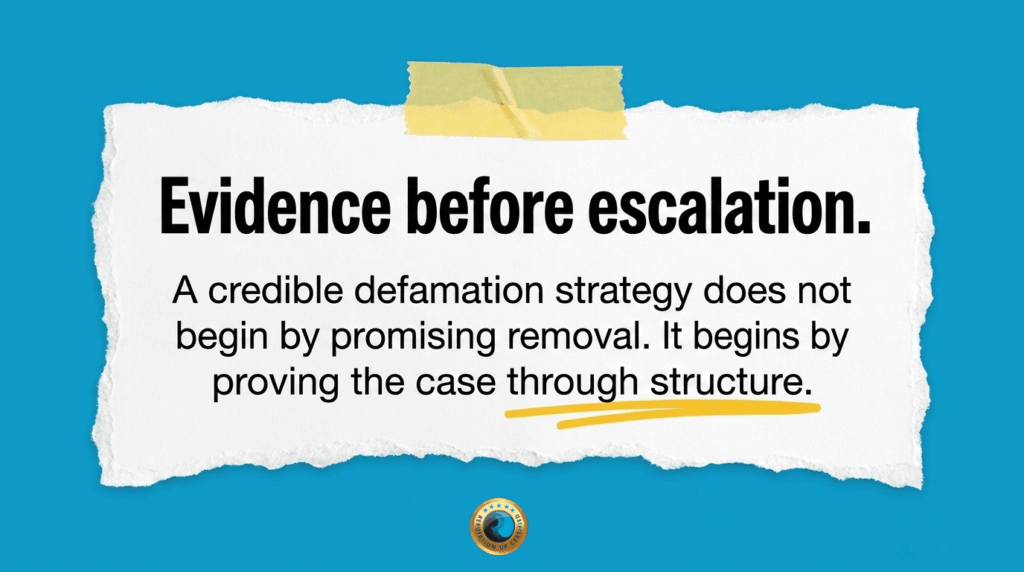
Online defamation is not proven through outrage or repetition. A credible response preserves the publication, isolates the challenged statement and builds evidence an independent reviewer can test.
That record may support correction, platform reporting, legal action, deindexing, suppression or crisis containment.
The risk of acting too late is that the allegation spreads; the risk of overclaiming is that the response creates more visibility. A defensible strategy begins by proving the case.