When negative online content appears in search results, the first question is often direct: Can it be removed? The correct answer is usually more complex.
For an executive, founder, legal counsel or reputation-sensitive company, the distinction between content removal, deindexing and suppression is not cosmetic. It determines:
- What evidence must be collected;
- Which legal or platform route may be available;
- What can realistically be requested;
- What should never be promised;
- How reputational exposure should be contained if the original content remains online.
A harmful article, outdated accusation, defamatory post, exposed personal detail or misleading search result may require different remedies depending on where the content is hosted, who controls the page, whether it is unlawful or policy-violating, and whether the real problem is the content itself or its visibility in search.
The first discipline is therefore not action.
It is classification.
“In reputation remediation, the first risk is misclassification. If removal, deindexing and suppression are confused, the strategy becomes weaker before it even starts.”
Andrea Baggio, CEO EMEA ReputationUP

Don’t like what Google says about you?
ReputationUP guarantees the elimination of any negative link (photos, videos, comments, content, reviews) from Google
The executive answer: removal, deindexing and suppression are not the same
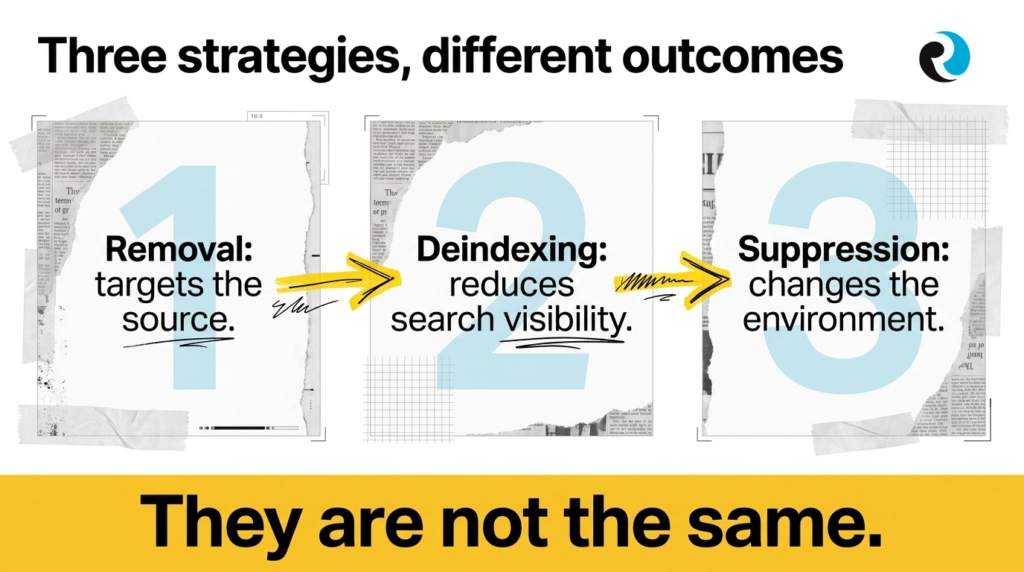
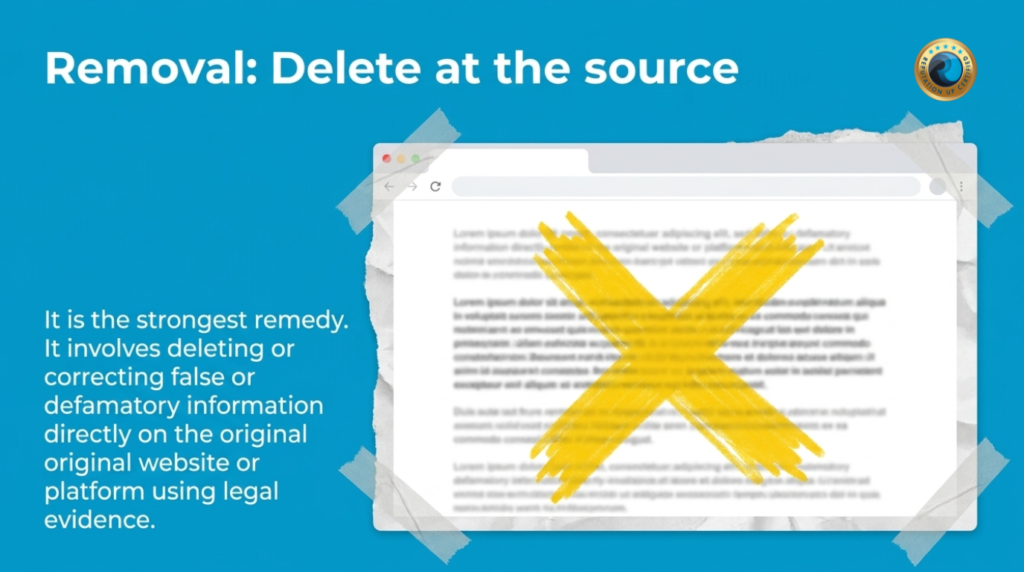
Content removal means eliminating, correcting or modifying the harmful material at the source usually on the website, platform, publisher page or database where it appears.
Deindexing means reducing or removing a URL’s visibility from search results, without necessarily deleting the original content from the internet.
Suppression means reducing the prominence and practical impact of harmful content by strengthening more accurate, authoritative and strategically relevant digital assets around the same person, company, brand or search intent.
Put simply:
This distinction matters because each remedy has different limits.
The source may remove a page entirely. In other cases, the content remains online but disappears from certain search results. Sometimes, the page stays visible while losing influence as stronger, more authoritative content outranks it.
These are different outcomes. They require different strategies.
Why the distinction matters in high-risk reputation cases
One of the most common mistakes in online reputation management is treating every negative result as a “removal” problem.
That creates three risks.
First, the wrong operational route.
A publisher correction request, a platform policy report, a legal notice, a privacy request, a Google deindexing request and a reputational suppression strategy do not follow the same logic.
Second, false expectations.
Some negative pages may be lawful.
Outdated content does not automatically qualify for deindexing.
Publishers are not always required to remove content simply because it causes reputational damage.
Third, reputational amplification.
Poorly structured requests can trigger resistance, screenshots, reposts, public dispute or renewed attention around the harmful material.
The better question is not:
“How do we remove this?”
The better question is:
“Which layer of the problem can be lawfully, technically and reputationally addressed?”
Content removal: when the source can be addressed
Content removal is the strongest remedy because it targets the original publication.
It may involve:
- Deletion of the page;
- Correction of inaccurate information;
- Redaction of names, images, documents or personal data;
- Anonymisation;
- Removal of specific defamatory or privacy-invasive elements;
- Limitation of access;
- Publisher-side updates.
Removal may be relevant where the content is:
- False or defamatory;
- Privacy-invasive;
- Outdated in a legally relevant way;
- Based on unlawfully processed personal data;
- In breach of platform rules;
- Exposing sensitive personal information;
- Presenting facts in a misleading or materially incomplete way.
But removal is not automatic.
The European Commission’s guidance on the right to erasure explains that personal data deletion obligations may be limited where data is needed for freedom of expression, legal obligations or public interest reasons. See the European Commission’s guidance: Do we always have to delete personal data if a person asks?
That is why a credible removal strategy must begin with evidence, not pressure.
The evidence normally includes:
- Exact URLs;
- Screenshots and timestamps;
- Publication dates;
- Author, publisher, platform or host details;
- Search queries where the result appears;
- Factual inaccuracies or misleading statements;
- Evidence of outdated, excessive or unlawfully processed information;
- Evidence of reputational, financial or corporate harm;
- Jurisdictional relevance;
- Prior correspondence, if any;
- The legal, policy or editorial basis for the request.
For companies and exposed individuals, a removal request should be precise, proportionate and evidence-based. Otherwise, it may be perceived as an attempt to suppress criticism rather than a legitimate request for correction, protection or lawful removal.
For further context on this remediation layer, see ReputationUP’s resources on harmful links removal and how to remove negative information from Google.
Deindexing: when visibility can be reduced without deleting the source
Deindexing is not deletion.
This is the point many executives, founders and even internal teams misunderstand.
A page may remain live on a website but no longer appear in search results for certain queries, in certain jurisdictions or under certain conditions. The content may still be accessible through:
- The direct URL;
- The publisher’s own website;
- Internal site search;
- Other search engines;
- Archives;
- Copied pages;
- Social shares;
- Third-party references.
Google’s own Search Central documentation distinguishes between removing a page from a site and removing or limiting its appearance in Google Search. For pages hosted on a site the requester controls, Google explains that temporary removals can be requested through Search Console, while more durable options may include removing the content, password-protecting the page or using a noindex directive. See Google Search Central: Remove a page hosted on your site from Google
Google also explains that a noindex rule tells search engines that support it not to index a page, provided the crawler can access the page and read the directive. See Google Search Central: Block Search indexing with noindex
Where the requester does not control the page, the route is different. Google provides separate processes for certain personal information removal requests and legal removal requests. These procedures are not universal deletion mechanisms. They require review, criteria and context.
This is why deindexing must be treated as a structured legal, policy or technical request — not as a shortcut.
It may be relevant when:
- The original source cannot be removed;
- The search result is disproportionate or outdated;
- Personal data is exposed;
- The result appears for sensitive name-based searches;
- The page remains live but its search visibility creates excessive harm;
- There is a valid legal or policy basis for delisting.
For a broader legal and reputational view, see ReputationUP’s guide on the right to erasure and right to be forgotten.
Suppression: when the problem is not only the URL, but the search environment
Suppression does not delete the source.
Removing the content does not necessarily eliminate the URL from Google.
The objective is not to “hide the truth.” Flooding the web with weak positive content should not be considered an effective strategy.
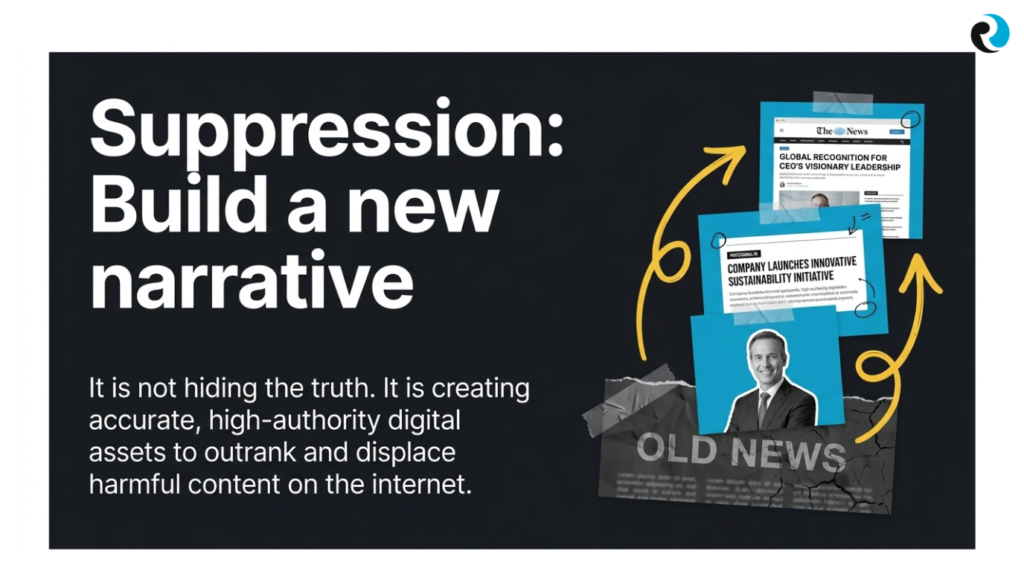
In serious reputation work, suppression means building a stronger, more accurate and more authoritative public record around the affected person, company or topic.
That may include:
- Executive profiles;
- Institutional pages;
- Expert articles;
- Credible third-party media coverage;
- Interviews;
- Legal or technical explainers;
- Updated company information;
- Public statements;
- Thought leadership assets;
- Multilingual content where exposure crosses jurisdictions;
- Structured content that answers the search intent behind the negative result.
Suppression becomes relevant when removal is:
- Legally unavailable;
- Editorially unrealistic;
- Procedurally slow;
- Only partially successful;
- Insufficient because the negative narrative has already spread.
This is especially important when the reputational problem is not one URL, but a broader environment.
A founder may face an old article, copied forum references and AI-generated summaries that compress the entire issue into one damaging impression.
A company may face an outdated controversy, negative search suggestions and derivative commentary across multiple platforms.
A high-profile individual may see one hostile page become the anchor for multiple search results, social discussions and due diligence references.
In these cases, suppression is not a substitute for legal action.
It is a reputational containment layer.
How AI Search changes the risk
Search visibility is no longer limited to the traditional list of blue links.
Generative search systems increasingly synthesize answers from indexed, crawlable and retrievable information. Google’s Search Central guidance states that its generative AI features in Search are rooted in its core ranking and quality systems, and that foundational SEO principles remain relevant for visibility in AI search experiences.
For reputation-sensitive entities, the implication is clear:
harmful content can influence not only what users click, but also what AI systems may summarize, contextualize or retrieve.
This does not mean that every negative page will appear in AI-generated answers. It also does not mean that AEO or GEO can erase reputational risk.
It means that remediation must now consider both:
- Classic search visibility;
- AI-mediated answer environments.
A page that remains indexed, cited, summarized or semantically reinforced may continue to influence:
- Investor review;
- Client perception;
- Bank onboarding;
- Compliance escalation;
- Recruitment;
- Litigation context;
- Media interpretation;
- Executive credibility.
That is why removal, deindexing and suppression should no longer be assessed only as SEO issues.
They are governance issues.

Do you want to grow your brand’s online reputation?
97% of entrepreneurs say online reputation management is the main key to success for their business
A practical decision framework
Choosing the right response requires more than identifying negative content.
The key is to understand where the reputational risk originates, how it becomes visible, and whether the problem lies in the source itself, its search exposure, or the broader narrative it creates.
1. The source layer
Who controls the original content?
A platform, publisher, forum, data broker, archive, regulator, court database or private website will each require a different route.
If the content is hosted on a controlled website, the solution may involve removal, update, password protection or noindex.
If the content is hosted by a third party, the request must rely on a legal, policy, privacy or editorial basis.
2. The search layer
Is the real problem the content itself, or the fact that it appears for a specific name, company, brand or query?
If the source remains online but search exposure is disproportionate, outdated, privacy-invasive or policy-relevant, deindexing may be more realistic than source removal.
3. The narrative layer
Is the negative result isolated, or has it become the dominant public narrative?
If multiple assets repeat the same allegation, if search suggestions reinforce it, or if AI systems may summarize the negative interpretation, removal alone may not be enough.
Suppression and narrative correction may be required.
4. The risk layer
What happens if the request fails, becomes visible or triggers renewed attention?
Certain cases require quiet legal review.
Others call for platform escalation.
Monitoring may be the best first step before any intervention.
In more urgent situations, immediate containment is necessary while legal options are assessed.
The wrong first move can amplify the issue.
What to do
A credible strategy should start with a forensic map of the exposure.
That means identifying:
- Every relevant URL;
- The search queries involved;
- Publication dates;
- Authors and publishers;
- Duplicate versions;
- Screenshots and timestamps;
- Indexed and cached versions;
- Jurisdictions involved;
- Platform policies potentially applicable;
- Legal rights potentially engaged;
- Reputational and commercial consequences.
Then the remedy should be selected with discipline.
If the source is unlawful or policy-violating, removal may be the priority.
Disproportionate search visibility can make deindexing appropriate, even when the source itself remains online.
If the content cannot be removed or delisted quickly enough, suppression and narrative containment may need to start in parallel.
AI search exposure should also be considered when evaluating whether accurate, authoritative and structured content exists around the relevant entity.
What to avoid
Certain mistakes create unnecessary reputational risk.
Avoid:
- Promising guaranteed removal;
- Treating deindexing as deletion;
- Presenting suppression as a way to “hide” information;
- Sending vague takedown requests without evidence;
- Contacting publishers emotionally or aggressively;
- Creating low-quality positive content only to push results down;
- Ignoring jurisdiction;
- Assuming that one successful removal solves every duplicate, archive, social share or AI-search reference;
- Waiting until the negative result becomes the dominant source for journalists, investors, banks, clients or search systems.
In reputation work, speed matters.
But precision matters more.
The real distinction
The difference between removal, deindexing and suppression is the difference between:
- Deleting or correcting a source;
- Limiting a search pathway;
- Changing the discoverable context around a person or organisation.
Certain cases can be removed.
Others may qualify for deindexing.
Some can only be contained and displaced.
Many require a combination of the three.
The larger risk is not only that harmful content remains online.
The larger risk is that an inaccurate, obsolete or disproportionate narrative becomes the easiest version of reality for search engines, platforms, AI systems and decision-makers to retrieve.
Before acting, the essential question is not whether the content is damaging.
The essential question is whether the damage can be addressed at the source, reduced in search, or contained through a broader reputation strategy.
Digital reputation is not repaired through fast promises.
It is repaired through evidence, legal precision, technical discipline and controlled execution.