
A practical framework for executives and legal teams deciding when negative content cannot realistically be removed.Not every negative online result can be removed, even when its reputational impact is significant.
Lawful articles, public records and protected opinions may remain accessible even after circumstances change. Boeing illustrates the problem: its 737 MAX history remains public while later judicial and regulatory developments add new context.
The key question is whether removal, correction or deindexing is legally available and what to do when it is not.
“Take it down.”

Sometimes that response is justified. In other cases, the content is accurate, protected, still relevant or outside the affected party’s control.
When stronger remedies are unavailable, suppression can become lawful reputational containment by strengthening current, authoritative information.
When is suppression the only realistic option for negative content?
Suppression is appropriate only after stronger remedies have been tested. If removal, deindexing and platform routes lack a valid basis, visibility management may be proportionate.
The objective is not to erase the content. It is to reduce the extent to which one negative result controls the interpretation of a person, company or event.
That requires accurate, authoritative information capable of giving decision-makers a more complete record.
“Suppression should never be presented as a shortcut. It is the lawful option when removal is unavailable, the evidence is insufficient, or escalation would create more risk than control.” — Andrea Baggio, CEO EMEA ReputationUP
Boeing: when the public record cannot simply disappear
The U.S. Department of Justice records a May 29, 2025 non-prosecution agreement with Boeing. In November 2025, a federal court granted the government’s motion to dismiss the criminal charge tied to the 737 MAX case.
Those developments did not erase the crashes, investigations or judicial record; they added later facts to an established public history.
In July 2026, the Federal Aviation Administration said Boeing could again issue airworthiness certificates for all 737 MAX and 787 aircraft after months of safety and production review, with FAA oversight continuing.
This is not evidence that Boeing used suppression. It shows how lawful negative history can remain visible while newer official information changes the present context.
The reputational question is whether search results show only the historical controversy or also the subsequent official record.
Classify before suppressing
Negative content may be false, outdated, defamatory, privacy-invasive, protected opinion, public record material or simply accurate but damaging. Each category opens different options.
A Harmful Links Removal assessment should therefore begin with the source, the exact URL, the type of content and the evidence supporting any challenge. Suppression should follow that classification, not replace it.
If removal, correction or deindexing has a credible basis, it should be considered before suppression.
When removal and deindexing are not available
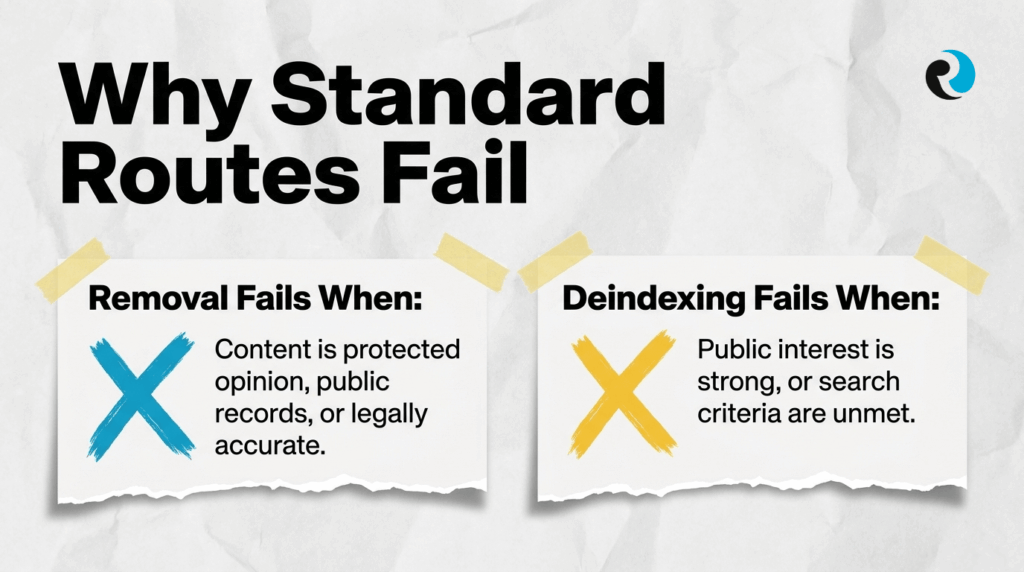
Removal acts at the source through deletion, correction, redaction, anonymisation or access restriction, usually requiring legal grounds, cooperation, platform rules or control of the page.
It may be unavailable when content is accurate, protected opinion, based on public records or supported by strong public interest.
A company that does not control the source cannot apply technical removal measures unilaterally; it must rely on legal, platform or publisher routes.
Deindexing has different limits
Deindexing affects search visibility, not the original publication. A page can disappear from some results and remain accessible through direct links, archives or other queries.
It may apply to specific privacy or outdated-information claims, but accurate and still-relevant material may remain searchable where public interest is significant.
When neither removal nor deindexing has a credible basis, the remaining task is to manage how much interpretive weight the negative result carries.
Cases where the right to erasure does not apply
Data-protection rights can support deletion in some circumstances, but the European Commission states that the right to erasure is not absolute. Freedom of expression, legal obligations and legal claims can justify continued processing.
That balance matters for news, public records, court documents and regulatory notices, where reputational harm may coexist with a legitimate reason for access.
The distinction between deletion and continued lawful visibility is central to Right to erasure, particularly when older material remains discoverable through name searches.
When the content is accurate but disproportionate
Some difficult cases involve information that is accurate but dominates current searches beyond its present relevance.
An old legal reference may outrank later outcomes, or a past controversy may become an executive’s first impression years later.
The issue is therefore not necessarily falsity. It may be ranking weight, narrative imbalance and the absence of current authoritative context.
If removal is not lawful and deindexing is unavailable, suppression can be proportionate: not to deny history, but to prevent one old source from becoming the only visible interpretation.
Cases where escalation creates more risk than control
A possible challenge is not always strategically wise. Publisher contact, legal correspondence or a public rebuttal can renew attention to a low-visibility result.
Risk rises when the subject is high-profile, the issue involves litigation or regulation, evidence is incomplete, or the intervention may be framed as censorship.
Suppression can be safer when it reduces exposure without creating a second news cycle. The decision should account for what intervention may trigger.
When the negative result is part of a wider search environment
Sometimes the problem is an ecosystem: copied articles, forums, old PDFs, snippets, images, social references and AI-mediated summaries can reinforce the same narrative.
Removing one page may leave the broader narrative unchanged. Suppression matters more when the issue has become a cluster of reinforcing results.
The response can combine updated institutional pages, executive profiles, credible media, expert commentary and structured content that answers the search intent.
That is why How To Remove Google Search Results must be approached as more than a deletion question: source control, search visibility and the surrounding information environment are separate layers of the same problem.
What suppression is and what it is not
Suppression does not guarantee disappearance or page-one movement. It is not keyword flooding, fabricated positivity or low-quality content created only to occupy rankings.
A defensible strategy relies on relevance, accuracy, authority, editorial quality and monitoring to strengthen the accurate public record.
For quick searches, ranking order becomes context: what appears first can shape how everything else is interpreted.
The decision framework: when suppression becomes the lawful option
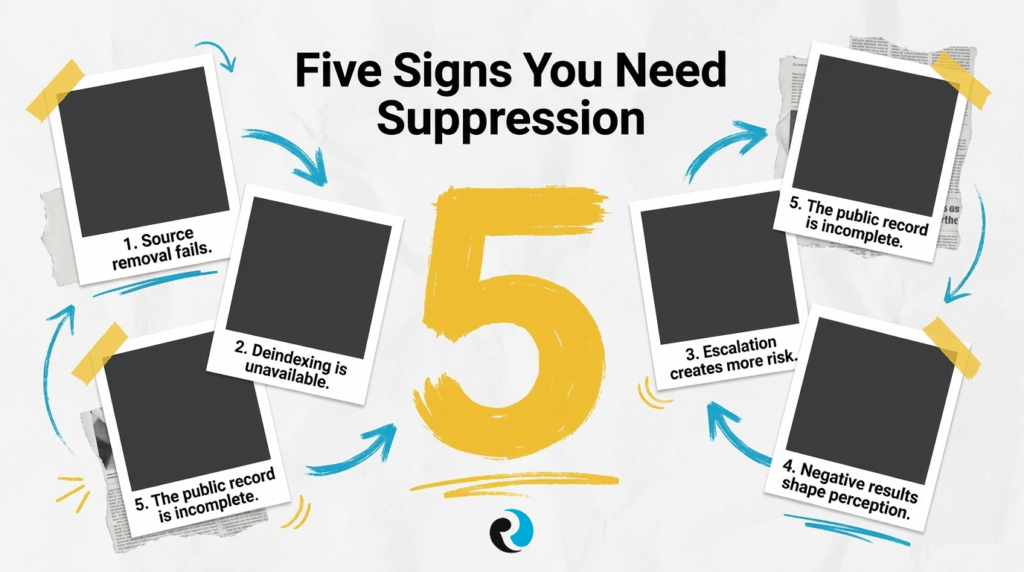
Suppression is most defensible when removal is unavailable, deindexing is unsupported, escalation is risky, negative results shape important queries and current authoritative context is missing.
Five conditions to test
First, confirm there is no credible source-removal route. Second, test whether deindexing criteria are actually met.
Third, assess escalation risk. Fourth, identify decision-critical queries. Fifth, determine what reliable current information is missing.
When those conditions align, suppression is not avoidance. It is a controlled response to the limits of removal.
What to do
Start with classification and evidence. Preserve URLs, screenshots, search queries, ranking positions, publication dates and copies before deciding which remedy is realistic.
Define the target query and assess proportionality. A founder, company and legal issue can produce different search environments.
Build authoritative assets with current, verifiable context, then monitor rankings, snippets, copies and new mentions over time.
What to avoid
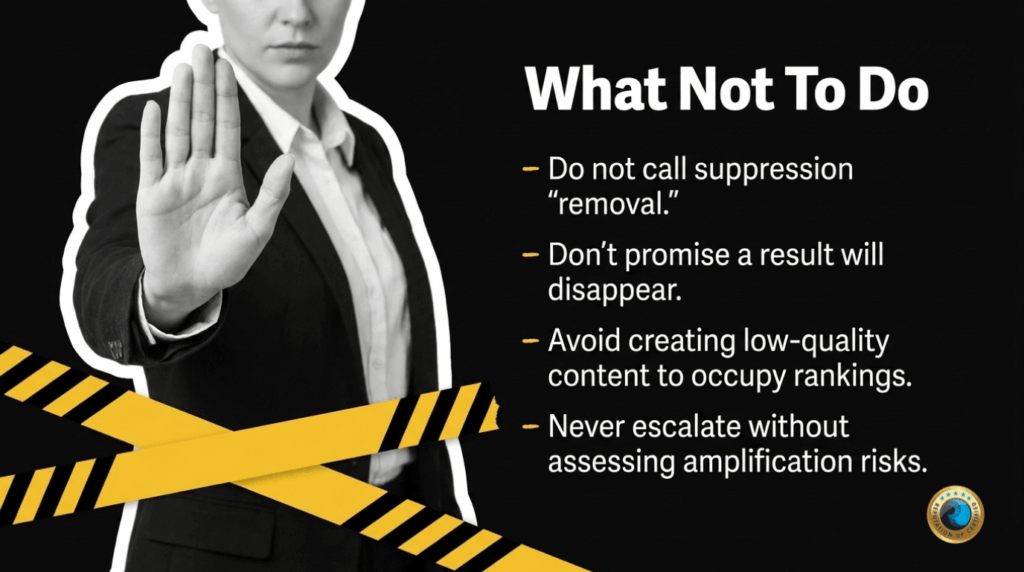
Do not label suppression as removal, promise that a result will disappear or create weak content simply to occupy search positions.
Do not escalate publicly without assessing amplification risk, and do not ignore a lawful removal route when one genuinely exists.
One positive article rarely rebalances a complex search environment; consistency matters more than a single publication.
The executive decision point
The decisive question is whether there is a lawful route to remove, correct or deindex the content or whether its impact must be contained through suppression.
Suppression is appropriate when stronger remedies are unavailable or disproportionate and negative results continue to shape interpretation.
That does not erase history. It makes the current public record more complete, accurate and useful.