
A colleague calls. The voice is familiar, the tone convincing, and the words sound authentic. Yet the person on the other end may not be who we think they are.
Voice cloning is changing how we recognize people and judge the credibility of communications. Thanks to artificial intelligence, a recording available online can become the starting point for artificially reproducing a voice.
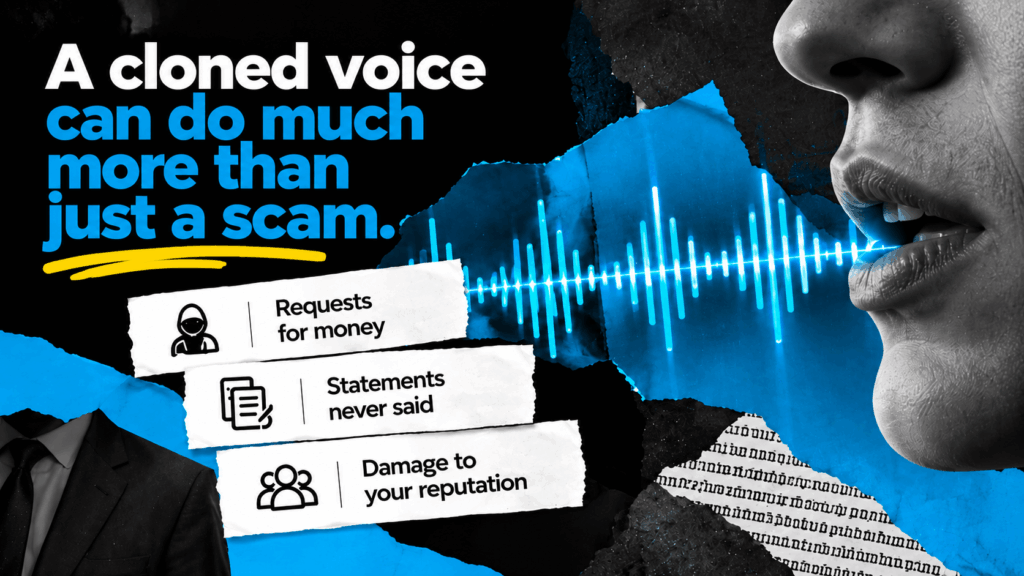
The risk goes beyond fraud. When someone can speak using another person’s voice, they can also attribute statements to them that they never made, compromising digital identity, trust and personal reputation management.
What is voice cloning and how does it work?
Voice cloning is a technology that uses artificial intelligence to reproduce a person’s vocal characteristics: tone, intonation, rhythm and pronunciation.
These systems analyze audio recordings and generate a synthetic voice capable of saying things the original speaker has never said.
The technology is not inherently harmful. It can be used in dubbing, accessibility and digital content production. Problems arise when a voice is reproduced without authorization or used to deceive.
A 2025 Consumer Reports study examined six voice cloning services, finding shortcomings in safeguards against potential misuse.
This means that the risk depends not only on how sophisticated the technology is, but also on the conditions under which it is made accessible.
Why is voice so important to reputation?
When we think about personal reputation management, we generally consider behavior, professional achievements, public statements and information available online.
Voice, however, plays an equally important role: it helps make a person recognizable and credible.
Hearing someone speak can convey a stronger sense of authenticity than reading a text. An audio recording seems to provide a direct record of what a person said.
Voice cloning exploits precisely this perception.
Synthetic audio could make people believe that a professional expressed controversial views, an executive disclosed confidential information, or a public figure endorsed statements they never made.
Even when the manipulation is later proven, the correction may not reach everyone exposed to the original content.
From identity theft to manipulating credibility
Voice cloning can be used for different purposes, with consequences that go beyond simple imitation.
In online scams with artificial intelligence, a familiar voice can be cloned to make urgent requests for money, bank transfers or confidential information more convincing.
According to data published by the Federal Trade Commission in 2026, reported losses from impersonation scams in the United States reached $3.5 billion in 2025.
The figure covers various forms of impersonation, not just voice cloning, but highlights the economic scale of deception based on false identities.
There is also a less immediate risk: manipulating reputation through fabricated statements.
Fake audio can be circulated to discredit a professional, influence perceptions of a leader or undermine trust between a company and its stakeholders.
In these cases, the damage does not necessarily involve a direct financial loss. It can take the form of suspicion, controversy and loss of credibility.
When voice becomes an identity to protect
Growing attention to this phenomenon is also evident in initiatives taken by some public figures.
In October 2026, Giorgia Meloni, the Italian Prime Minister, filed an application to register a sound trademark with the European Union Intellectual Property Office (EUIPO) for the phrase “Io sono Giorgia Meloni” (“I am Giorgia Meloni”).
The initiative, reported by ANSA on October 5, 2026, was linked to efforts to strengthen protection of her voice against potential unauthorized use through artificial intelligence.
Registering a sound trademark does not technically prevent imitations from being created and does not automatically guarantee protection against every form of misuse.
The episode nevertheless highlights a significant shift: voice is increasingly seen as an element of identity that must also be protected in the digital environment.
This issue concerns not only politicians or celebrities, but anyone who uses their voice to communicate and build professional relationships.
How can you recognize a cloned voice?
Identifying an artificial recording by listening alone can be difficult.
Some recordings have unusual intonation, unnatural pauses or implausible variations. However, more advanced systems can produce results realistic enough to make these signs unreliable.
That is why recognizing a voice no longer means verifying the speaker’s identity.
When a recording contains unusual statements, urgent requests or particularly sensitive information, it is advisable to check its origin.
A confirmation call to a known contact, checking official channels and comparing other communications can help identify potential manipulation.
Attention should focus above all on context: who published the audio, where did it first appear, and what evidence confirms its authenticity?
How can you protect your reputation from voice cloning?
Prevention requires an approach that combines digital security and reputation management.
Limiting unnecessary sharing of personal recordings can reduce some opportunities for misuse, but cannot eliminate the risk. For professionals and public figures, having audio content online is often unavoidable.
It is therefore important to put online reputation monitoring tools in place to promptly detect suspicious content and possible misuse of a person’s identity.
When a manipulated recording emerges, the priorities should be:
- Preserve evidence, documenting the content, source and distribution.
- Verify authenticity, avoiding premature or unsupported denials.
- Communicate promptly through official, recognizable channels.
- Assess available responses, including reporting to platforms and, where appropriate, requesting removal, de-indexing and suppression.
Speed matters, but it must go hand in hand with accuracy. A confusing response can amplify the content instead of limiting its effects.
Reputation in the age of artificial identities
Voice cloning introduces a new vulnerability: we can no longer consider an audio recording sufficient proof of the speaker’s identity.
Reputation protection must therefore evolve to include verifying synthetic content, monitoring impersonation and establishing appropriate response procedures.
To avoid mistakes in online reputation management, taking action only after a false statement has gone viral is not enough.
We need to create conditions that make authentic communications easier to recognize and manipulated ones easier to challenge promptly.
Protecting your voice today also means protecting your identity, credibility and reputation.
Frequently asked questions about voice cloning
Yes. Some artificial intelligence systems can reproduce vocal characteristics using short recordings, although quality and fidelity depend on the technology and the material available.
Not necessarily. Its legality depends on consent, how it is used and the applicable laws. Fraudulent impersonation and harmful uses may give rise to legal liability.
There is no listening method that is always reliable. It is better to verify the source, context and sender’s identity through independent channels.
Public figures, executives and professionals with many recordings available online may be particularly exposed, but private individuals can also be affected.
Preserve evidence, report the content to the platform, check for potential violations, and consider legal assistance and measures to protect your reputation.