
A video shows a company CEO making a controversial statement. An audio recording appears to capture a professional’s voice as they disclose confidential information. An image depicts a public figure in a situation that could undermine their credibility.
The problem is that none of this content necessarily has to be real.
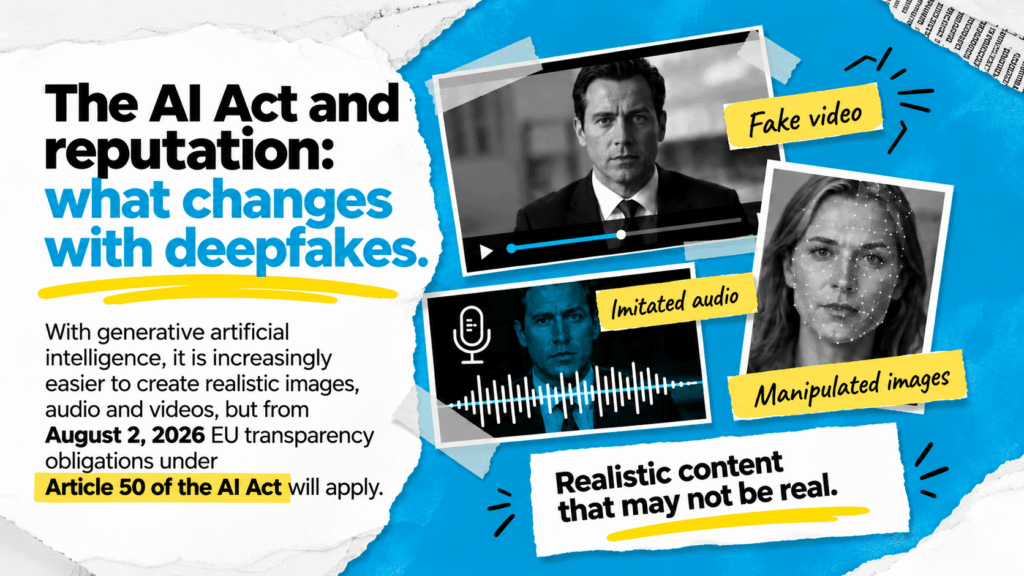
Generative artificial intelligence has made it easier to produce images, audio and video capable of imitating real people and events. From 2 August 2026, however, the transparency obligations set out in Article 50 of the AI Act, which also concern deepfakes and other content generated or manipulated using artificial intelligence, apply in the European Union.
The relationship between the AI Act and reputation begins here: if it becomes more difficult to distinguish immediately between what is authentic and what is not, transparency about the origin of content also becomes a tool for protecting trust.
What is a deepfake under the AI Act?
Not everything created using artificial intelligence is automatically a deepfake.
The AI Act uses this definition for AI-generated or manipulated image, audio or video content that resembles existing persons, objects, places, entities or events and could falsely appear authentic or truthful.
The distinction is important. An explicitly artificial image used in a creative campaign and a fake video attributed to a CEO do not create the same risk.
In the second case, the content exploits the appearance of authenticity. It is precisely this ability to blur reality and simulation that makes the relationship between AI and reputation particularly sensitive.
What changes from 2 August 2026?
Article 50 introduces different responsibilities depending on the role performed.
On one side are providers, meaning the suppliers of the systems. When a system generates certain synthetic audio, image, video or text content, the provider must ensure that the outputs are marked in a machine-readable format and detectable as artificially generated or manipulated, within the limits established by the legislation.
On the other side are deployers, meaning those who use AI systems. When they use a system to generate or manipulate image, audio or video content that constitutes a deepfake, they must disclose that the content has been artificially generated or manipulated.
The European Commission guidelines on transparency obligations, published in 2026, are intended to clarify precisely how these provisions should be applied in practice.
In simple terms, the AI Act therefore operates on two levels: making artificial origin technically detectable and informing people when they are exposed to certain synthetic content.
Imagine that a fake audio recording attributed to a company executive begins to circulate.
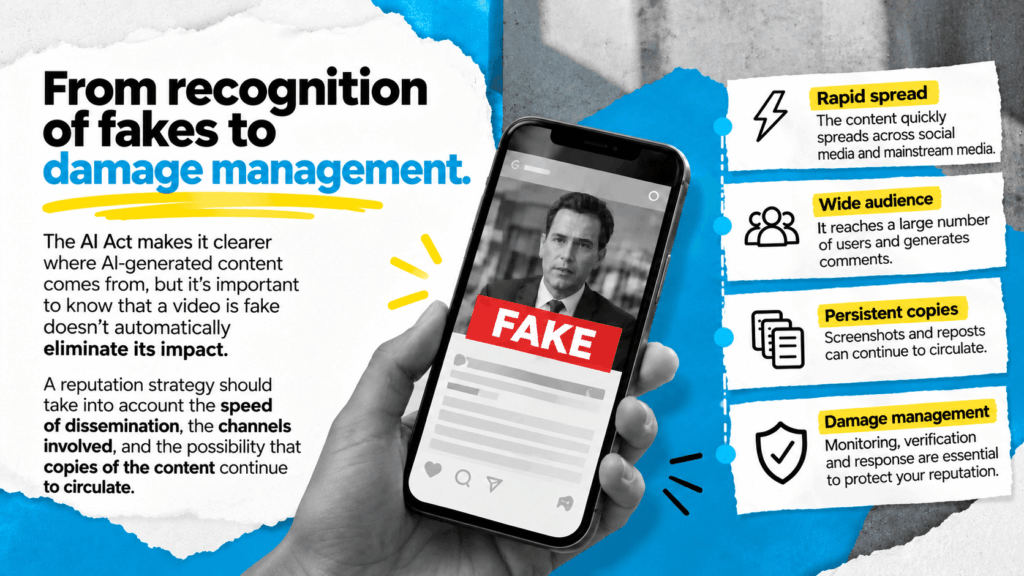
Before the organisation can verify it, someone posts it on social media. Other users share it. Comments, screenshots and articles appear. By the time the recording is shown to be artificial, part of the public conversation has already unfolded.
This is where a deepfake becomes a reputational problem.
Reputation also depends on the information people believe to be true, not only on information that is actually true. False but credible content can therefore influence perceptions of a person or organisation before the narrative can be corrected.
The same mechanism can be exploited in AI-powered online scams, where a voice, a face or other elements of someone’s identity are imitated to make a deception more convincing.
Reputational risk therefore arises from the combination of three factors: the realism of the content, the speed at which it spreads and the time needed to verify that it is false.
Can a label really stop a deepfake?
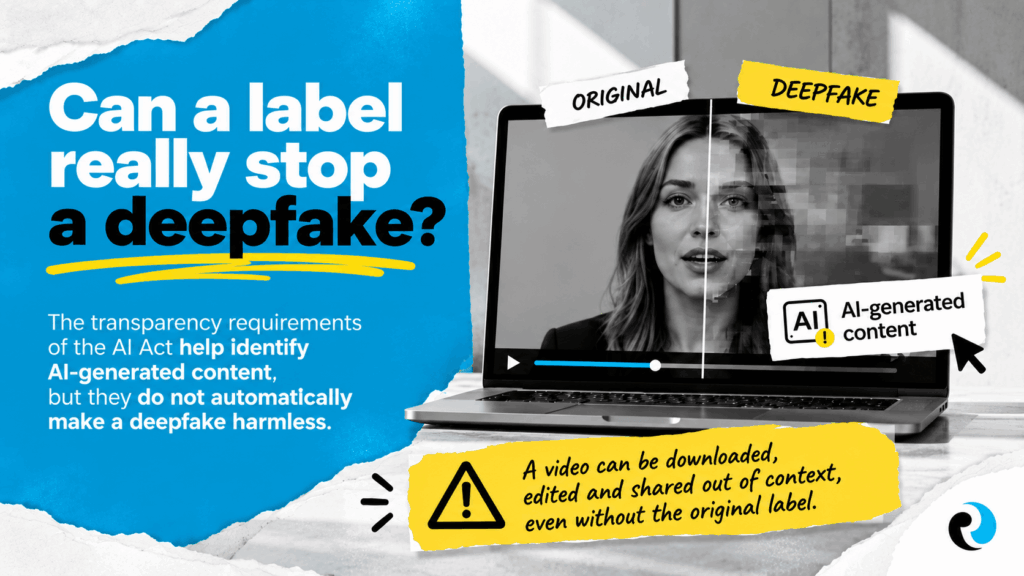
Transparency obligations can help people recognise artificial content, but they do not automatically make a deepfake harmless.
A video can be downloaded and reposted. It can be edited, turned into a screenshot or shared outside its original context. A label present at the source may therefore not accompany every subsequent version of the content.
For this reason, regulatory compliance and reputational protection are not the same thing.
The Code of Practice on Transparency of AI-generated Content, published in 2026, examines aspects such as marking, detectability and labelling in greater detail to help providers and deployers apply the obligations under Article 50.
Transparency can reduce the risk of artificial content being mistaken for authentic content. Reputation management, however, must also address what happens after that content has begun to circulate.
Not all AI content should be treated in the same way
The AI Act does not generally prohibit deepfakes and does not require all AI-generated content to be treated in the same way.
For works that are evidently artistic, creative, satirical or fictional, for example, the legislation provides specific ways to disclose their artificial origin without hampering the enjoyment of the work.
Special rules also apply to AI-generated or manipulated text published to inform the public about matters of public interest. Its artificial origin must be disclosed, but exceptions are provided, including cases in which the content has undergone human review or editorial control and a natural or legal person assumes editorial responsibility for it.
This clarifies an important point: using artificial intelligence does not automatically mean producing problematic content. The context, purpose and way in which the use of AI is communicated all matter.
What should companies and professionals do?
Companies, managers, professionals and public figures face two separate issues.
The first concerns the content they produce. They need to understand when the use of artificial intelligence falls within the transparency obligations and establish internal procedures to manage synthetic content and responsibilities properly.
The second concerns content produced by others.
A company may comply fully with the AI Act and still find itself at the centre of a crisis caused by a fake video of its CEO. This makes online reputation monitoring even more important: identifying manipulated content quickly makes it possible to verify it before the narrative takes hold.
An effective response should include preserving evidence, verifying the origin of the content, communicating clearly about the manipulation and assessing the available tools for limiting its spread.
When the content is harmful and the relevant conditions are met, removal, de-indexing and suppression strategies may also be considered.
From recognising a fake to managing the damage
The AI Act introduces an important change: the artificial origin of certain content should not remain invisible.
But knowing that a video is fake does not automatically erase its effects.
A reputation strategy must consider the speed of dissemination, the channels involved, the people reached and the possibility that copies of the content will continue to circulate. One of the mistakes in online reputation management can be responding too late, when the manipulated content has already become part of the public conversation.
The challenge posed by deepfakes is therefore twofold: making artificial content recognisable and protecting what is authentic. The AI Act provides new transparency tools; companies and individuals must complement them with monitoring, verification and response capabilities.
FAQ on the AI Act and reputation
The transparency obligations under Article 50 of the AI Act apply from 2 August 2026.
No. The regulation does not introduce a general ban on deepfakes, but it does establish specific transparency obligations for certain content generated or manipulated using AI.
No. A deepfake is AI-generated or manipulated image, audio or video content that resembles existing persons, objects, places, entities or events and may falsely appear authentic.
Because it can falsely attribute words, actions or conduct to a person or organisation and influence public perception before the manipulation is verified.
No. It increases transparency, but does not necessarily prevent the content from spreading. Monitoring, timely verification and management of the reputational response are therefore also necessary.