
Artificial intelligence is changing how people and companies become known online. Until just a few years ago, digital reputation depended mainly on search engine results. Today, tools such as Google AI Overview, ChatGPT, Microsoft Copilot, Gemini and Perplexity can process large amounts of information and turn it into concise answers that users often perceive as authoritative.
This change has given rise to a new concept: AI reputation.
Today, a first impression of a professional, entrepreneur or organisation can come from an AI-generated answer, even before a user visits the company’s official website or reads a newspaper article.
For this reason, it is increasingly important to understand how ChatGPT gathers information, which sources are considered reliable, and why content published many years ago can continue to influence how a person or company is described by AI Search systems.
Online reputation management is therefore no longer limited to traditional SEO; it also concerns the quality of the information artificial intelligence uses to build its representation of reality.
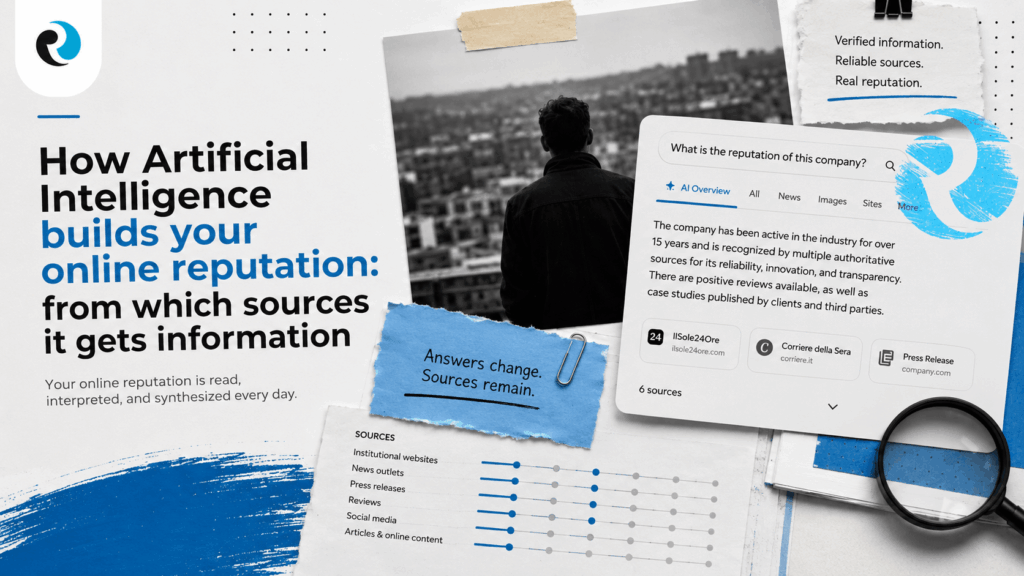
What is AI reputation?
AI reputation is the representation that an artificial intelligence system builds of a person, professional, company or organisation based on publicly available online information.
Unlike traditional search engines, which display a list of results, AI Search tools analyse content from multiple sources, compare it and synthesise it into a single answer.
This means that users do not necessarily browse dozens of web pages: increasingly, they read a summary produced directly by artificial intelligence.
Consequently, AI reputation depends on the quality of the entire information ecosystem available on the web, not merely on the ranking of a single page.
Why AI reputation has become so important
More and more people use artificial intelligence to obtain information quickly before making a decision.
The most common questions concern not only products and services, but also people and organisations.
For example:
- “Is this company trustworthy?”
- “Who is this entrepreneur?”
- “What is this professional’s reputation?”
- “Are there any negative news reports about this company?”
In just a few seconds, an AI system can gather information from different sources and provide a concise answer that helps shape the user’s perception.
For this reason, AI reputation is now just as strategic as traditional digital reputation.
How does ChatGPT gather information?
One of the most common questions concerns how artificial intelligence systems work.
When it uses web search, ChatGPT incorporates information from up-to-date online sources and provides links to the websites used to construct its answer.
OpenAI explains that ChatGPT Search combines the capabilities of the language model with information retrieved from the web, allowing users to explore topics through direct links to the original sources. This approach makes the search process more transparent and enables users to verify the origin of the information used, as explained in the official documentation for ChatGPT Search.
It is important to emphasise that artificial intelligence does not copy a single web page; instead, it interprets information from multiple sources in an effort to construct a coherent, contextualised answer.
Which sources does Artificial Intelligence use?
When discussing AI reputation, one of the most common questions is: where does the information that artificial intelligence uses to describe a person or company come from?
There is no single source.
Modern AI Search systems process information from a digital ecosystem made up of different kinds of content, giving greater weight to material considered authoritative, verifiable and consistent.
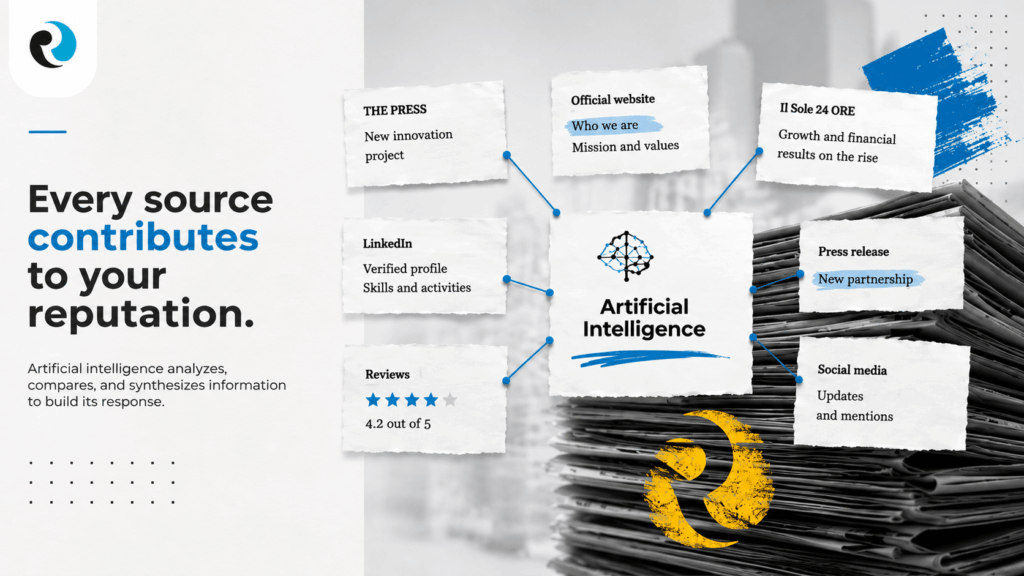
The sources that most strongly influence AI reputation include institutional websites, the official websites of companies and professionals, authoritative news outlets, public records, press releases and specialist publications. Reviews, professional profiles and content posted on social media can also help shape digital reputation, but their weight varies according to the authority of the source, the context and their consistency with other available information.
In other words, artificial intelligence does not build a person’s reputation based on a single article or website, but instead interprets all publicly accessible information to create an overall representation.
For this reason, Brand Reputation management cannot be limited to the occasional publication of new content. It requires an ongoing strategy that strengthens the brand’s authority, monitors the information available online and intervenes when content emerges that could alter public perception. This approach is the foundation of effective Brand Reputation Management, now one of the most powerful tools for building a solid reputation in the eyes of artificial intelligence systems as well.
Outdated content can also influence AI reputation
One of the lesser-known aspects is how long information can persist over time.
Many people assume that a news story published years ago has lost all relevance.
In reality, this is not always the case.
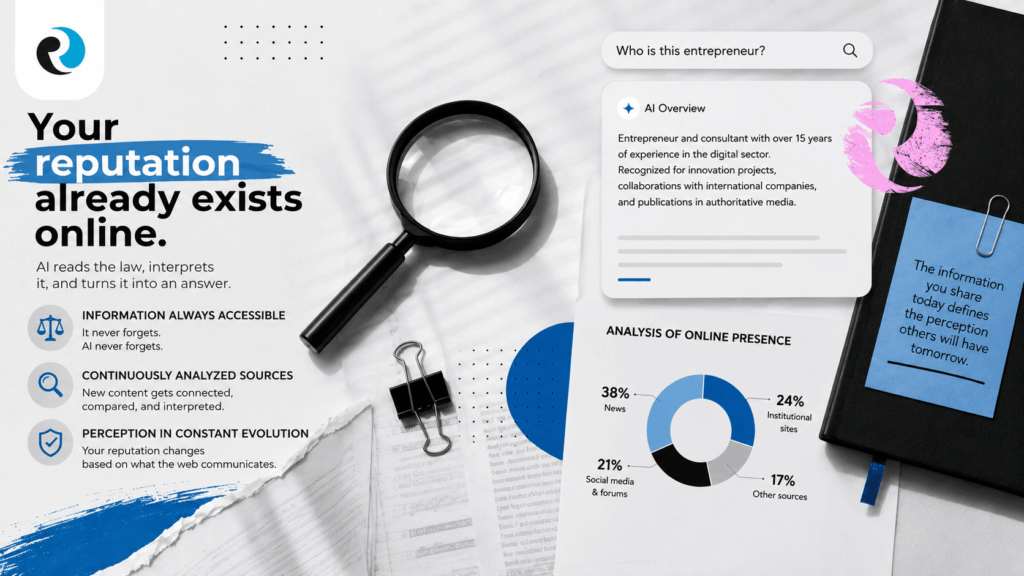
If that content remains available online, is cited by other sources or is still easy to find, it can continue to contribute to the construction of an AI reputation.
This happens, for example, with:
- old news articles;
- legal proceedings that have already concluded;
- reviews that are no longer representative;
- incomplete information;
- out-of-date data;
- content taken out of context.
Artificial intelligence can connect this information with more recent content and construct a summary that does not always reflect the current situation.
For this reason, online reputation management is not only about publishing new content; it also involves constantly monitoring information already available on the web and assessing its impact on one’s digital image. Brand Monitoring Tool solutions can promptly identify new content, analyse its potential reputational impact and enable action before it is absorbed by artificial intelligence systems. This is becoming an increasingly strategic activity for companies and professionals seeking to maintain a reliable, up-to-date digital presence.
Google AI Overview and AI Search: why they are changing online reputation
The introduction of Google AI Overview represents one of the most significant changes in the evolution of online search.
In the past, users consulted several results before forming an opinion. Today, they increasingly receive an answer already prepared by artificial intelligence, built by synthesising information from different sources.
The same approach is used by other AI Search tools, including ChatGPT Search, Microsoft Copilot, Gemini and Perplexity.
This means that AI reputation no longer depends solely on where a page ranks in search results, but on the overall quality of the information available online.
The growing adoption of generative search confirms this transformation. Google has announced that AI Overviews is now available in more than 200 countries and territories and supports over 40 languages. The company has also stated that, in major markets where the feature has been introduced, searches showing AI Overviews have produced an increase of more than 10% in Google usage, indicating the increasingly widespread use of AI-generated answers. These figures are reported in Google’s official update on the expansion of AI Overviews.
Google also explains that AI Overviews generates a synthesis of information from multiple web sources and that, as with any artificial intelligence-based system, answers may contain errors. For this reason, it encourages users to verify the most important information by consulting the original sources directly, as explained in the official documentation.
Public data is the raw material of AI reputation
When discussing public data, people often think only of official registers or administrative documents.
In reality, the body of information used by artificial intelligence systems is much broader.
Newspaper articles, press releases, institutional websites, corporate websites, academic publications, interviews, professional profiles and other publicly accessible content all contribute, to varying degrees, to the construction of AI reputation.
Artificial intelligence does not assess these elements individually; rather, it looks for connections between different sources to develop a coherent representation.
For this reason, it is no longer enough to ask, “What appears when I search for my name on Google?”
The more appropriate question is:
“What overall image does an artificial intelligence system construct when it analyses all the information available about me or my company?”
This synthesis can influence customers, business partners, investors, journalists and recruiters.
How to improve AI reputation
AI reputation cannot be improved by intervening directly in artificial intelligence, but by working on the information it uses to construct its answers.
This means developing an ongoing strategy that covers the entire digital ecosystem.
The most effective activities include:
- regularly updating the corporate website;
- publishing authoritative, verifiable content;
- strengthening the presence on reliable sources;
- correcting inaccurate or outdated information;
- constantly monitoring what is published online;
- developing Digital PR activities that increase the brand’s authority.
A consistent digital reputation makes it more likely that AI systems will find accurate, up-to-date and contextualised information.
For this reason, reputational risk analysis is an essential phase of any reputation management strategy. Through an in-depth analysis, it is possible to identify promptly the content that could influence how people and companies are described by artificial intelligence systems, allowing action to be taken before that information affects public perception.
AI reputation requires a long-term strategy
The evolution of artificial intelligence-based search highlights a fundamental point: reputation is no longer the result of a single piece of content, but of the consistency of all the information available online.
An up-to-date institutional website, authoritative editorial content, Digital PR, constant monitoring and a consistent presence across key sources all help build a reliable information ecosystem.
Conversely, neglecting outdated content, inaccurate information or decontextualised news increases the risk that these elements will continue to influence the answers generated by AI systems.
For this reason, Brand Protection now plays an even more strategic role. Protecting an organisation’s reputation also means ensuring that the information available online is up to date, accurate and consistent with reality, reducing the risk that outdated content will be used by artificial intelligence systems to construct a distorted representation of the brand.
Conclusion
AI reputation is one of the main challenges of contemporary digital communication.
Artificial intelligence does not create information from nothing; it builds a synthesis using what it finds online. For this reason, every article, press release, institutional resource or authoritative publication can help define how a person or organisation is perceived.
Understanding how ChatGPT gathers information, which sources influence AI Search systems and how to manage the quality of one’s information ecosystem means adopting a more advanced approach to digital reputation.
In a context where more and more users rely on AI-generated answers, monitoring, updating and protecting one’s online presence is no longer merely good practice. It is a strategic requirement for building trust, authority and credibility over the long term.
FAQ
AI reputation is the representation that an artificial intelligence system builds of a person, company or organisation by analysing and synthesising publicly available information on the web.
When it uses web search, ChatGPT incorporates information from up-to-date, authoritative online sources and provides links to the sources used to construct its answer.
Google AI Overview synthesises information from multiple sources and can represent the first point of contact between a user and a company. For this reason, the quality of the information available online is increasingly important.
Yes. If content remains available online and is still considered relevant, it can contribute to the representation that artificial intelligence constructs of a person or organisation, even years later.
It is advisable to monitor one’s online presence constantly, update official information, publish authoritative content, correct inaccurate data and develop an ongoing digital reputation management strategy.