
Managing what appears online has become part of managing one’s identity. Social media profiles, search results and professional content help shape a public image even before a direct encounter. However, a good digital presence is not enough on its own to build an authentic reputation.
Reputation arises from the relationship between what a person communicates and what others experience in practice. If reliability and transparency emerge online while professional conduct tells a different story, that gap can become a reputational problem.
For this reason, mistakes in online reputation management can arise precisely from treating the digital sphere as a showcase separate from reality. A well-constructed online presence can highlight qualities and achievements, but it can also amplify inconsistencies when what is communicated is not confirmed by offline behaviour.
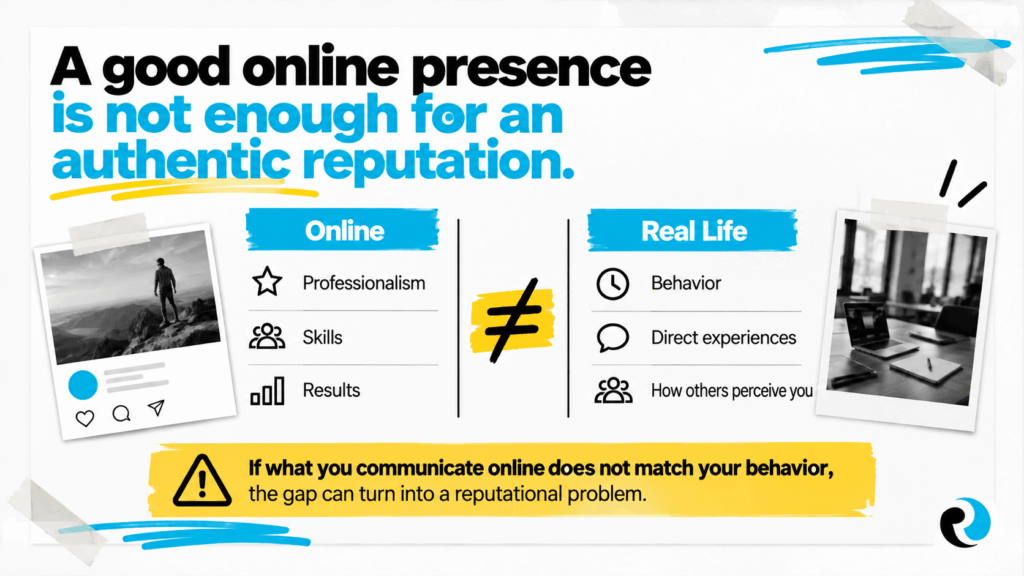
What does it mean to have an authentic reputation?
An authentic reputation emerges when communicated identity, behaviour and other people’s perceptions remain sufficiently consistent. It does not mean showing every aspect of one’s life or giving up personal branding, but avoiding the construction of an image that is not reflected in one’s actions.
In personal branding, it is normal to select the skills, achievements and values to highlight. The problem arises when this selection becomes an artificial representation: claiming to focus on customers and then providing a negative experience, or presenting oneself as an expert without being able to demonstrate real expertise.
In these cases, the issue concerns personal reputation management, because perception is also shaped through direct experiences, testimonials and observable behaviour.
Trust is not built solely through what we say
Credibility does not depend on the amount of content published. What a person says about themselves represents only one part of their public identity. Reviews, experiences, references and observable results can confirm or challenge what is communicated.
It is therefore unsurprising that trust has acquired tangible importance in people’s decisions. In the 2026 Edelman Trust Barometer Special Report, 88% of respondents regard trust in a brand as an important or decisive criterion when making a choice, virtually on the same level as quality, cited by 89%, and value, cited by 88%.
The figure concerns brands, but it highlights a principle that also applies to individual reputation: being perceived as credible influences other people’s decisions.
This is where personal reputation management takes on a broader meaning: it is not simply about controlling what appears online, but about understanding which elements genuinely contribute to trust.
When online and offline portray two different people
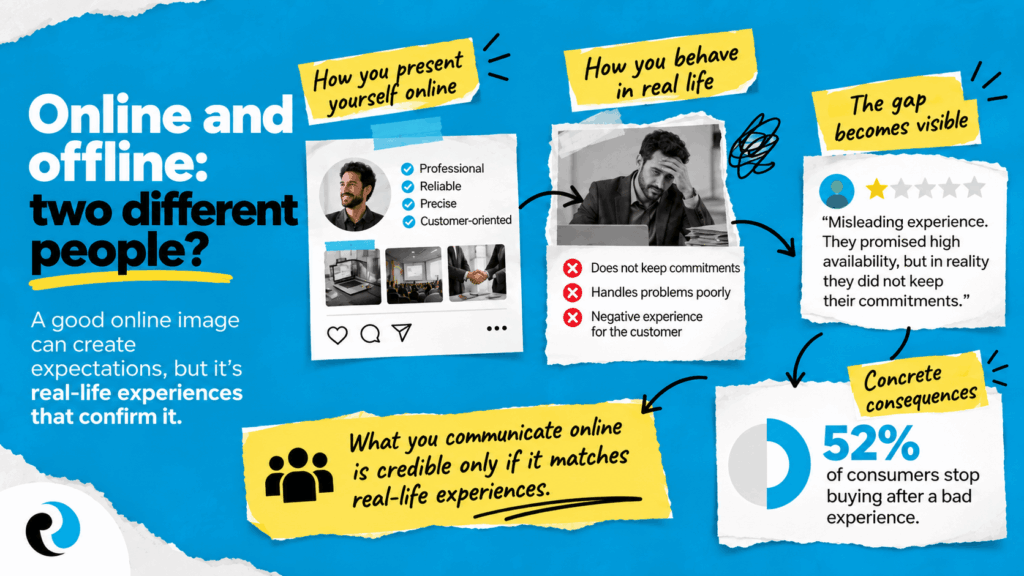
Imagine a professional who presents themselves on social media as helpful, precise and customer-focused. If, in real interactions, they fail to keep commitments or handle problems poorly, the digital image can hold up only while those experiences remain private.
A single review or client testimonial is enough to make the gap between promise and experience visible.
Practical experience can have immediate consequences. In PwC’s 2025 Customer Experience Survey, 52% of surveyed consumers said they had stopped using or buying from a brand after a poor experience with its products or services.
Applied to personal reputation, the principle is similar: what is presented online gains credibility when it is confirmed by real interactions. Communication creates expectations; behaviour determines whether they will be met.
Personal branding does not mean creating a persona
A sustainable personal branding strategy should begin with verifiable elements: skills, experience, working methods, results and values that are genuinely put into practice.
Creating a persona that is excessively distant from one’s identity involves a risk. The greater the visibility, the more opportunities there are for that representation to be compared with reality.
Edelman’s 2025 Trust Barometer also helps explain this relationship between communication and trust. The research links the development of trust not only to statements, but also to the ability to meet expectations through concrete actions.
This distinction is also useful for personal branding: stating a value and making it recognisable through one’s behaviour are two different things. An authentic reputation emerges when these dimensions coincide.
Why inconsistencies become more visible online
The digital world preserves traces. An interview, a post, a review or an old statement may remain available and be compared with more recent information.
This makes it harder to sustain a narrative without a concrete foundation over time. Furthermore, there are many sources through which a person can be observed, and not all of them are directly controllable.
Monitoring of reputation makes it possible to identify content and results associated with one’s name. Monitoring, however, is not only useful for finding negative content: it can help determine whether the perceived image corresponds to the one a person intends to communicate.
In some cases, communication needs to be corrected; in others, behaviour needs to change. Reputation management thus becomes a tool for observing the distance between declared identity and perceived identity.
How to build a consistent reputation over time
A strong reputation requires continuity. It is useful to listen to how clients, colleagues and other contacts describe their experience and compare it with the image presented online.
Excessive promises should also be avoided. Credibility grows when the expectations created through communication can be supported by behaviour.
Tips To Protect Online Reputation become more effective when they go beyond digital content alone. Protecting reputation also means maintaining consistency in relationships, responding appropriately to mistakes and demonstrating over time that public statements are supported by real behaviour.
Authenticity, in fact, does not require a perfect reputation. Acknowledging a mistake and demonstrating concrete change can be more consistent than attempting to maintain an image without imperfections.

Authentic reputation: from controlling the image to consistency
Managing online reputation remains important, but it cannot replace the reality that the reputation should represent. Search engines and social media make one part of an identity visible; clients, colleagues and other contacts experience another.
When these dimensions are consistent, a digital presence can reinforce credibility that is already supported by behaviour. When they conflict, even an effective communication strategy risks becoming fragile.
Reputation management must therefore consider the relationship between identity, perception and trust. The most resilient reputation is not necessarily the one that appears perfect: it is the one that is confirmed by reality.
Frequently asked questions about authentic reputation
It is a reputation based on consistency between what a person communicates, their behaviour and other people’s experience, in both digital and real-world interactions.
Are online reputation and real-world reputation the same thing?
They are not identical, but they are closely connected. Online reputation represents part of public perception and can be influenced by behaviour that occurs offline.
Not in itself. The risk emerges when it creates expectations that are not reflected in actual behaviour, skills or results.
Published content, search results, reviews and feedback can be compared with the values and characteristics that a person wishes to communicate.
Through monitoring, consistency, transparency and responsible management of mistakes. Protection concerns both online content and the behaviour that contributes to how a person is perceived.