
A defamatory statement becomes harder to contain when it stops living on one page and begins appearing inside search. The reputational problem then includes the source, the query and the AI-generated answer a stakeholder encounters first.
The Jimmy Keene-Google dispute illustrates that shift. Keene alleges that Google AI Overviews attached false criminal claims to his name, turning ordinary searches into a reputational risk created inside the search experience.
Between May and June 2025, Keene alleges that four Google AI Overviews made statements about his criminal history and current status. Two said he was serving life without parole; one added that the sentence was for the murders of three women. In September 2026, a federal court allowed claims involving those two outputs to continue and dismissed two others without prejudice.
The ruling was not a finding that Google committed defamation, and no damages have been awarded. It also shows that search can create a second reputational surface: information can be disputed not only at the source, but also in the way search systems present it.
Why indexing changes the risk
Search engines can turn a hard-to-find page into a visible reputation event. Google Search Central explains that Search works through crawling, indexing and serving results, so discoverability depends on both the source and the query environment.
Keene’s case adds another layer to any online defamation guide: three challenged outputs allegedly appeared after searches for “Jimmy Keene net worth,” while another followed “Is Jimmy Keene still alive.” A user looking for basic biographical information could therefore encounter serious criminal claims before opening any underlying source.
The public court record does not quantify lost contracts, revenue, or other economic losses.
Still, for an author and producer, search results linking their name to murder and life imprisonment create direct reputational exposure when credibility is being evaluated.
“Indexed defamation extends the damage because the search result becomes a reputational gateway. The response must address both the source and the visibility layer.”
Andrea Baggio

Google-Keene in 2026: from AI error to legal dispute
According to the court, the challenged AI Overviews cited a Wikipedia page, but that page did not contain the allegedly false statements that Keene was serving life without parole or had murdered three women. The first two outputs were allegedly seen by family members, friends and acquaintances.
Keene also contacted Google repeatedly about the results. Those notices later mattered because he is a limited public figure and therefore had to plausibly allege actual malice, not merely falsity.
At the motion-to-dismiss stage, the court rejected Google’s argument that the relevant AI Overviews could not reasonably be read as factual assertions.
It noted that an ordinary user conducting a basic Google search may understand an answer presented with citations as objectively verifiable information.
What the ruling actually decided
The September 14, 2026 ruling split the four outputs. Claims based on the two life-sentence statements survived. A third statement describing Keene as having been convicted of drug trafficking was dismissed because the court considered it substantially true in light of his prior conviction for conspiracy to distribute cocaine.
A fourth claim was dismissed because the complaint did not adequately allege publication to a third party, although Keene was permitted to amend. The practical lesson is important: each output needs its own proof of falsity, publication, context and impact.
Step 1: Preserve both the content and the search result
The Keene dispute shows why evidence should capture two layers at once. Teams should save the original source, exact query, generated answer, cited links, timestamps and screenshots before contacting a platform or publisher.
Third-party exposure and the notification trail also matter. One weakness in Keene’s pleading was the lack of a publication allegation for one output, while his repeated reports to Google became relevant to whether he had plausibly alleged knowledge or reckless disregard.
Step 2: Prove the defamation, not only the damage
Indexed visibility can intensify harm, but it does not prove that every challenged statement is false. Keene’s third AI Overview was dismissed because the court found its description of his drug conviction substantially true.
Under the Defamation Act 2013, serious harm is required in England and Wales, and a body trading for profit must show serious financial loss or likely serious financial loss.
More broadly, if economic damage is claimed, it should be documented. Keene’s publicly available ruling establishes no quantified economic loss or damages award.
Step 3: Separate source removal from deindexing
Keene’s dispute is unusual because the most serious challenged statements were not alleged to appear in the cited Wikipedia source. The reputational problem was the AI-generated search layer, so correcting the underlying source alone would not necessarily have solved it.
For name-based visibility and personal-data issues, the European Commission notes that the right to erasure exists but is not absolute. The practical lesson behind remove negative information from Google is to identify which layer controls the harmful statement before choosing source removal, deindexing or suppression.
Step 4: Choose the correct route
A false publisher statement may support correction or removal; a search result may require deindexing; and an AI-generated answer may require product reporting, legal escalation and monitoring.
Keene used Google’s legal-removal process, and the record shows that repeated notices later became relevant to his actual-malice allegations.
From a risk-management perspective, faster human review after a serious legal notice could reduce repeated exposure. For the affected person, the lesson is equally practical: document each output separately.
The court’s different treatment of the four statements shows why one broad complaint should not be treated as one uniform problem.
Step 5: Assess the amplification risk
Legal escalation can correct the record, but it can also create new searchable material describing the allegation. The Keene litigation itself produced court documents and coverage that repeat the disputed statements, a common tension in high-profile reputation cases.
That does not make escalation wrong. It means crisis management should run alongside legal action, with accurate biographical material, stakeholder explanations and monitoring prepared before the dispute becomes a second search narrative.
Step 6: Monitor what remains after the first action
AI-mediated search makes post-action monitoring essential because an answer can change, disappear or reappear. Keene alleged that similar problematic outputs continued after he contacted Google, making recurrence part of the legal and reputational story.
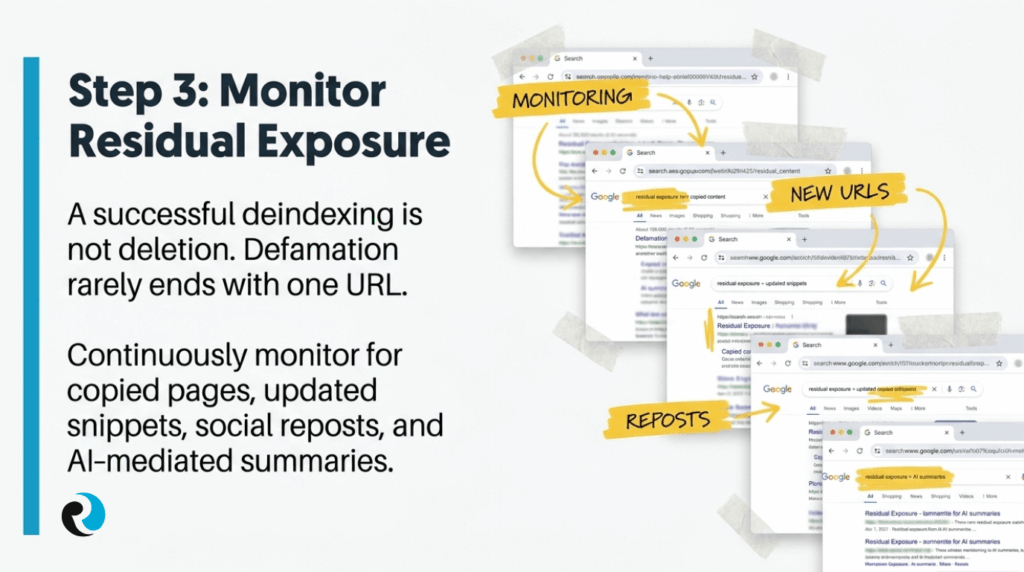
Monitoring should cover the original query, adjacent queries, snippets, copied pages, images, PDFs and AI-generated summaries. Residual exposure is part of remediation: teams need to document what changed and what still shapes the public record.
What to do — and what to avoid
Preserve the source and search result first, classify each challenged statement separately and build a proof file that records falsity, third-party publication, notices sent and any documented commercial or reputational impact.
Avoid guaranteed-removal promises, vague complaints and public escalation before amplification risk has been assessed.
Do not treat search visibility as proof of illegality, and do not claim financial losses that the available evidence cannot support.
The executive decision framework
Leadership should ask what exactly is false, where it appears and what proves it. The Keene case shows why the answer may differ from one AI output to another: some claims may survive legal scrutiny, while others may fail on truth or publication.
The next questions are who controls the relevant layer, which remedy is proportionate and what remains visible afterward. Removal, correction, deindexing, suppression and containment should remain separate outcomes in both strategy and reporting.
The controlled conclusion
The Keene dispute shows how search can become more than a distribution channel. When an AI-generated answer presents contested information directly to a user, the search layer can become part of the reputational event itself.
The strongest response starts by proving each statement, preserving each output and documenting who saw it. It then selects the route that corresponds to the source, the search layer and the residual exposure rather than promising that one intervention will erase the problem.
Search visibility extends the damage, but a controlled response can limit how far it travels. The goal is to correct what can be corrected, challenge what is legally actionable and monitor what continues to shape the public record.