
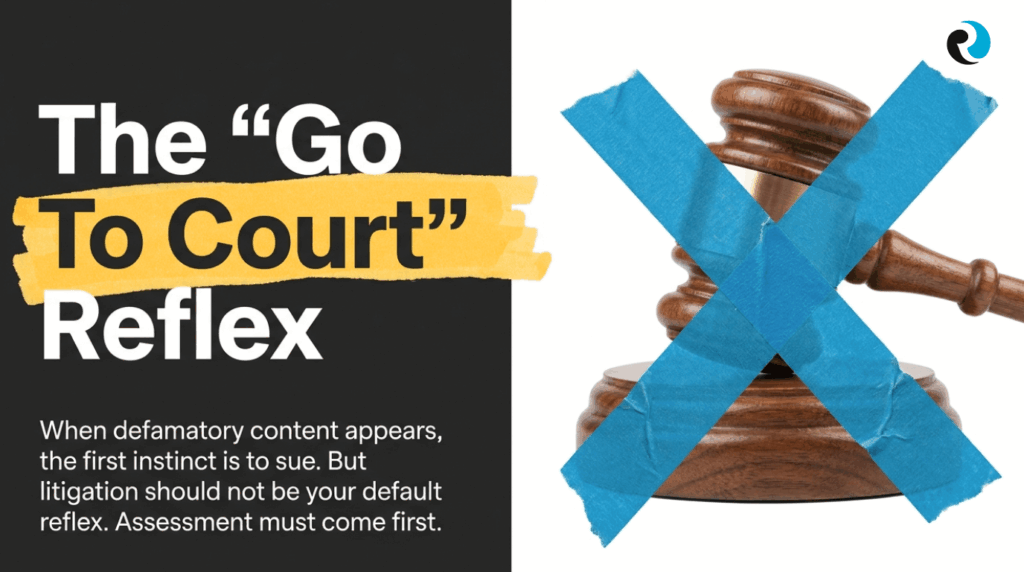
Online defamation does not automatically make litigation the first or best response. A damaging article, post or allegation may justify legal action, but the first operational question is whether the harm can be reduced through evidence, correction, platform procedures, search remediation or reputational containment.
The Trump-BBC dispute shows how corrective action and litigation can follow one another. The BBC acknowledged an editing error and said the programme would not be rebroadcast in that form.
Trump later pursued a federal defamation action, illustrating why the sequence of reputational and legal responses matters.
The dispute remained active in 2026, showing that a non-court remedy can matter without necessarily ending the legal conflict.
For companies, executives and crisis teams, the practical issue is therefore not simply whether content feels defamatory.
The stronger question is whether the allegation can be classified, evidenced and addressed proportionately before formal proceedings become necessary.
“Court action can be necessary, but it should not be the default reflex. The first decision is whether evidence, platform rules, publisher correction or search remediation can reduce the harm without increasing exposure.”
Juan Ricardo Palacio, CEO America ReputationUP
Can online defamation be removed without going to court?
Yes. In some cases, online defamation can be corrected, removed, restricted or made less visible without immediate litigation.
The available route may involve publisher engagement, platform reporting, a legal notice, a privacy request, deindexing, removal of copied material or reputational suppression.
The choice depends on the source, the evidence, the jurisdiction and the remedy being requested.
An online defamation guide is useful at this stage because the first task is to distinguish a false factual allegation from opinion, outdated information, private data, public records or search exposure.
None of these routes is guaranteed. Publishers, platforms and search engines retain their own procedures, and public-interest or freedom-of-expression considerations may limit what can lawfully be changed. The value of a non-court strategy is precision, not certainty.
The first step is not escalation. It is classification.
Broad complaints are usually weaker than precise ones. A credible file should identify the exact URL, the disputed statement, why it is alleged to be false, who is affected and which documents or records support the correction.
It should also separate factual claims from opinion and identify whether the issue is source removal, search visibility or wider reputational damage.
This classification matters because the same publication can contain several different problems at once.
A false statement may support correction or removal, while an outdated but historically accurate reference may call for context or deindexing. A privacy issue may require a different route again.
Trump and the BBC: when correction does not end the dispute
The Trump-BBC dispute shows that non-court remedies and litigation can coexist. The BBC acknowledged that an edit created a misleading impression and chose not to rebroadcast the documentary in that form.
Trump nevertheless pursued a defamation action in the United States, showing that corrective measures do not always prevent formal legal proceedings.
The U.S. District Court record shows that the case remained active in 2026, with discovery disputes and court orders continuing during the year.
That does not establish that defamation occurred; it shows that an editorial correction or withdrawal can reduce one layer of harm while leaving disagreement over liability, damages or adequacy of the remedy unresolved.
For reputation teams, the lesson is procedural: test the least escalatory credible remedy first, preserve the evidence, and keep the legal route available if correction, removal or containment does not resolve the dispute.
Five non-court routes to assess first
Once the allegation has been classified, the response can move through a sequence of non-court options.
The objective is not to avoid litigation at all costs, but to determine whether a narrower remedy can address the problem with less cost, delay or amplification risk.
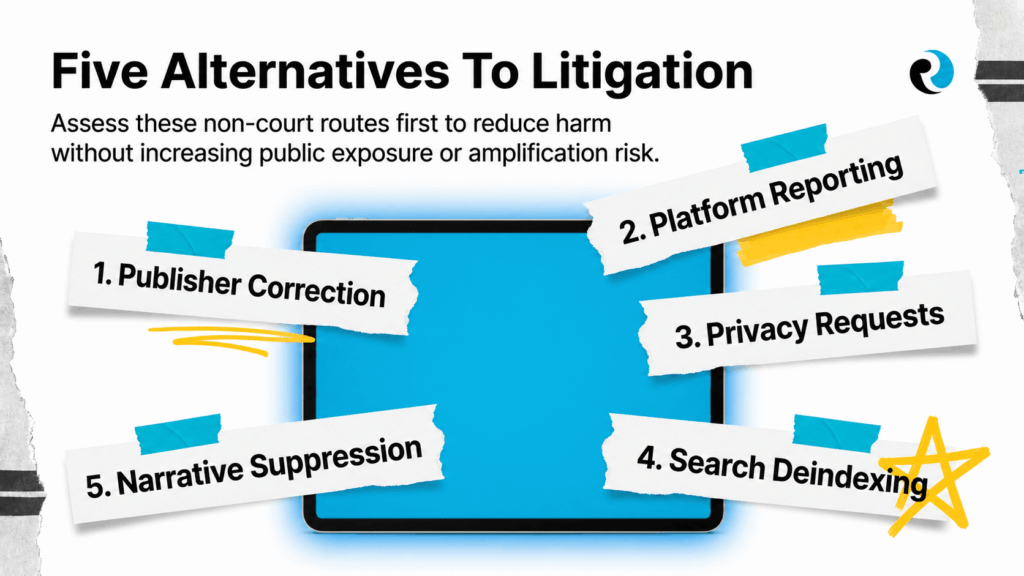
Route 1: Publisher correction or removal
When the material appears in an article, blog post or editorial page, direct publisher engagement may be the most efficient route.
A request can seek correction of a false statement, removal of an unsupported passage, addition of missing context, anonymisation or redaction of unnecessary personal data.
The strongest requests are specific and evidence-based. They identify the exact wording, provide supporting documents and ask for a proportionate remedy.
A general demand to “delete everything” is more likely to trigger resistance, while an aggressive approach can produce follow-up coverage or screenshots that increase visibility.
Route 2: Platform or legal reporting
When the content appears on a platform, forum, social network or Google product, the route may depend on platform rules or legal grounds such as harassment, impersonation, doxxing, threats, copyright infringement or unlawful disclosure.
The report should identify the precise URL, the rule or legal basis and the requested action.
Google’s legal reporting process states that users can report material they believe violates the law or their rights, after which Google may consider blocking, limiting or removing access.
That procedure is separate from contacting the publisher and does not mean every defamation complaint will qualify.
Route 3: Privacy and personal-data requests
Defamatory material may also expose addresses, financial data, identification details, medical information, family information or other sensitive personal data.
In those cases, privacy remedies can sometimes address a specific exposure even when a broader defamation claim is complex.
The European Commission’s explanation of the right to erasure makes clear that deletion is not absolute. Freedom of expression, legal obligations and the exercise of legal claims can limit erasure rights, particularly where executives, media coverage, litigation or matters of legitimate public interest are involved.
Route 4: Deindexing from search results
A page may remain online while becoming less visible in specific searches. Deindexing can help when content is outdated, privacy-invasive or disproportionate.
However, deindexing is not deletion: the original source may remain accessible even if it no longer appears in certain search results.
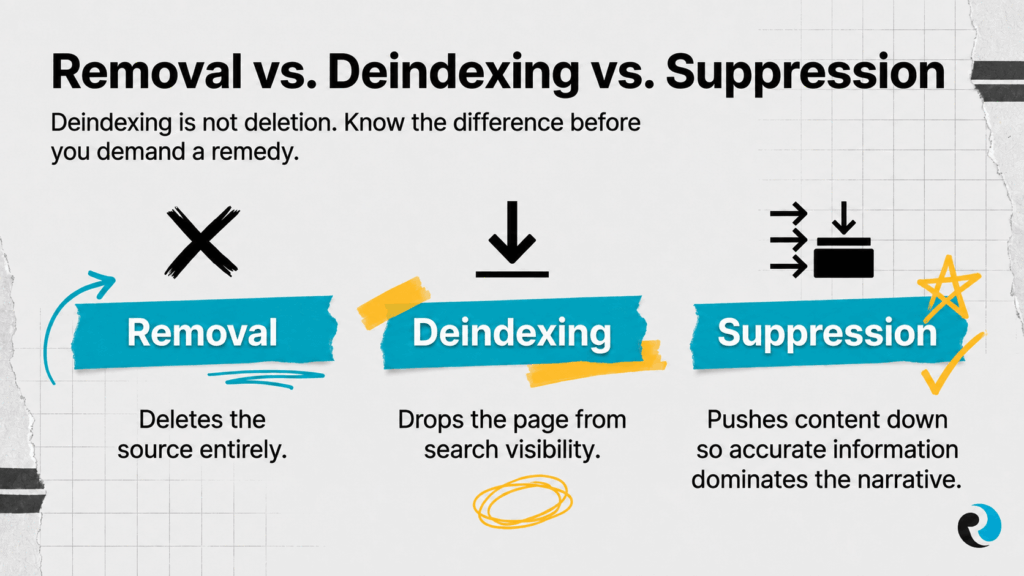
Deindexing may be relevant where the content is outdated, privacy-invasive, legally challengeable or disproportionate in name-based search results.
A remove negative information from Google assessment should therefore distinguish between what can be changed at the source and what can only be limited in search.
Direct URLs, archives, screenshots, copied pages and other search engines may remain accessible even after a successful deindexing request.
Route 5: Suppression and containment
Sometimes the content cannot be removed quickly, a publisher refuses correction or an allegation has already spread across several URLs.
In that situation, suppression can strengthen accurate and authoritative information so that one disputed source does not become the dominant interpretation of a person or company.
Containment addresses the wider consequences: internal stakeholder briefings, media coordination, monitoring copies and reposts, and avoiding public statements that amplify the allegation.
When defamation becomes a broader operational issue, crisis management should be coordinated with the legal and search response rather than treated as a separate exercise.
When court may still be necessary
Non-court routes are useful, but formal proceedings may become necessary when serious allegations persist or publishers refuse to cooperate.
They may also be required to obtain evidence, stop repeated publication or seek damages and injunctive relief.
The same is true when platform procedures fail or the allegation creates material commercial, regulatory or personal-safety consequences.
In those circumstances, litigation may be the proportionate response rather than an escalation failure.
The key decision is sequencing. Court action should follow evidence preservation, legal analysis and an assessment of amplification risk.
Starting with litigation before understanding the source and remedy can make a manageable dispute larger; delaying necessary litigation can allow a damaging allegation to consolidate.
What to do when faced with online defamation
Preserve the evidence early. Capture URLs, screenshots, timestamps, snippets, author details and copied versions before contacting the source.
Online material can change quickly, and the original record may later be essential to legal or platform review.
Define the exact allegation and proof. Separate the disputed factual statement from opinion, context and other material on the page.
Use official records, contracts, filings, correspondence or judgments where available, then match the evidence to the remedy being requested.
Coordinate the response. Publisher engagement, platform reporting, deindexing, suppression and legal action should not operate in isolation.
Legal, reputation and crisis teams need the same evidence and a common assessment of what each intervention could trigger.
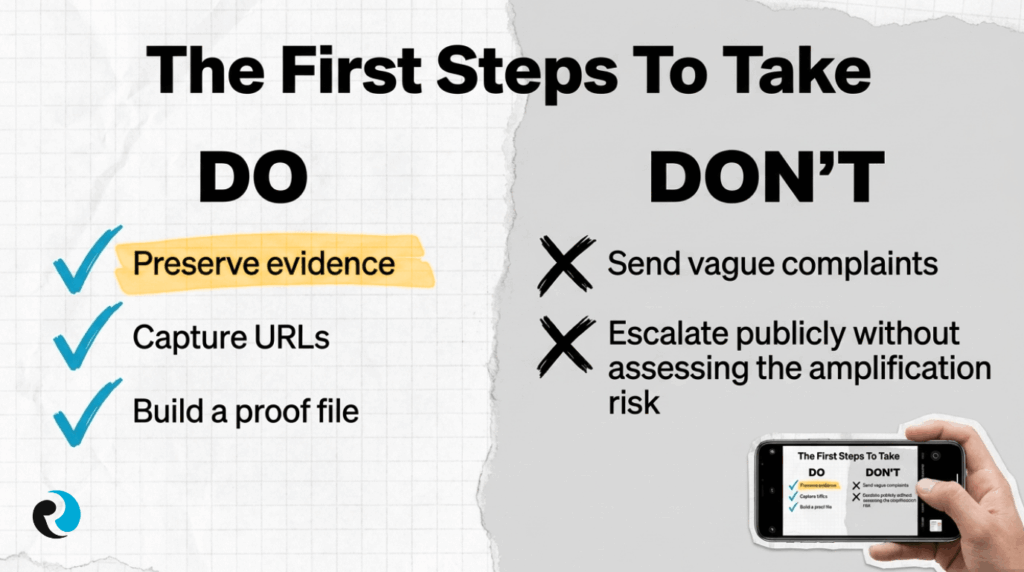
What to avoid
Do not treat every negative statement as defamatory or send vague complaints without exact URLs and evidence.
Opinion and factual allegation are not the same, and confusing them weakens both legal credibility and reputational strategy.
Do not describe deindexing as deletion, promise guaranteed removal or escalate publicly before assessing amplification risk. A forceful response can become part of the story if it creates new coverage, reposts or stakeholder questions.
Finally, do not rely only on suppression where unlawful content should be challenged directly, and do not stop monitoring after one page changes.
Copies, snippets, archives and related search results can preserve the narrative after the first intervention.
The executive decision point
The objective is not to avoid court at all costs. It is to determine whether the harm can first be reduced through a lawful, proportionate and evidence-based route before formal litigation becomes necessary.
Sometimes a publisher will correct the source, a platform will act or a search remedy will reduce visibility.
In other cases, those measures will be incomplete and court proceedings will remain necessary. The responsible strategy keeps both possibilities open.
Online defamation is not managed by volume or speed alone. It is managed through evidence, legal precision, controlled escalation and reputational judgment.