
Every search, prompt, uploaded file, or piece of information published online helps create a digital trail. With artificial intelligence, the issue becomes even more delicate: AI systems can process large amounts of information, connect different sources, and return answers concerning individuals, companies, and professionals.
Discussing online privacy and AI means distinguishing three areas: data provided directly to a service, information already available online, and the way it is processed. The fact that data is accessible on the web does not mean it can be used without limits.
In Europe, the GDPR remains a central reference whenever artificial intelligence processes personal data. Protecting your digital identity therefore means understanding what information is used, where it comes from, and what rights can be exercised.
What data can artificial intelligence use?
An AI system may come into contact with information from different contexts. It all depends on the service, the features used, and the user’s settings.
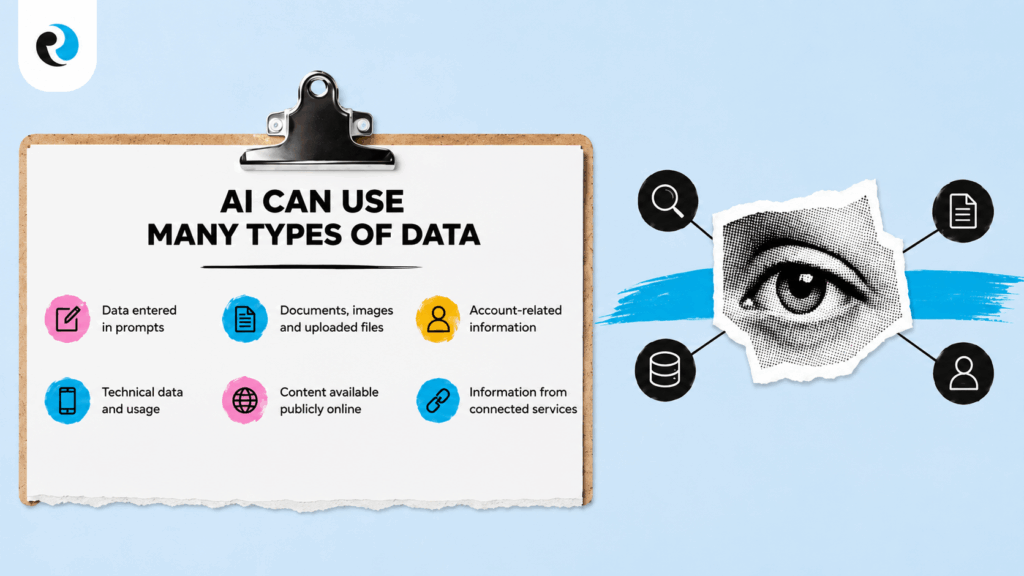
Potentially relevant information includes:
- data entered in prompts
- uploaded documents, images, and files
- information associated with the account
- technical and usage data
- content publicly available online
- information from connected services
This does not mean that every platform collects or uses all of this data in the same way.
The GDPR imposes principles such as lawfulness, transparency, data minimization, and accuracy. Data protection therefore does not disappear when AI enters the picture. The regulatory framework is explained in greater detail in ReputationUP’s GDPR guide.
Public data does not mean freely usable data
One of the most common misunderstandings concerns public data. A name on a website, an old article, a professional profile, or a photograph accessible online may still constitute personal data.
Public availability does not automatically remove data protection rules. The context, purpose of processing, legal basis, and rights of the data subject all matter.
This aspect is particularly important for reputation. Information that was accurate years ago may now be incomplete; decontextualized content may create a distorted image; and data relating to people with the same name may be associated incorrectly.
The quality of the information that makes up a digital identity therefore also affects how automated systems and search engines may represent a person.
ChatGPT and privacy: what happens to conversation data?
When we use a chatbot, we often communicate information that we would not publish on a social network: documents, work-related text, names, business problems, or information about other people.
In its documentation on data handling, OpenAI distinguishes between different ways of using ChatGPT. For consumer services, content may be used to improve models, while users can act through the available controls; Temporary Chats, by contrast, are not used for training.
This distinction is important because it shows that privacy management also depends on the settings and the way the service is used.
Using ChatGPT does not automatically make a conversation public. At the same time, this does not mean that any information should be entered without first assessing whether it is necessary and under what conditions it will be processed.
Companies and professionals should also monitor their reputation on ChatGPT, because the issue concerns both what we provide to AI and what AI returns about us.
Google AI and personal data: it depends on the service
Speaking generically about Google AI can also cause confusion. Search, Gemini, and connected services are not the same and may process different information.
Google explains that using Gemini may involve different types of data depending on the features enabled. The Gemini Apps Privacy Hub mentions prompts, files, and content shared by the user, among other things, as well as information from connected services when certain integrations are used.
This means that assessing the privacy of an AI system requires considering not only the model but the entire ecosystem of services with which it interacts.
The practical consequence is clear: users need to check which service they are using, which connections are active, and what information is actually being shared.
Does the GDPR apply to artificial intelligence?
Yes. When a system processes personal data and the conditions set out in the regulation are met, the GDPR continues to apply to artificial intelligence. The AI Act does not replace data protection law: the two frameworks have different purposes and can operate at the same time.
Principles of particular importance for AI systems include:
- transparency
- purpose limitation
- data minimization
- accuracy
- security
- respect for data subject rights
In 2025, the CNIL, France’s data protection authority, specifically examined how the GDPR applies to artificial intelligence models. The Authority explains that an AI model may fall within personal data rules when it retains information about people that was used during training and that information can be extracted using reasonably available means.
The principle broadens the perspective: data protection concerns not only what a user enters into an AI system, but may also involve the information used during the model’s development.
Privacy and reputation: when data creates the wrong image
Online privacy and reputation are not the same, but they are increasingly connected.
An AI system may return existing information that is outdated, incomplete, or lacking the necessary context. In other cases, it may produce an inaccurate answer or attribute information to a person that does not belong to them.
The reputational problem arises when that representation is considered reliable by the person consulting it. For a manager, professional, or company, an AI-generated answer may contribute to a client’s, partner’s, or stakeholder’s first impression.
It is therefore necessary to monitor not only Google and social media, but also AI reputation, checking which sources artificial intelligence relies on and what information appears in relevant queries.
How to protect your digital identity in the age of AI
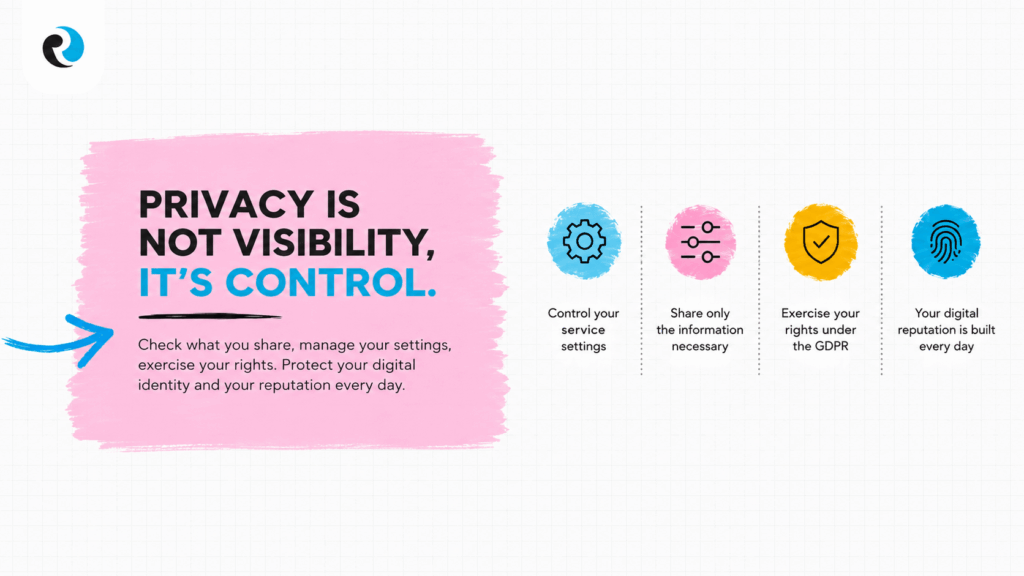
Effective protection begins with understanding your digital exposure. It does not mean removing every piece of personal information from the web, but building an accurate and controllable information environment.
The main actions are:
- Periodically check what personal information is visible online.
- Review the privacy settings of the AI services you use.
- Avoid sensitive or confidential data when it is not necessary.
- Correct inaccurate information at the source whenever possible.
- Exercise the rights provided by law when the relevant conditions are met.
- Monitor how search engines and AI systems represent your name.
When personal information should no longer be processed, it may be necessary to consider a request for the deletion of personal data. The right to erasure is not absolute and must be assessed in light of the conditions and exceptions provided by the GDPR.
The new frontier of reputation is control over information
Artificial intelligence does not make privacy irrelevant. On the contrary, it increases the value of the quality of the data that defines a person online.
Protecting privacy means knowing what information is shared and what rights can be exercised. Protecting reputation also means checking how that information is interpreted, connected, and returned.
Digital identity management therefore requires monitoring sources, correcting inaccurate information, and controlling what Google, ChatGPT, and other AI systems display when someone searches for a name.
Reputation monitoring on ChatGPT thus becomes part of a protection strategy that can no longer stop at traditional search-engine results. In the AI ecosystem, managing your digital presence also means checking the quality of the information from which new representations may take shape.
Frequently asked questions about online privacy and AI
In consumer services, OpenAI may use content to improve models according to the applicable settings. Users can adjust controls concerning the use of conversations for model improvement.
The fact that data is public does not automatically remove personal data protection rules. Processing must be assessed by considering the context, purpose, and legal basis.
Yes. When personal data is processed and the processing falls within its scope, the GDPR continues to apply to AI systems.
In certain circumstances, yes. The GDPR recognizes the right to erasure, but it provides conditions and exceptions. The specific possibility must be assessed on a case-by-case basis.
It is useful to monitor answers associated with your name, review online sources, and act on inaccurate or outdated data. Protecting digital identity today also includes monitoring how AI systems represent people and companies.