
Can political support be manipulated on social media? How to counter coordinated campaigns
A hashtag surges, hundreds of comments appear, and a controversy seems to involve everyone. But who is really driving the conversation? Here is how to identify coordinated campaigns before they influence an election team’s decisions.
Key takeaways
- Manipulation campaigns can artificially amplify political support or opposition. In 2025, Operation Overload produced more than 700 manipulative videos, according to the European External Action Service (EEAS).
- Identifying potential coordinated attacks requires examining profile authenticity, activity synchronisation and amplification networks, without mistaking legitimate dissent for manipulation.
- ReputationUP’s RepUP Guardian Tool detects suspicious behaviour, reconstructs connections between accounts and collects evidence to help assess reputational protection measures.
When a hashtag can influence an election campaign
There are only a few weeks left before the election. A candidate announces a proposal and, within hours, a hashtag opposing their position begins circulating on social media. Hundreds of comments repeat similar accusations. Some profiles share the same videos, while others tag journalists and opinion leaders.
The communications director looks at the figures and must make a quick decision: respond publicly, change the campaign message or wait?
But one question comes before all the others: do those interactions genuinely represent independent people expressing their own opinions?
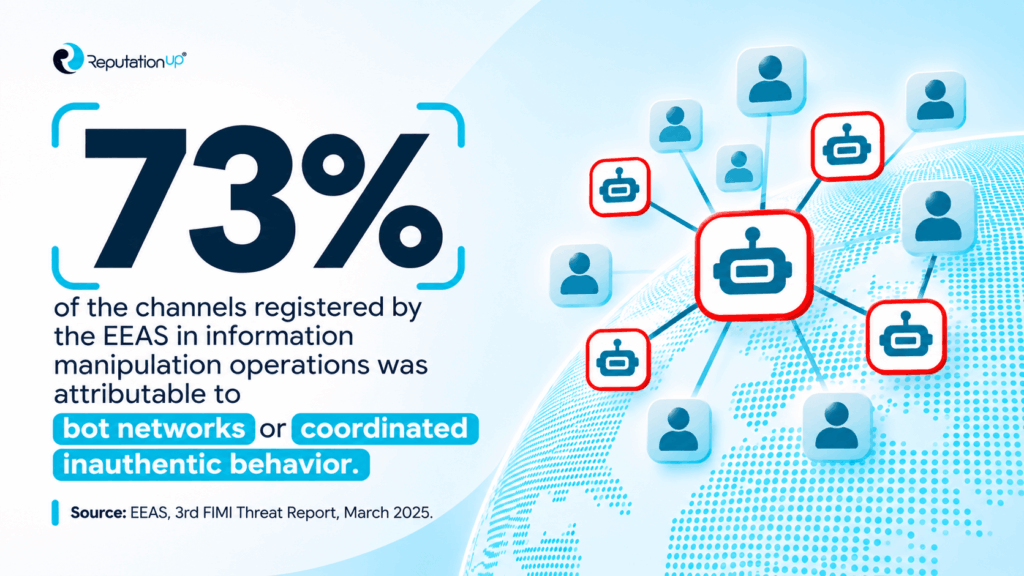
The risk is not merely theoretical. In 2025, Operation Overload, documented by the European External Action Service (EEAS), produced more than 700 videos containing manipulative material, with peaks of up to 20 per day. The operation also affected the context surrounding elections in Moldova, using coordinated distribution mechanisms to amplify misleading narratives.
For a candidate, the consequence is tangible: an artificially amplified controversy can appear far more representative of public opinion than it really is, influencing the team’s decisions.
Determining whether a wave of comments comes from genuine citizens or an organised network, however, requires much more than simply analysing engagement. This is where ReputationUP’s RepUP Guardian Tool comes in.
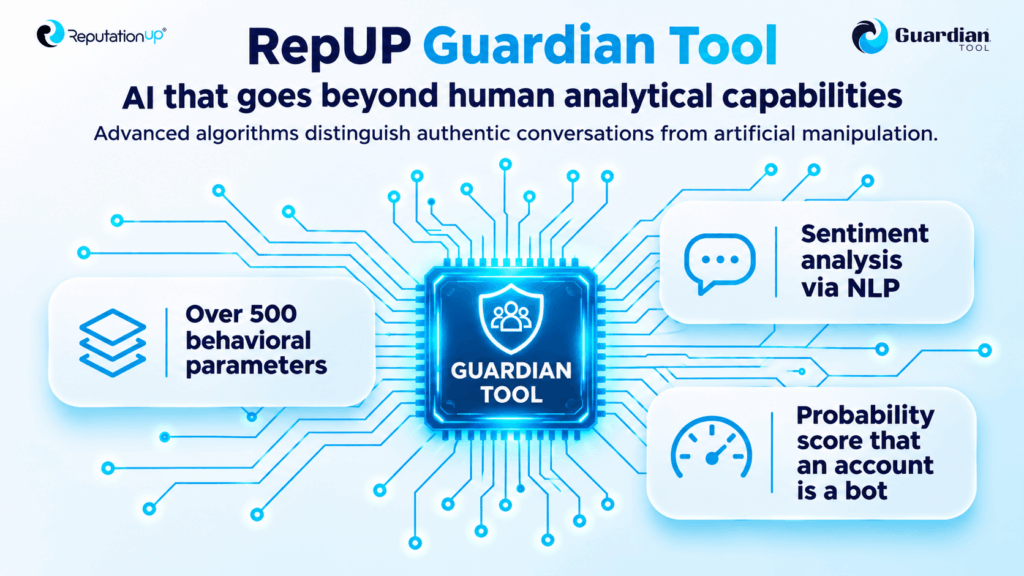
The system examines posting times, recurring messages, hashtags and connections between profiles to detect potential bots, fake accounts and coordinated activity.
But it does more than flag anomalies. RepUP Guardian Tool reconstructs amplification networks, identifies the key profiles driving distribution and organises evidence such as URLs, timestamps and content, helping the team assess the threat and possible responses.
The aim is not to make criticism disappear. It is to prevent an artificial network from being mistaken for the views of voters.
Moldova’s 2025 elections: disinformation enters the campaign
An influence campaign can be timed to strike precisely when there is the least opportunity to verify information.
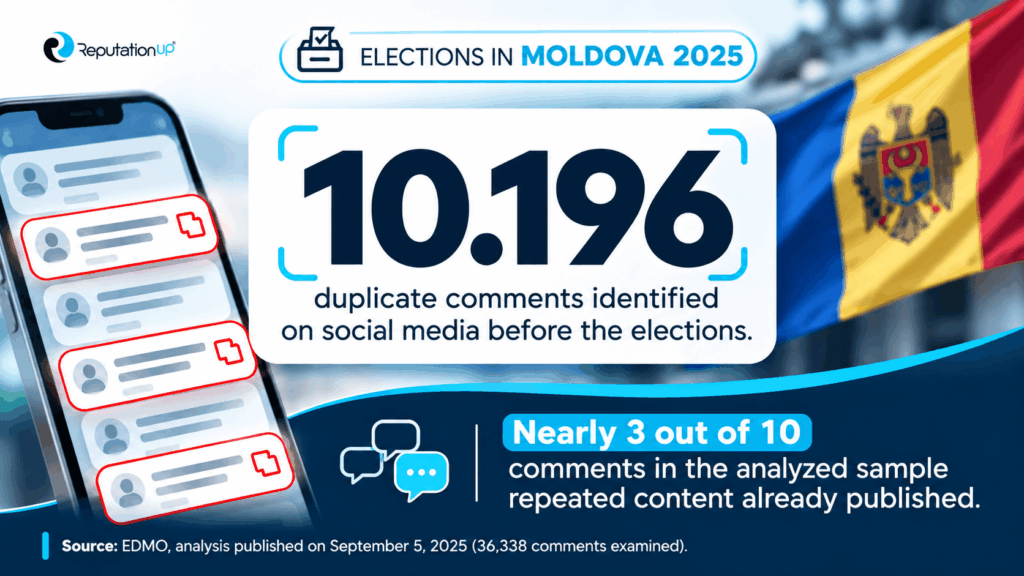
The G7 Rapid Response Mechanism documented information manipulation operations linked to Moldova’s September 2025 parliamentary elections, noting an intensification of activity as voting approached.
These incidents do not prove that the operations changed the election result. They do, however, show how the timing of a narrative’s release can itself be part of the strategy.
Imagine a controversy on the eve of a decisive debate. If the team interprets it as a spontaneous protest, it might change the candidate’s message. If it dismisses it as an artificial attack without evidence, it risks overlooking genuine criticism.
The danger lies in making political decisions based on a distorted picture of online conversation. Understanding how to protect the integrity of political campaigns also means being able to distinguish a genuine reputational crisis from potential manipulation.
Four indicators of a coordinated campaign
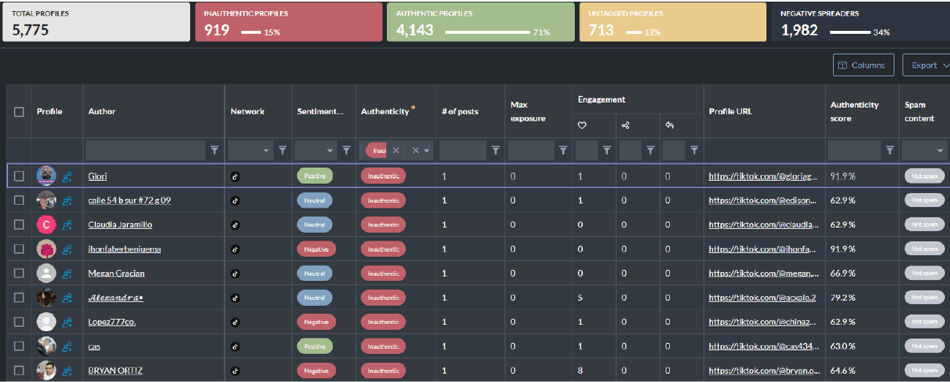
A hundred negative comments in an hour do not necessarily constitute an attack. But if dozens of profiles publish similar messages seconds apart and repeatedly amplify one another, the situation warrants closer examination.
RepUP Guardian Tool analyses:
- Timing: synchronised posts and recurring sequences.
- Messages: systematic repetition of text, hashtags and links.
- Connections: accounts that mention and amplify one another.
- Central nodes: profiles that connect different groups and help content spread.
The analysis can also establish whether content initially shared by suspicious accounts is subsequently picked up by genuine users. A campaign can originate in coordinated activity and then involve real people who share messages without knowing where they came from.
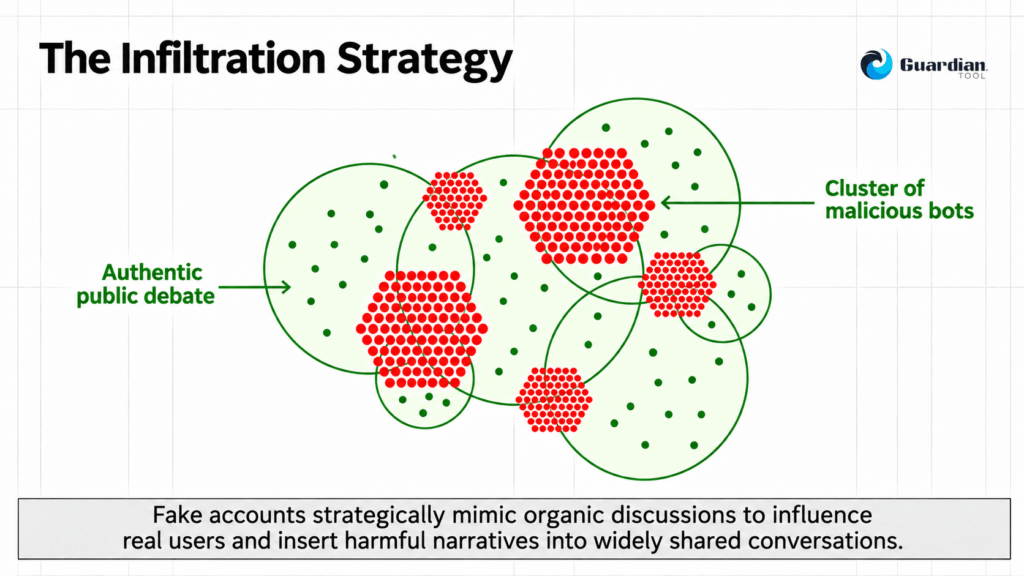
No single indicator proves manipulation. It is the combination of anomalies and their context that warrants further investigation.
“Not everything that goes viral starts spontaneously. But not everything artificially amplified remains confined to a network of fake accounts,” observes Andrea Baggio, CEO of ReputationUP.
A coordinated campaign has been detected: how should you respond?
Recognising suspicious behaviour is only the first step. The real challenge is to intervene without turning a limited controversy into a reputational crisis.
The response depends on the evidence collected:
- Genuine criticism: the candidate should address the substance of the controversy. Accusing users of being bots without evidence can damage credibility.
- Coordinated amplification: RepUP Guardian Tool helps document profiles, connections and content. The evidence enables the team to assess the scale of the activity and identify appropriate measures, avoiding hasty reactions.
- Impersonation or unlawful content: evidence can support reports to platforms, removal requests and technical or legal assessments where the relevant conditions are met.
Where content breaches applicable rules, it may also be useful to explore options for removing harmful links, distinguishing legitimate requests from attempts to suppress genuine criticism.
RepUP Guardian Tool can collect and organise digital evidence, including screenshots, URLs of suspicious content, timestamps and visual representations of account networks, to support detailed, evidence-based reports.
Does artificial intelligence make fake mobilisation more convincing?
Not all influence campaigns rely on easily recognisable bots. Artificial intelligence can make it easier to produce varied content and construct fictitious identities, increasing the risks to political reputation in the age of AI.
In October 2026, OpenAI documented an influence operation that used fake journalistic identities to pitch articles to online publications. The investigation identified nearly 100 articles that had been published or republished, while comments circulated on social media generally attracted limited engagement.
The case highlights a fundamental distinction: producing content, gaining visibility and genuinely influencing people are not the same thing.
Identifying potential manipulation therefore means examining not only what is published, but also who amplifies messages and through which connections.
Protecting political reputation before controversy becomes a crisis
During an election campaign, ignoring coordinated activity can be risky. So can treating genuine protest as an organised attack.
ReputationUP’s RepUP Guardian Tool supports candidates, parties and campaign managers in detecting suspicious activity, reconstructing networks and collecting the evidence needed to assess potential protective measures.
Requesting a specialist analysis with RepUP Guardian Tool makes it possible to investigate the origins of a controversy before taking decisions that could amplify it.
Political support is measured in people, not in the number of accounts repeating the same message.
Frequently asked questions about coordinated campaigns and political opinion manipulation
A sudden increase in comments is not enough. Profile authenticity, posting frequency, repeated messages and connections between accounts must be examined. RepUP Guardian Tool helps identify anomalous behaviour and potential coordinated networks.
It can alter the visibility of a controversy and create an artificial impression of support or opposition. This may shape perceptions of public debate, but it does not automatically demonstrate a change in voting intentions.
Before publicly accusing anyone, it is important to preserve evidence, reconstruct how the content spread and assess reputational risk. Where breaches can be documented, reporting to platforms and technical or legal action may be considered.
Network analysis can identify central profiles, connections and coordinated behaviour, reconstructing how content spreads and is amplified. These findings can reveal potential manipulation strategies even when the identity of those managing the accounts or coordinating the operation cannot be established with certainty.
It is important to detect suspicious activity promptly, distinguish genuine criticism from manipulation and document potential violations. RepUP Guardian Tool supports these checks, helping the team choose proportionate measures without unnecessarily amplifying the controversy.