
One risk. One decision point. One practical framework for executives, founders and legal teams assessing harmful online content. When a damaging article, post, image or search result appears online, the instinctive response is often: “We need it removed.”
But “negative” is not, by itself, a legal basis, a platform-policy violation or a technical reason for deletion.
Some content can be removed from its original source. Other material may qualify for deindexing from particular search results. In some cases, correction or restriction may be the most appropriate option.
Other content may remain lawful and accessible, requiring monitoring, response, suppression or broader reputational containment.
The executive question is therefore not simply whether the content is harmful.
It is:
What characteristic of the content creates a credible basis for action?
What types of negative online content can actually be removed?
Negative online content may be removable when at least one of the following conditions applies:
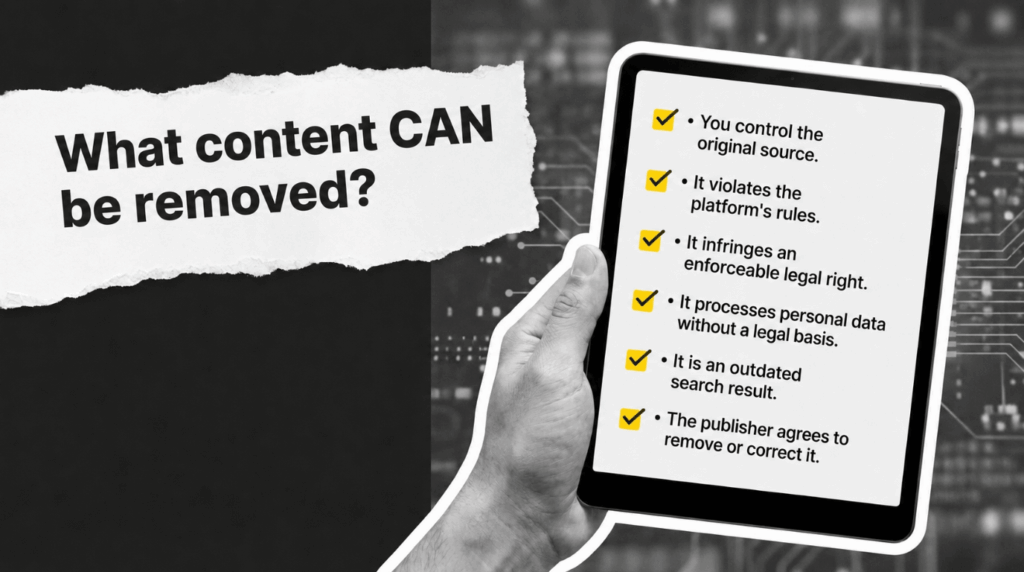
The outcome always depends on the source, jurisdiction, evidence, publication context, public interest and remedy requested.
A removal assessment should never start with the question:
“How damaging is this?”
It should start with:
“Who controls it, what rule or right applies, and what exactly would a successful request remove?”
“Negative content is not automatically removable. The real question is whether the content creates a legal, technical, editorial or platform-based basis for action.”
Juan Ricardo Palacio, CEO America ReputationUP
1. Content published on a source you control
The most technically straightforward category is content hosted on a website, profile, account or repository controlled by the affected organisation.
Depending on the system and the reason for acting, the owner may be able to:
- Delete the page;
- Correct the text;
- Redact personal information;
- Remove an image or document;
- Restrict access;
- Password-protect the material;
- Apply a noindex instruction;
- Redirect or retire the URL.
This does not eliminate every reputational consequence.
Copies, screenshots, quotations, cached versions, social posts and archived references may survive after the original material is changed. Search engines may also need time to recrawl the source and update their results.
The practical distinction is important:
Control over the original source improves the available options, but it does not guarantee complete disappearance from the wider digital environment.
For source-level remediation, ReputationUP’s resource on harmful links removal explains why URL classification, content type and source control must come before any removal strategy.
2. Content that violates platform rules
Content hosted by a third-party platform may be removable when it falls within a defined policy category.
Depending on the platform, potentially actionable material may include:
- Impersonation;
- Threats or targeted harassment;
- Doxxing;
- Exposure of sensitive personal information;
- Non-consensual intimate material;
- Fraudulent or deceptive content;
- Intellectual-property infringement;
- Content connected to compromised accounts;
- Other material expressly prohibited by the platform’s terms.
Google, for example, allows individuals to request the removal of certain private information from Search, including qualifying personally identifiable information and specific categories of sensitive content. The request is reviewed against Google’s criteria; submission does not guarantee acceptance. See Google’s official guidance on removing private information from Google Search.
A platform report should identify:
- The precise URL;
- The relevant policy category;
- Where the violating material appears;
- Who is affected;
- Why the policy applies;
- Supporting screenshots or documentation;
- Whether the content has been replicated elsewhere.
Generic reports such as “this is damaging” or “this is false” are usually weaker than submissions tied to a specific rule and supported by evidence.
3. Unlawful content or material that infringes legal rights
Some negative content may be actionable because it potentially infringes rights relating to:
- Defamation;
- Privacy;
- Confidentiality;
- Copyright;
- Identity misuse;
- Unlawful disclosure of personal data;
- Non-consensual publication;
- Harassment or threats.
However, these categories are highly jurisdiction-dependent.
A statement that is defamatory under one legal framework may be treated differently elsewhere. A publication may contain a mixture of factual claims, protected opinion, public-interest reporting and legally sensitive allegations. A valid copyright complaint must concern protected material and the rights of the complainant, not merely the reputational effect of the publication.
Google maintains a process for reporting content that may violate applicable law or legal rights. Google states that it reviews the material and may consider blocking, limiting or removing access, but the existence of the reporting route does not predetermine the outcome. See Google’s official legal content removal guidance.
Before alleging illegality, legal and reputational teams should separate:
- False factual assertions from opinion;
- Privacy-invasive disclosure from information already lawfully public;
- Copyright infringement from criticism or quotation;
- Outdated information from information that remains relevant;
- Reputational harm from an enforceable legal wrong.
For broader context on this distinction, ReputationUP’s online defamation guide explains why harmful commentary and potentially actionable false statements require different forms of assessment.
4. Personal data that may qualify for erasure
In applicable data-protection contexts, individuals may have the right to request deletion of personal data where the conditions for erasure are met.
Possible grounds may include situations where:
- The data is no longer necessary for its original purpose;
- Consent has been withdrawn and no other basis applies;
- The processing was unlawful;
- A valid objection has been made;
- Deletion is required to comply with a legal obligation.
But the right to erasure is not absolute.
The European Commission explains that organisations may be entitled or required to retain data in circumstances involving freedom of expression, legal obligations or public-interest purposes. See the Commission’s guidance on when personal data must or need not be deleted.
This is why an erasure request should not be framed merely as:
“This information is damaging to me.”
It should explain:
- Which personal data is involved;
- Who is processing it;
- Why the original purpose no longer justifies its continued use;
- Which legal ground supports the request;
- Whether public-interest or freedom-of-expression considerations may apply;
- Whether deletion, anonymisation, correction or restricted processing is the proportionate remedy.
5. Search results that may qualify for deindexing
A search result can sometimes be delisted even when the original page remains online.
This is deindexing, not source removal.
A successful deindexing request may affect specific:
- URLs;
- Name-based queries;
- Search-engine services;
- Jurisdictions or geographic versions;
- Categories of personal information.
It does not necessarily remove the original article, document or page.
The content may still be found through:
- Its direct URL;
- The publisher’s website;
- Another search engine;
- Social media;
- Archives;
- Copied versions;
- Searches using different terms.
This distinction matters because reputational teams often report the outcome incorrectly.
Removal from search visibility is not the same as deletion from the internet.
6. Outdated search remnants after the source has changed
Sometimes the publisher has already removed or corrected the content, but the search result still displays an outdated title, snippet, image or cached reference.
This is not always a dispute about the legality of the original publication.
It may be a question of synchronisation between the source and the search index.
In such circumstances, the appropriate action may involve:
- Confirming that the original page has been removed or updated;
- Requesting a refresh of outdated search information;
- Checking whether duplicate URLs remain;
- Identifying syndicated or copied versions;
- Verifying whether images are hosted separately;
- Monitoring whether search snippets update after recrawling.
The evidence must show what has changed at the source and what remains inaccurately visible.
7. Publisher-approved corrections, redactions and removals
Not every successful outcome results from a court order or platform procedure.
A publisher may voluntarily agree to:
- Correct a factual error;
- Update an outdated article;
- Add the outcome of subsequent proceedings;
- Redact unnecessary personal information;
- Anonymise an individual;
- Remove an obsolete document;
- Add material context;
- Delete content that breaches its own editorial standards.
This route requires judgment.
An aggressive or poorly substantiated approach can produce resistance, renewed editorial attention or further publication. A precise request supported by documentary evidence is more credible than a general demand based only on reputational impact.
Before contacting a publisher, teams should determine:
- Which statement is inaccurate or incomplete;
- What evidence proves the point;
- Whether correction would be sufficient;
- Whether the public-interest context has changed;
- Whether the requested remedy is proportionate;
- What escalation risk the contact may create.
What is usually not removable simply because it is negative?
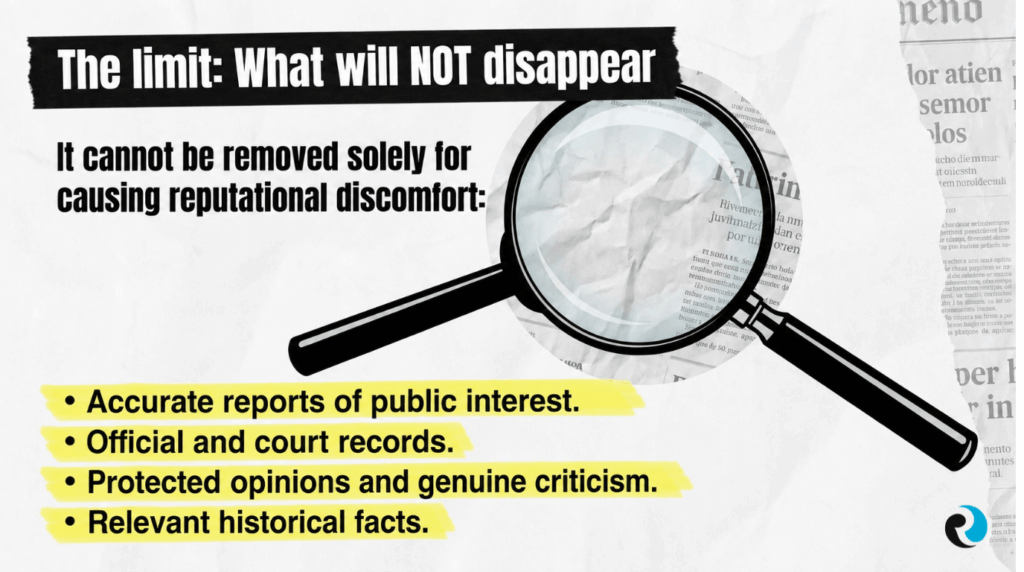
The following types of material may be difficult or impossible to remove solely because they cause reputational discomfort:
- Accurate reporting on matters of continuing public interest;
- Lawfully published public records;
- Official regulatory or judicial information;
- Protected opinion;
- Genuine criticism;
- Truthful accounts of professional or commercial disputes;
- Historical information that remains relevant;
- Allegations being reported as allegations rather than established facts;
- Content that does not breach the host platform’s policies;
- Material published in a jurisdiction where the claimed right does not apply.
This does not mean that no action is available.
The response might involve:
- Correcting factual inaccuracies;
- Adding context;
- Publishing an authoritative response;
- Challenging duplicates;
- Requesting deindexing where justified;
- Monitoring continued exposure;
- Strengthening the accurate public record;
- Using suppression where source removal is unavailable.
The key is not to label lawful but damaging content as automatically removable.
That weakens legal credibility and can create additional reputational risk.
Removal, deindexing and suppression: define the outcome before acting
Executives should require teams and advisers to specify the intended outcome.
Removal
The content is deleted, altered, redacted or made inaccessible at the original source.
Deindexing
A search engine limits or removes the URL from qualifying search results, but the source may remain online.
Suppression
The negative source remains available, but its prominence and influence are reduced through stronger, accurate and more authoritative content.
Correction
The source remains online but is amended to address inaccuracies, omissions or outdated information.
Containment
The organisation limits further spread, monitors new copies, manages stakeholders and prevents the harmful narrative from becoming the dominant interpretation.
These remedies can operate together.
For example, one defamatory post might be removed from a platform, copied versions might require separate reporting, an outdated search result might require deindexing, and the wider narrative might still require reputational containment.
For additional context on negative search visibility, ReputationUP’s guide on how to remove Google search results is useful because it distinguishes between the publication layer and the search-result layer.
The five-question removability test
Before taking action, executive and legal teams should answer five questions.
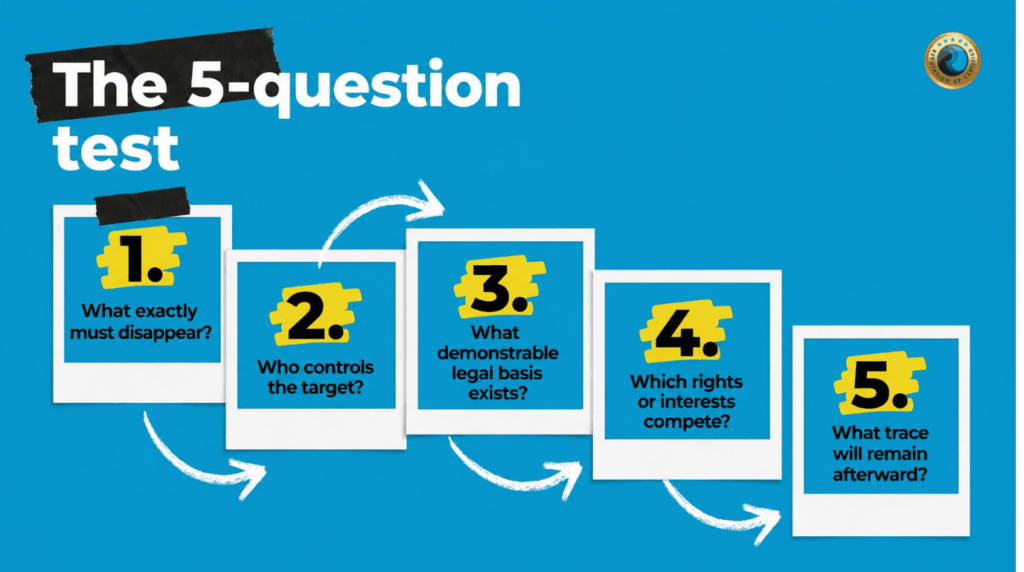
1. What exactly should disappear?
Is the objective to remove the original page, a sentence, an image, a document, a search result, an autocomplete association or a copied version?
Without a defined target, “removal” becomes an ambiguous promise.
2. Who controls the target?
Is it controlled by the organisation, a publisher, a platform, a search engine, a regulator, a court, a data broker, an anonymous website or an archive?
Each controller requires a different route.
3. What enforceable basis exists?
Is there evidence of illegality, policy violation, privacy infringement, copyright infringement, impersonation, doxxing, inaccuracy or obsolete personal-data processing?
Reputational harm alone may not be enough.
4. What competing rights or interests apply?
Could the publisher rely on freedom of expression, public interest, legal reporting obligations, historical relevance or an official-record function?
Ignoring these considerations produces unrealistic assessments.
5. What will remain after a successful action?
Will copies, screenshots, indexed snippets, archives, social posts or AI-generated references remain accessible?
A successful request against one URL is not necessarily the end of the reputational problem.
Why this matters in AI-mediated search
Online reputation is increasingly interpreted through both traditional search results and generative search experiences.
The reasonable reputational inference is that a harmful source which remains public, crawlable and authoritative may continue to influence the wider information environment even after its position in classic search results changes.
This does not mean that every negative URL will appear in an AI-generated answer.
It means that reputation remediation should consider:
- What remains accessible;
- Which sources carry authority;
- Whether accurate countervailing information exists;
- Whether the entity is consistently described across trusted sources;
- Whether the intervention addressed only one URL or the underlying narrative.
A removal decision is therefore not complete until the residual exposure has been assessed.
What to do
An effective response requires evidence, careful classification and a proportionate strategy. Each step should reduce harm without creating unnecessary visibility or escalation.
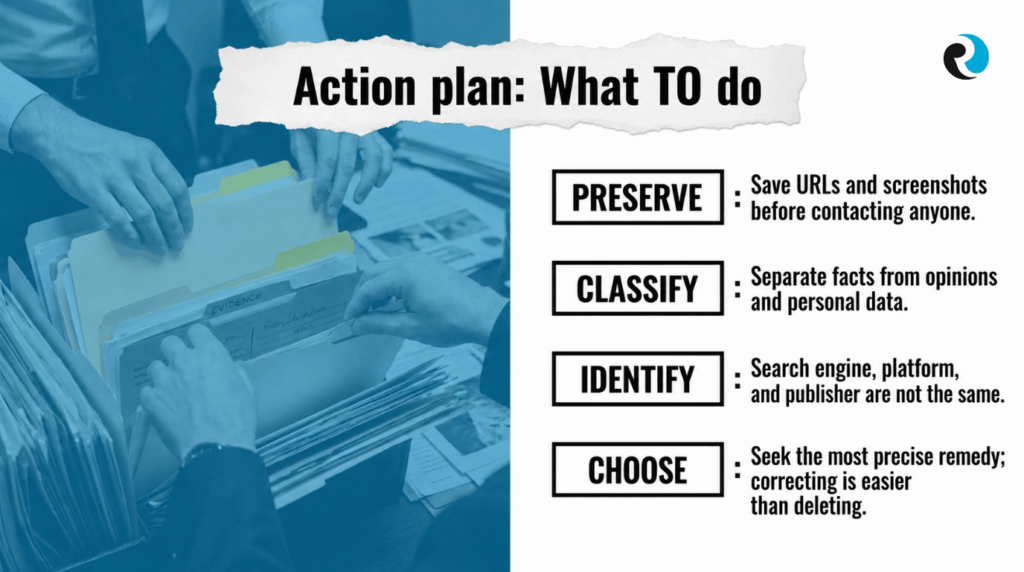
Assess escalation risk.
Consider whether contact could create renewed coverage, screenshots, reposting or adversarial attention.
Monitor the aftermath.
Check duplicates, archives, snippets, social references and AI-mediated answers after the intervention.
The process does not end with removal or correction. Ongoing monitoring is essential to detect copies, residual visibility and new reputational risks.
What to avoid
Do not promise guaranteed removal.
Damaging content should not be presented as automatically unlawful.
Removal from Google Search is not the same as deletion from the internet.
Legal or platform complaints should have a specific basis.
Threatening publishers before assessing the consequences can be counterproductive.
Suppression should not replace a challenge to unlawful content when removal is viable.
Monitoring should continue even after one URL disappears.
A remedy available in one jurisdiction should not be assumed to apply globally.
The executive decision point
The decisive question is not:
“Is this content negative?”
It is:
“Is there a defensible route to remove the source, limit its search visibility, correct its substance or contain its reputational effect?”
Negative online content is most likely to be removable when ownership, platform rules, legal rights, data-protection grounds or publisher cooperation create a concrete basis for action.
Where no such basis exists, the responsible strategy is not to make a stronger promise.
It is to choose a different remedy.
Digital reputation is protected through evidence, classification and proportional action — not through assumptions about what the internet can be forced to forget.