
An apology should be the first step towards regaining trust. Yet during a reputational crisis, a public statement can have the opposite effect: fuelling criticism, attracting more media attention and further undermining a company’s credibility. That is why effective crisis management is essential to prevent a misguided response from making the situation worse.
The problem is not necessarily apologising, but how, when and why it is done. A message perceived as opportunistic, evasive or inconsistent with subsequent actions risks turning an initial mistake into a wider controversy.
To understand why some apologies work and others fail, we need to consider an often overlooked point: trust is rebuilt not through a statement, but through accountability demonstrated over time.

Why can public apologies make a reputational crisis worse?
When an organisation makes a mistake, the public does not judge only what happened. It also observes how the company responds, acknowledges its responsibilities and deals with the consequences.
Apologies therefore become an integral part of the crisis response, but they can backfire when they seem intended solely to silence criticism.
A generic statement, for example, can give the impression that the company has failed to grasp the seriousness of the incident. Similarly, excessive justifications may be interpreted as an attempt to downplay its responsibilities.
The risk increases when there is a clear gap between what the organisation says and what it actually does.
In these cases, the original crisis is compounded by a second issue: the credibility of the response.
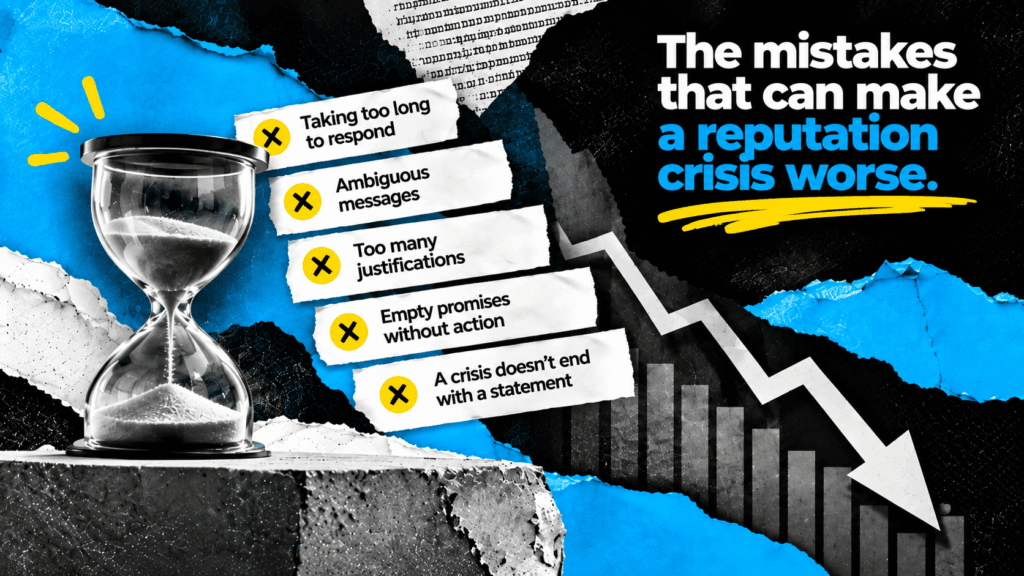
Five mistakes that make public apologies ineffective
There is no universal formula for apologising. However, certain behaviours can make it harder to regain trust.
1. Responding too late. Prolonged silence, especially when the problem is already public knowledge, can create a perception of indifference. This does not mean responding without checking the facts, but promptly communicating what is known and what investigations are underway.
2. Using ambiguous language. Expressions that shift the focus to the public’s reactions, rather than the behaviour being criticised, risk sounding like a failure to take responsibility.
3. Seeking justifications before acknowledging the problem. Explaining the context is important, but doing so too early can appear to be an attempt to minimise the consequences.
4. Promising change without specifying concrete actions. Vague commitments that are difficult to verify can increase scepticism, especially when the organisation has faced similar controversies before.
5. Treating an apology as the end of the crisis. Communication is only one stage of the process. Without follow-up action, the statement loses credibility.
These mistakes affect corporate reputation because they influence perceptions of the organisation’s ability to take responsibility and honour its commitments.
Starbucks Korea: when apologies fail to stop the controversy
A recent case illustrates how difficult it can be to regain trust after a communication misstep.
In May 2026, Starbucks Korea launched a promotion called Tank Day on the anniversary of the 1980 Gwangju democratic uprising, which was violently suppressed by South Korea’s military authorities.
The campaign drew strong criticism over references considered offensive to the historical memory of the event.
The chairman of the Shinsegae Group, which is linked to Starbucks’ South Korean operator, publicly apologised. However, as reported by the Yonhap News Agency, some associations deemed the explanations and announced measures insufficient.
The controversy had tangible consequences: according to figures reported by Yonhap, the weekly volume of payments at Starbucks Korea fell by 26.3% compared with the previous week. The figure shows the commercial impact recorded after the controversy, without proving that the decline was caused by the apologies.
The episode highlights a fundamental point: acknowledging a mistake does not automatically restore trust, especially when the public considers subsequent action inadequate.
The role of language in crisis communication
During a controversy, every word helps shape perceptions of the organisation.
Effective communication should distinguish between three elements: acknowledgement of what happened, responsibility and corrective action.
Acknowledgement means describing the problem without distorting its scale. Taking responsibility requires clarifying the organisation’s role, while avoiding automatically blaming external parties.
Setting out corrective action means explaining what will change and how it can be verified.
The language must be proportionate to the seriousness of the incident. An excessively formal tone can seem distant, while overly emotional communication risks appearing contrived.
This is where crisis management plays a strategic role: it involves not just choosing words, but coordinating decisions, responsibilities and communications.
The aim should not be to secure immediate forgiveness, but to demonstrate that the organisation understands the problem and intends to address it.
Why does trust not automatically return after an apology?
Trust is the result of experiences, expectations and behaviours observed over time. A single statement, even a sincere one, is unlikely to change an established negative judgement on its own.
The 2026 Edelman Trust Barometer describes a climate of mistrust: seven in ten people say they are hesitant or unwilling to trust those who do not share their values or sources of information.
The finding does not directly measure the effectiveness of public apologies, but it helps explain how difficult it is to rebuild relationships of trust.
When the public starts from a position of scepticism, statements may be interpreted as tools for protecting the organisation’s image.
That is why the credibility of an apology also depends on the reputation built before the crisis.

How to handle apologies without fuelling further controversy
Before publishing a statement, it is necessary to understand the nature of the controversy, identify those involved and assess the public’s expectations.
The response should be based on verified facts, avoiding both unjustified silence and premature statements.
Once the problem has been acknowledged, it is essential to define concrete actions, internal responsibilities and procedures for providing updates.
The work does not end when the statement is published. It is necessary to observe how the public conversation evolves, check whether new issues emerge and ensure consistency between statements and behaviour.
Monitoring of the reputation can help identify the main reactions, understand which issues generate mistrust and assess how the crisis is evolving.
Neither apologising nor avoiding an apology is a solution that works in every situation. The choice must depend on actual responsibilities and the consequences of what happened.
Overcoming a reputational crisis through action
Apologies can be an important step, but they are not a solution on their own.
The duration of a reputational crisis also depends on the organisation’s ability to address the causes of the problem, honour its commitments and demonstrate verifiable change.
A well-worded statement can help restore dialogue. An inconsistent response, however, risks turning the initial mistake into a longer-lasting crisis of trust.
The true measure of an apology’s effectiveness is not the attention it receives when published, but the credibility the organisation manages to rebuild afterwards.
FAQs on reputational crises and public apologies
No. It depends on the nature of what happened and the actual responsibilities involved. It is essential to verify the facts before choosing the most appropriate response.
When they appear evasive, late, insincere or inconsistent with the organisation’s subsequent actions.
It is important to communicate promptly, without making unverified statements. The problem can be acknowledged and the public kept informed while investigations are underway.
Through accountability, concrete action, transparency and consistency over time. Apologies can support the process, but they cannot replace action.
There is no fixed duration. It depends on the seriousness of the incident, the spread of information, the organisation’s response and its ability to rebuild trust.