
Reputation SEO is n’t about simply moving a page up a few positions and calling it a day. Its true value lies in organizing a brand’s digital presence so that Google can find, understand, and display it with greater clarity, consistency, and credibility. When this work is done well, the brand not only gains visibility but also gains thematic authority, narrative control, and responsiveness.
Google continues to explain that its AI features within Search are based on general SEO principles and that there is no “parallel” optimization for AI Overviews or AI Mode. What does exist is a greater demand for usability, clarity, and structure. It also makes clear that pages that want to rank well in Search must be crawlable, indexable, and technically sound.
It is not enough to simply show up: you have to show up with authority.
Many brands still assess their digital reputation with an overly simplistic question: “Does my website rank highly?” That approach is no longer sufficient. Users don’t just see the homepage. They see headlines, snippets, associated profiles, secondary pages, third-party results, and, increasingly, summarized answers from multiple sources.
Therefore, a serious strategy isn’t limited to simply “defending the brand name” on Google. What it does is build an ecosystem of results capable of explaining the brand better than any isolated element. That’s where reputational SEO ceases to be a mere technical discipline and becomes a matter of reputational architecture.
First level: asset architecture and intent hierarchy
One of the foundations of advanced reputation SEO is understanding that not all pages should do the same thing. Some exist to attract business. Others should establish an official position. Still others should reinforce leadership, address concerns, or build trust.
Google continues to maintain in its documentation that the logical structure of the site, clarity of content, and technical eligibility remain the basis of performance in Search.
In terms of reputation, that means something very concrete: if the company’s assets are poorly distributed or compete with each other, the brand loses precision even before losing positions.
A solid reputational strategy requires that each asset fulfills a clear function. When that hierarchy doesn’t exist, the public perception of the brand is weakened.
Second level: entity, semantics, and consistency
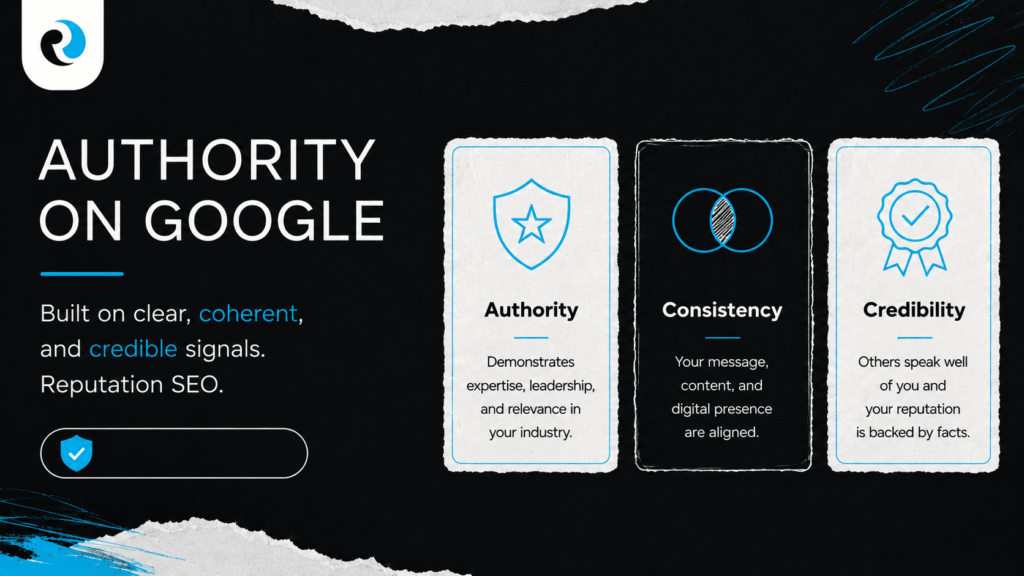
High-level reputation SEO doesn’t just focus on keywords. It focuses on brand identity. In other words, it helps Google understand more clearly who the brand is, what topics it’s an expert on, who speaks on its behalf, and what content deserves to be considered a reference.
This point becomes crucial in an environment where the search engine no longer just ranks links, but can also summarize, associate, and prioritize information. If a company presents inconsistent biographies, overlapping messages, or assets without a well-defined function, Google has fewer clear signals.
The problem doesn’t always result in a sharp drop. Sometimes it manifests in a more subtle and damaging way: a fragmented reading that weakens trust even if the brand continues to appear in the results.
Advanced techniques that do improve search engine reputation
Model sensitive searches before they do harm
The most mature brands don’t wait for a critical search query to appear before they start working on it. They proactively identify which queries could affect perception and create assets capable of answering them with context, precision, and authority. It’s not about filling the site with defensive content, but about preventing gaps that others can then fill.
Treat the snippet as a reputational space
In digital reputation, the snippet matters as much as the position. An official result can lose clicks not because it ranks poorly, but because it’s poorly presented. This is where a particularly useful metric comes in: the official CTR.
The Search Console performance report remains a useful tool for reviewing clicks, impressions, CTR, and average position. But, from a reputational standpoint, its value lies not only in the metrics themselves: it also helps detect whether official assets are gaining visibility with explanatory power or if they continue to appear without generating sufficient trust.
Consolidate subject matter authority, not just volume
In 2025, Google reinforced its position that the most effective content in its AI experiences is that which provides specific, useful, and unique value, not generic or mass-produced content. This benefits brands that publish with expert judgment and disadvantages those that produce a lot but say little.
In terms of reputation, the consequence is very clear: publishing less and explaining better is usually more profitable than publishing a lot without providing context . One authoritative piece of content can better protect a brand than ten superficial pieces.
Expanding observation beyond the classic SERP
Reputation is no longer solely determined by the traditional search results page. How a brand is summarized or mentioned in generative and conversational environments also matters. Therefore, an advanced strategy must consider not only rankings but also how public information circulates, is understood, and is synthesized—something that this also addresses. Reputation monitoring in ChatGPT, in a context where the The European Commission, through the Digital Services Act, has reinforced the requirement for a safer and more reliable digital environment.
What mistakes sabotage a strategy even if the SEO seems correct
There are brands with high traffic that still lack reputational control. This usually happens due to four very specific mistakes.
The first mistake is focusing solely on generic keywords and neglecting branded searches or queries with context.
The second is leaving official assets without a clear function within the reputation ecosystem.
The third is publishing a lot but explaining little.
And the fourth is only measuring rankings, without analyzing whether the results generate clicks, build trust, and provide clear explanations.
Here’s one of the least understood keys to reputation SEO: a brand can gain visibility without gaining authority. And if that happens, the improvement is more apparent than real. This same fragility becomes even more delicate when a negative perception begins to solidify in generative environments, as explained How to remove a negative reputation on ChatGPT.
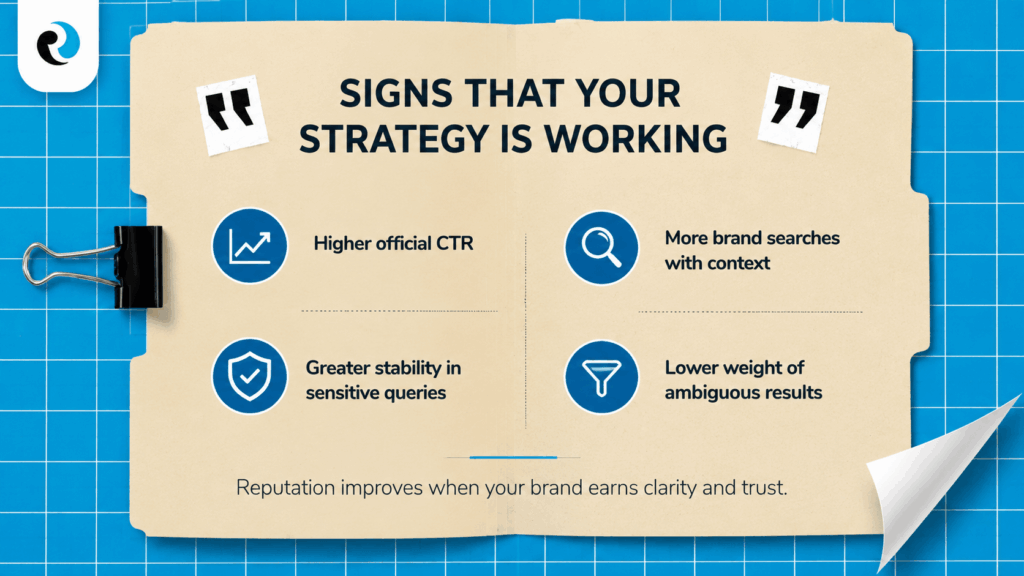
How to tell if the strategy is working
Reputational improvement isn’t measured solely by a higher ranking. It’s measured when the brand gains visible consistency, better explanatory power, and greater clickable appeal in the searches that truly matter.
The most useful signs are usually these:
- Growth in brand searches with better context
- Increase in CTR on official assets
- Improved performance of institutional or service pages
- Less weight given to ambiguous results
- Greater stability in sensitive queries
Search Console remains an essential tool for monitoring this evolution. The performance report itself allows you to review which queries drive traffic, which pages appear most frequently, and which have a weaker CTR—something especially useful when the goal is not only to gain traffic but also to build visible authority.
Conclusion
reputation SEO is n’t about indiscriminately pushing results. It’s about giving Google better signals, better assets, and better context so that the brand can be found, understood, and chosen more effectively.
Brands that master this logic don’t rely on a single page or a single position. They rely on a coherent architecture , authoritative content , well-distributed semantic signals , and a strategy capable of reducing ambiguity in relevant searches. That’s where a brand stops simply reacting and truly begins to influence how it’s interpreted.
Frequently Asked Questions (FAQ)
Traditional SEO typically prioritizes traffic, keywords, and conversions. Reputation SEO adds another layer: protecting the brand’s digital identity, strengthening critical assets, and improving how the entity is perceived in search engines.
No. In reputation management, a single page never holds the entire perception. A network of assets with different functions is needed: institutional, semantic, explanatory, and authoritative.
The requirements change, but not the fundamentals. Google explains that the basics of SEO remain valid for AI Overviews and AI Mode, but that usefulness, clarity, and structure carry even more weight when a brand can be summarized or contextualized within Search.
Both are important, but the official CTR can be even more revealing. If an official asset appears frequently but receives few clicks, the problem is likely not just ranking, but also presentation, trustworthiness, or a lack of clarity.
ReputationUP can work on the diagnosis of the results ecosystem , the prioritization of critical assets , semantic optimization , the strengthening of owned assets , editorial strategy and control of the visible context so that the brand gains solidity in search engines and reduces ambiguity in sensitive queries.