
Reputational communication has entered a phase where it is no longer enough to influence public perception: now it is necessary to influence the systems that construct that perception.
PR in the age of AI is the set of actions aimed at structuring coherent, verifiable and understandable information for systems that interpret and synthesize digital reputation.
For decades, public relations operated under a relatively stable logic: generate visibility, position messages, and consolidate a presence in media and search engines. However, this model has been disrupted by a new intermediary that not only distributes information but also interprets it: artificial intelligence.
By 2026, reputation will no longer be limited to what is published or where it is published. It will be increasingly defined by how AI models process, connect, and synthesize that information into a single narrative .
PR in the age of AI does not represent an incremental evolution of communication. It represents a paradigm shift.
From visibility to interpretation: the new axis of reputation
The most significant shift is not technological, but conceptual. Reputation no longer depends exclusively on media exposure but rather on its ability to be accurately interpreted by generative systems .
When a user searches for a brand, company, or executive in an artificial intelligence model today , they don’t receive a list of results: they receive a summary . This summary is not neutral. It is the result of a process of data selection, prioritization, and interpretation.
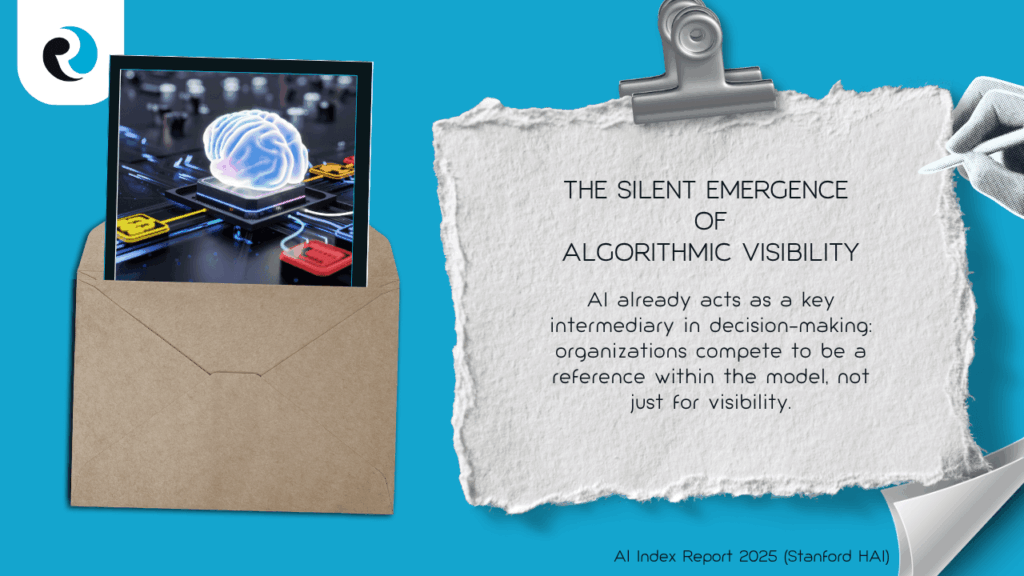
The Stanford HAI AI Index Report 2025 confirms that artificial intelligence systems are being rapidly integrated into real-world decision-making and analysis processes, establishing themselves as top-tier information intermediaries.
In this environment, reputation ceases to be a sum of impacts and becomes a narrative structure that must withstand algorithmic synthesis processes , which reinforces the importance of asolid and structured online reputation management.
Strategic PR in the age of AI: from dissemination to architecture
The direct consequence of this change is that communication ceases to be an activity focused on dissemination and becomes an exercise in narrative architecture .
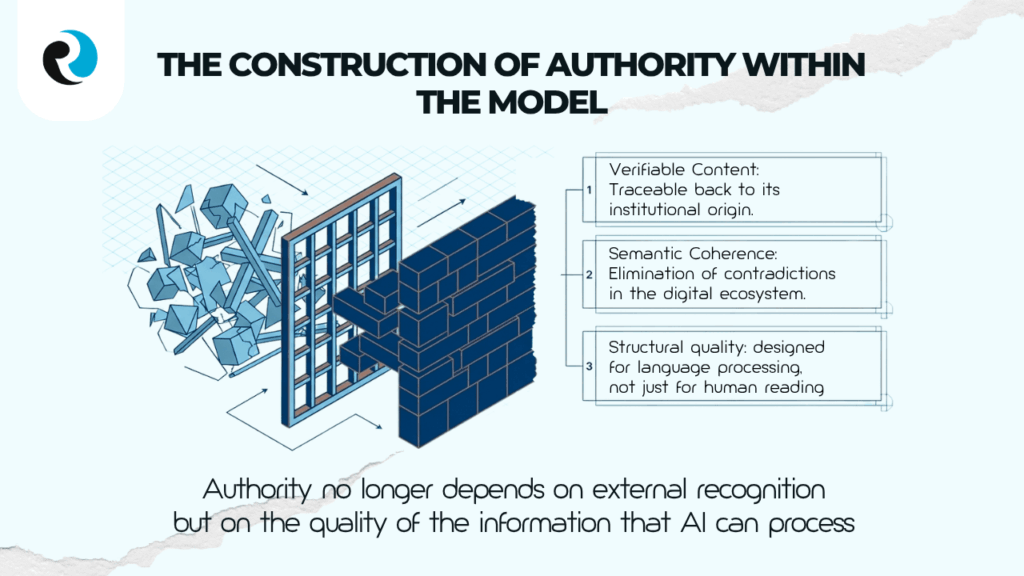
It’s not about communicating more, but about communicating better, using entirely different criteria. This new approach is based on four key pillars: conceptual precision, coherence between sources, continuity over time, and verifiability.
The European Commission has stated in its strategy on artificial intelligence that advanced systems require reliable, structured and transparent information ecosystems to operate correctly.
This implies that the quality of communication not only affects public perception, but also the way in which AI systems reconstruct an organization’s identity.
Online reputation management is consolidating as a digital governance model, aimed at structuring information in a coherent, traceable and understandable way for artificial intelligence systems.
Algorithmic visibility as a new competitive terrain
One of the quietest, yet most profound, changes is the emergence of a new form of visibility: algorithmic visibility.
Organizations no longer compete solely for media space or search rankings. They compete to be a valid reference within artificial intelligence models.
This introduces an additional requirement: the information must be understandable not only to humans, but also to systems that process language, context, and semantic relationships.
Today, reputation management allows you to structure your digital presence in a way that is consistent with how artificial intelligence interprets information.
Reputation, therefore, ceases to be a reflection and becomes a structured asset that must be deliberately designed.
Regulation, trust, and information responsibility
The evolution of communication cannot be separated from its accompanying regulatory framework. The European Union has established a clear approach: artificial intelligence must be developed under principles of transparency, traceability, and accountability.
The Council of the European Union He has insisted that AI systems must be safe, reliable, and aligned with the public interest . Disinformation and the loss of trust have become major global risks, reinforcing the role of information as a critical asset in reputation management and decision-making.
In this context, corporate communication ceases to be solely strategic and becomes structurally necessary from a regulatory point of view.
The new risk: unmanaged narrative
If the new environment is defined by algorithmic interpretation, the main risk is not classic disinformation, but the automatic reconstruction of incomplete identities.
When available information is fragmented, contradictory, or outdated, AI models don’t stop: they interpret. And in that process, they can consolidate narratives that don’t reflect reality, but which acquire legitimacy due to the very nature of the system.
This risk is especially relevant because it is silent. It doesn’t require a visible crisis. The absence of a structured narrative is enough.
Therefore, tools such as the right to be forgotten become strategic instruments to rebalance digital identity and eliminate signals that distort interpretation.
The Communication Director as an architect of interpretation
This new scenario redefines the role of the communications director. Their function is no longer to manage messages, but to ensure that the organization is correctly interpreted.
This involves designing coherent narrative structures, monitoring consistency across channels, anticipating interpretive risks, and integrating communication, technology, and regulation.
The Communications Director essentially becomes an architect of algorithmic interpretation.
Conclusion
PR in the age of AI does not represent a technical evolution of communication, but a transformation in the way reputational reality is built.
Visibility no longer guarantees understanding. Presence no longer guarantees authority. Today, victory doesn’t go to those who communicate the most , but to those who ensure their information is understood correctly.
This completely redefines the role of communication: reinforcing the need to actively control digital reputation in environments dominated by artificial intelligence.
Organizations that understand this change will be able to design their narrative, consolidate their legitimacy, and anticipate how they will be perceived.
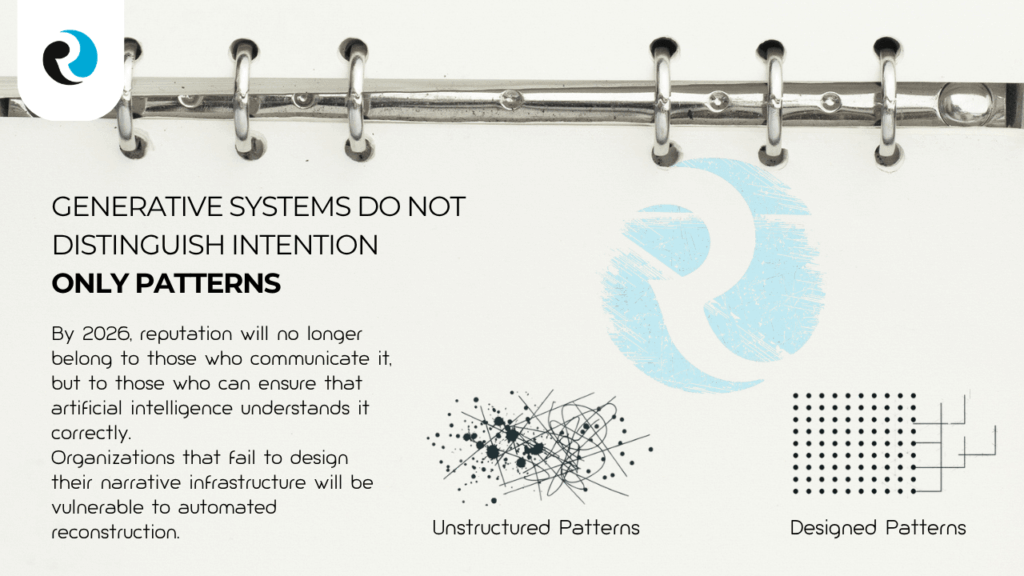
Those that do not will be exposed to a scenario in which their reputation will be rebuilt by systems that do not distinguish intention, only patterns.
Because in 2026, reputation no longer belongs to the one who communicates it, but to the one who manages to make artificial intelligence understand it correctly .
Frequently Asked Questions (FAQ)
It’s not the quantity of content, but its ability to be interpreted unambiguously. A solid narrative is one that maintains coherence across sources, conceptual precision, and continuity over time, allowing AI to reconstruct it without introducing distortions.
Because generative models don’t consume information in isolation: they integrate, compare, and reorganize it. Reputation emerges from this continuous process, making it a dynamic system rather than a static state.
This means that the identity reconstructed by AI does not match the real identity. This can lead to inaccurate responses, a loss of authority, or even negative associations stemming from incomplete or decontextualized information.
Through verifiable, coherent, and institutionally supported content. Authority no longer depends solely on external recognition, but on the structural quality of the information that the models can process.
Less and less. Although communication continues to influence media and search engines, the absence of a strategy geared towards generative systems leaves a void that AI will fill through inference.
Continue operating under a logic of visibility, not interpretation. In this new environment, simply being present is not enough: being correctly understood is essential.
The alignment between the narrative the organization constructs and the narrative reproduced by artificial intelligence. When both coincide, real reputational control exists.