
One risk. One decision point. One practical framework for companies, executives, legal counsel and crisis teams facing defamatory attacks online.
A defamatory attack against a company is not only a communications problem. It can influence commercial trust, investor confidence, banking relationships and due diligence before the facts have been tested or the company has chosen a response.
The 2026 dispute between X Corp. and Media Matters shows how quickly alleged false reporting can become a business-risk event. X says the publications were false and caused advertising and brand losses; Media Matters disputes the claims.
That distinction matters. A company should not begin with the assumption that damaging content can simply be deleted. The safer sequence is to preserve evidence, classify the statement, document business impact and then choose the legal, platform or reputational route that fits the facts.
“Defamatory attacks should be handled as risk events, not emotional disputes. The company must prove the issue, choose the correct route and avoid turning the response into a second reputational problem.”
Andrea Baggio, CEO EMEA ReputationUP
How can companies protect themselves from defamatory attacks?
Companies protect themselves by moving from reaction to structured evidence. First identify the exact statement, preserve how it was published, and determine whether the issue is factual falsity, opinion, missing context or outdated information.
The remedy then follows the classification. Depending on the source and evidence, the response may involve publisher correction, source removal, platform reporting, legal escalation, deindexing, suppression or crisis containment. These outcomes solve different problems and should not be presented as interchangeable.
The online defamation guide framework is useful at this stage because the company needs to distinguish a provable false statement from criticism or reputational discomfort before demanding removal.
No serious strategy should promise guaranteed deletion. The real question is whether there is a defensible route to remove, correct, deindex or contain the attack without creating greater exposure.
Why defamatory attacks require evidence, not reaction
Corporate attacks often spread faster than the internal review needed to answer them. A rushed denial can amplify the accusation, while a vague takedown request can fail because it does not identify the exact falsehood or the evidence supporting the company’s position.
The operational priority is therefore to convert reputational pressure into a record that an editor, platform, lawyer, regulator or court can independently assess. That means documenting both what was published and what the company can prove.
X Corp. in 2026: when alleged false reporting becomes a business-risk dispute
The X Corp. dispute with Media Matters illustrates that separation. In November 2023, Media Matters published articles about major-brand advertisements appearing next to conspiratorial, antisemitic and anti-LGBTQ content on X. X maintained that the reporting was false and sued under Texas law.
A Fifth Circuit opinion issued on August 21, 2026 describes X’s claims for business disparagement and contractual interference, and records its allegation that advertiser withdrawals caused significant revenue and brand losses.
The case does not establish that criticism of a company is automatically defamatory. Its relevance is narrower: when an organisation alleges false reporting, it must separate the disputed statement from the commercial consequences and support both with evidence.
Step 1: Preserve evidence and classify the attack
Before contacting an author, platform, publisher or host, preserve the current state of the material. Save the exact URLs, publication dates, account details, headlines, captions and search snippets, together with timestamped screenshots and copies of reposted or syndicated versions.
The evidence file should also contain documents that disprove the contested statement and records showing where it appears in search. Posts, snippets and copies can change after the first complaint is sent.
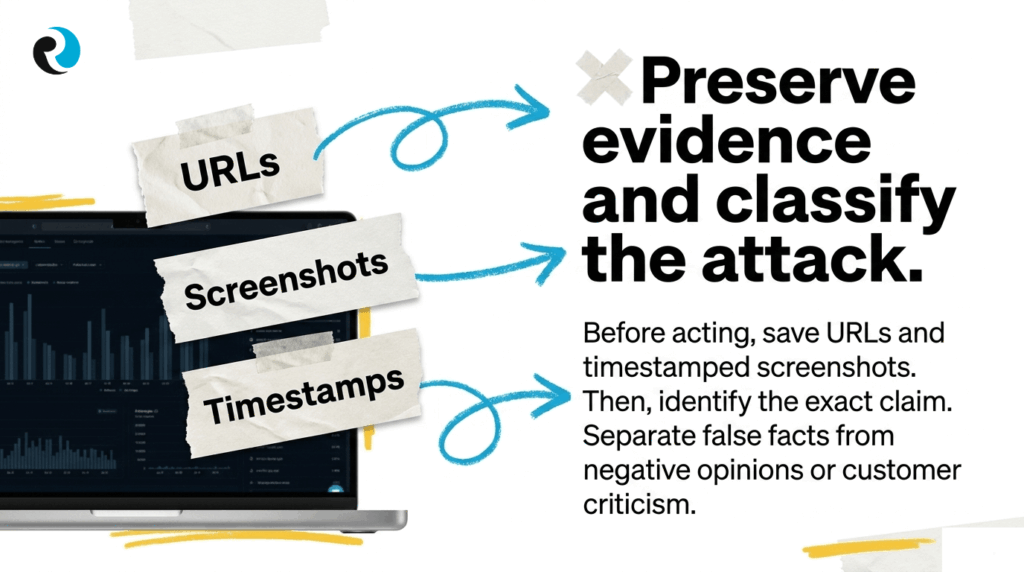
Preservation is only half of the first step. The company must then classify the statement: a factual allegation requires a different response from a negative opinion, customer criticism, an anonymous accusation or an outdated public record.
Precision improves credibility. Challenging an entire article or thread when only one sentence is false can weaken the request and make a publisher or platform less likely to engage with the underlying issue.
Step 2: Document business harm before escalating
Defamatory attacks against companies can produce operational effects long before a dispute reaches court. Investor questions, client hesitation, employee uncertainty, supplier concerns, media follow-ups and compliance reviews can turn an online allegation into a governance problem.
Those consequences should be documented rather than described generically. Evidence may include lost opportunities, client correspondence, banking delays, investor communications and board-level escalation.
The legal threshold varies by jurisdiction. Under the UK Defamation Act 2013, harm to the reputation of a body trading for profit is not considered “serious harm” unless it has caused or is likely to cause serious financial loss. That rule is not universal, but it illustrates why companies should prove impact instead of merely asserting it.
The escalation decision should also consider amplification risk. A legally defensible response may still be costly if it generates new coverage, screenshots or wider attention around material that previously had limited reach.
Step 3: Choose the correct remediation route
The source and the evidence determine the remedy. A legitimate publisher that made a factual error may respond to a correction request, while fabricated, impersonating or unlawful material may justify a stronger removal or legal route.
Source correction, removal and platform reporting
A correction request should identify the precise false statement, provide independent documentation and propose a proportionate change. Platform rules or applicable law may provide a separate reporting route.
Google’s legal-removal process asks users to identify the relevant product, the legal basis and the specific URLs at issue. Google states that it may review material for blocking, limiting or removing access, but that process is not a guarantee that a complaint will succeed.
Search visibility, suppression and containment
When the source remains online, deindexing may be relevant if a valid legal or privacy basis exists. The remove negative information from Google analysis becomes important here because source removal and search visibility are separate layers of the problem.
Suppression serves a different purpose. It may be appropriate when removal is unavailable or incomplete and accurate, authoritative information is needed to reduce the dominance of a distorted narrative.
Containment becomes necessary when the attack affects employees, clients, investors, media or governance. At that point, search remediation alone is insufficient because stakeholders may need direct and controlled information while legal or platform routes continue.
Step 4: Coordinate legal, communications and leadership
Fragmented responses increase risk. Legal, communications, leadership and digital reputation teams may see different parts of the problem, but all four perspectives need to be aligned before the first external contact.
A public statement can reassure stakeholders but also amplify the allegation. A takedown request can be justified but incomplete if copies remain, while suppression may improve visibility without answering urgent questions from banks, investors or employees.
When the dispute begins affecting operations and stakeholder confidence, crisis management becomes part of the remediation process. The objective is to coordinate evidence, timing, legal action and communications rather than allowing separate teams to create contradictory responses.
Step 5: Monitor spread and residual exposure
A defamatory attack may begin with one post and develop into an information cluster. Companies should monitor copies, search snippets, screenshots, forums, hostile domains and AI-mediated summaries that repeat the allegation.
Removing one source does not automatically eliminate cached or derivative versions. Post-action monitoring should test what remains visible for company, executive and due-diligence queries.
The objective is not only to remove what is eligible. It is to prevent the disputed narrative from becoming the easiest version of the story to retrieve after the first intervention.
What to do and what to avoid
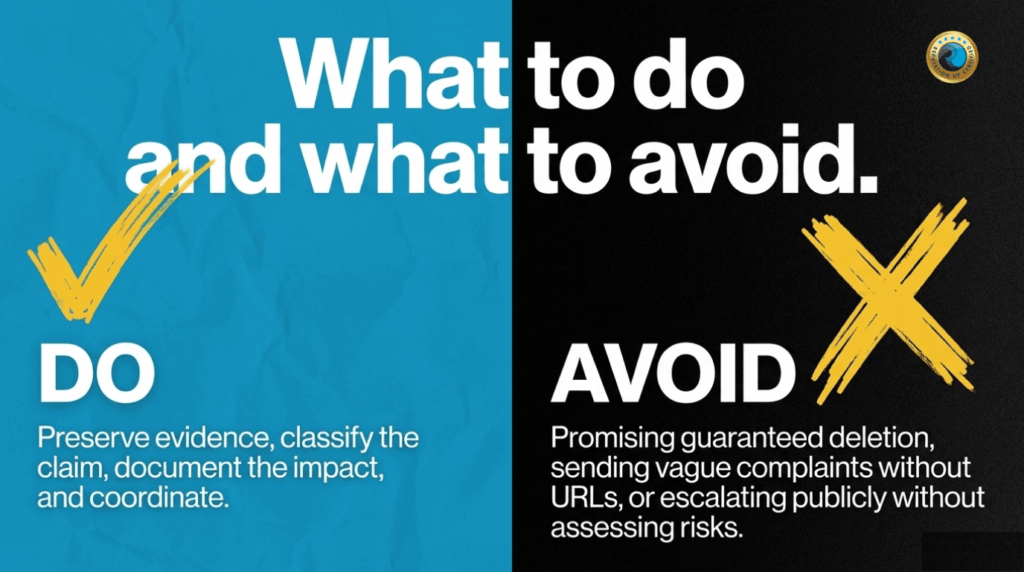
Start by preserving evidence, classifying the claim and documenting business impact. Then decide whether correction, removal, platform reporting, deindexing, suppression or containment is proportionate.
Avoid promising guaranteed deletion, sending complaints without URLs or proof, or escalating publicly before assessing amplification risk. Do not describe criticism as defamation simply because it is damaging, and do not confuse deindexing with deletion from the source.
Where content is genuinely false or unlawful, suppression should not replace a direct challenge. Conversely, where the content is lawful opinion or supported reporting, an aggressive legal response can create more visibility than control.
The company decision point
The decisive question is not how quickly the company can make an attack disappear. It is which lawful, evidentiary and reputational route can reduce the harm without increasing exposure.
Sometimes that route is correction or removal; in other cases it is platform reporting, deindexing, suppression, containment or formal legal action. The sequence depends on the evidence, source and business consequences.
A defamatory attack should not be answered with panic. It should be answered with proof, sequencing and judgment, followed by monitoring that tests whether the narrative continues to spread after the first action.
Companies protect themselves most effectively when they control the response before the attack controls the narrative.