
When a news article ranks prominently for an executive, founder or company, the reputational effect can arrive before anyone has assessed whether the story can actually be changed. Search visibility can influence investor confidence, banking relationships and due diligence even when the underlying publication remains legally protected.
That distinction became especially visible in 2026 as Prince Harry and other high-profile claimants continued litigation against Associated Newspapers.
The dispute is a reminder that a conflict with a publisher and the way an article appears on Google are two different layers of the same reputation problem.
A news article may sometimes be corrected or removed at the source. In other cases, the realistic remedy is deindexing for particular searches, an editorial update, or strategic reduction through stronger and more current information.
The first question should therefore not be whether the article is damaging. It should be which part of the exposure can lawfully and proportionately be changed without creating a second wave of attention.
“A news article on Google is not only a search result. It is a reputational signal. The first decision is whether the problem is the article, its indexing, its context or its dominance.”
Juan Ricardo Palacio, CEO America ReputationUP
The direct answer
A newspaper article can sometimes be removed from Google, but there is no single route. The remedy depends on whether the publisher can correct or remove the source, whether the result qualifies for deindexing, and whether the remaining visibility requires reputational reduction.
Teams asking how to get a newspaper article removed from the internet should first separate three outcomes. Removal changes or deletes the source; deindexing limits visibility for specific searches; and strategic reduction reduces the article’s dominance by strengthening accurate, authoritative information.
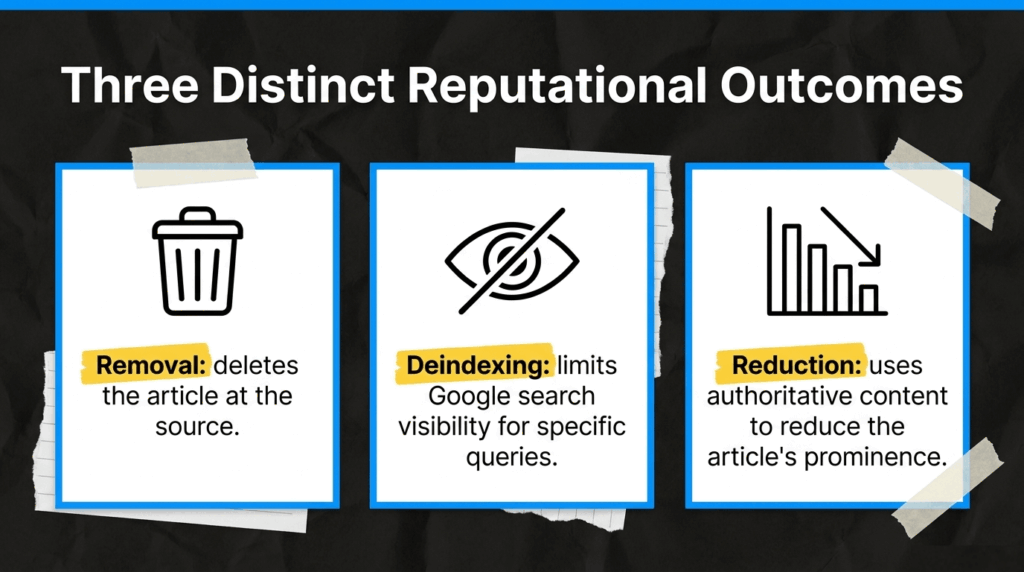
These outcomes are not interchangeable. A credible strategy defines the target before choosing the tactic, because reporting a deindexed article as “deleted” creates both legal and reputational confusion.
Why news articles are difficult to remove
News coverage is different from anonymous abuse or obvious platform spam. A news article may involve editorial judgment, public-interest reporting, court records, historical events, opinion, or facts that were accurate when published but later became incomplete.
For that reason, negative visibility does not automatically create a removal right. The strongest requests usually identify a specific factual error, defamatory statement, privacy issue, misleading omission or later development that materially changes the article’s meaning.
Where a story contains disputed factual allegations, the online defamation guide framework becomes relevant because the analysis must separate provable falsity from opinion, lawful reporting and reputational discomfort.
Prince Harry in 2026: a press dispute is not a Google-removal request
The distinction is visible in the litigation involving Prince Harry, Elton John, Elizabeth Hurley and other claimants against Associated Newspapers. A High Court judgment issued on 7 July 2026 confirms that the dispute remained before the Media and Communications List during 2026.
The case concerns contested allegations against the publisher and is not a Google delisting proceeding. That difference is precisely the point: source-level legal disputes and search-result visibility require different remedies, even when the same articles or allegations shape public perception.
For executives, this prevents a common error. The existence of a dispute with a newspaper does not mean Google must remove related coverage, and a search intervention does not resolve the underlying legal conflict with the publisher.
Step 1: Preserve the article and the search evidence
Before contacting a publisher, preserve the current state of the exposure. Capture the article URL, publication and update dates, author, headline, the exact statements at issue, and screenshots showing how the story appears in search.
The file should also record relevant queries, ranking positions, snippets, syndicated copies and documents that prove inaccuracy or missing context.
Evidence collected before intervention is more useful than trying to reconstruct the search environment after the article has changed.

This record can support publisher engagement, legal review, deindexing assessment and internal briefings. It also clarifies whether the reputational problem is one article or a wider cluster of copied and indexed material.
Step 2: Decide whether the problem is the source or Google visibility
A newspaper result has at least two layers. The source layer is the page controlled by the publisher; the search layer is how Google indexes, ranks and presents that page for a particular query.
If the publisher corrects, updates or removes the article, search results may eventually reflect that change. But executives and companies usually do not control the newspaper website, so they cannot apply source-side technical measures themselves.
That means the strategy may require publisher contact, a legal or privacy route, deindexing, or strategic reduction. Removal from the publisher is not the same as deindexing from Google, and neither should be described as disappearance from the internet.
Step 3: Assess whether publisher correction is realistic
In many news-related cases, correction is more proportionate than deletion. A publisher may be willing to correct a factual error, add a later court or regulatory outcome, clarify that an allegation was not proven, or update a headline that no longer reflects the full record.
The request should identify the exact passage, explain why it is inaccurate or incomplete, and provide documents that an editor can independently assess. A general statement that an article is “damaging” gives the publisher little basis to act.
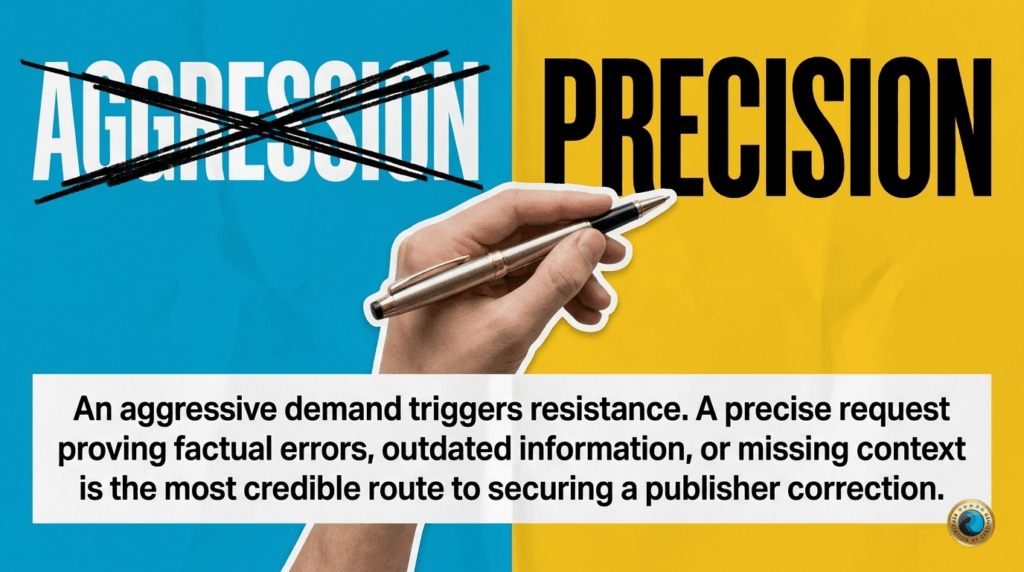
Publisher engagement also carries amplification risk. An aggressive demand can generate resistance, screenshots or follow-up coverage, while a precise and evidence-based correction request can reduce the chance that the remediation effort becomes a new story.
Step 4: Assess whether deindexing is available
Sometimes the article remains online but its appearance for a person’s name can be challenged. Google’s right to be forgotten overview explains that European data-protection law can allow individuals to request delisting of certain name-based results, while Google weighs relevance, accuracy and public interest.
A successful request does not necessarily remove the article from the newspaper’s archive. The page may still be accessible through its direct URL, other queries, other search engines, social media, screenshots or syndicated copies.
The operational question behind remove negative information from Google is therefore about search visibility rather than source ownership. Deindexing can reduce discoverability without changing the underlying publication.
Step 5: Account for privacy, public interest and freedom of expression
News articles often sit at the boundary between privacy and freedom of expression. Reputational harm can be serious, but that alone does not override legitimate journalism, legal reporting, archival value or continuing public interest.
The European Commission’s guidance on erasure requests states that personal data does not always have to be deleted when processing is necessary for freedom of expression, legal obligations, public-interest purposes or legal claims.
That balance becomes especially important for public figures, regulated executives, litigation, political exposure, financial allegations and official records. A harmful article is not automatically unlawful, removable or deindexable simply because it appears prominently in search.
Step 6: Consider strategic reduction when removal is unavailable
Some cases reach a point where source removal is unrealistic and the deindexing basis is weak. The article may be accurate, the publisher may refuse an update, or the public-interest justification may remain strong.
Strategic reduction then becomes a visibility-management response rather than a promise to hide history. The objective is to strengthen current executive profiles, institutional pages, credible media coverage, factual explainers and other authoritative information that reflects the present situation.
This approach is most defensible when it adds accurate context instead of manufacturing positivity. The goal is to prevent one old, incomplete or disproportionate article from becoming the only interpretation available to a decision-maker searching quickly.
What to do
Start with evidence and classification. Preserve the article and search results, identify the precise problem, and determine whether it is a factual error, missing context, outdated information, a privacy issue or lawful but damaging reporting.
Then sequence the remedies. Source-level correction or redaction should be considered before treating Google as the primary problem, while deindexing should be pursued only where there is a credible legal or data-protection basis.
Finally, monitor what remains visible. Copies, snippets, archives, social references and AI-mediated summaries can continue to shape perception after the original article changes.
What to avoid
Do not promise guaranteed removal or describe deindexing as deletion. Avoid contacting a publisher without evidence, and do not demand full deletion when a correction or update would address the specific problem more proportionately.
Public-interest and freedom-of-expression limits should be assessed before escalation. Where a story contains genuinely false or unlawful material, strategic reduction should not replace a stronger challenge to the source.
The executive decision framework
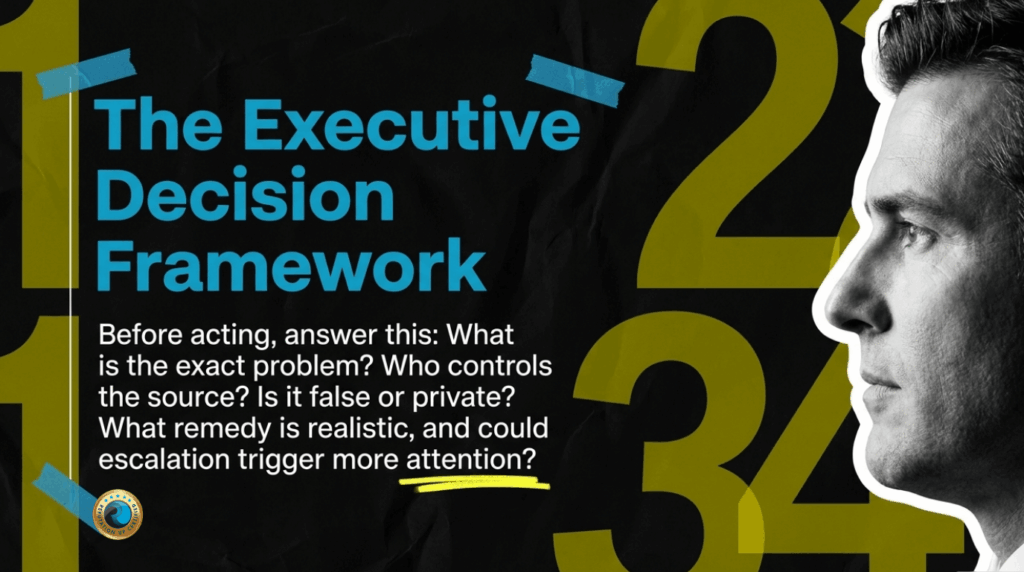
Leadership and counsel should answer six questions before acting: what exactly is the problem, who controls the source, and what category of information is involved? The answer may point to the article itself, a headline, a snippet, a personal-data issue or the ranking position.
They should then ask whether public interest is involved, which remedy is realistic, and what escalation could trigger. Correction, removal, deindexing and strategic reduction solve different problems and should be reported internally as different outcomes.
The controlled conclusion
A newspaper article can sometimes be removed or reduced in Google Search, but the correct strategy begins by identifying which layer of the problem can actually be changed. Desire for removal is not a legal or technical basis.
Sometimes the strongest route is publisher correction. In other cases, deindexing is available, or the article must remain online while more current and authoritative information reduces its dominance.
The most credible reputation strategy does not promise disappearance. It relies on evidence, classification, legal limits and proportionate action to determine what can be changed, what can be challenged and what must be contained.