
Defamatory content becomes more dangerous when search engines make it easy to retrieve. A false allegation on one website may already cause harm, but ranking for a company, executive or founder name can turn that allegation into a recurring first impression.
That risk now extends beyond ordinary blue links. In 2026, the dispute between Jimmy Keene and Google showed how a contested statement can surface directly inside an AI-generated search response, making the search layer itself part of the reputational problem.
The issue is therefore not only whether the underlying content is defamatory. Teams must also assess how it is indexed, which queries trigger it, whether search features repeat it, and what remains visible after the first intervention.
“Indexed defamation extends the damage because the search result becomes a reputational gateway. The response must address both the source and the visibility layer.”
Andrea Baggio
The direct answer
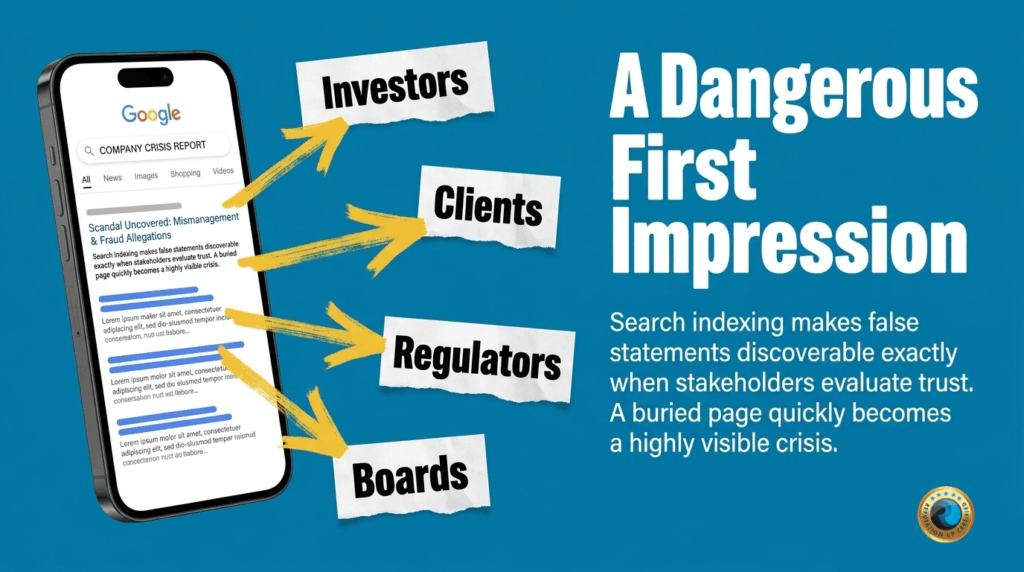
When defamatory content is indexed, the reputational risk expands beyond the original page. Search can expose the allegation during investor checks, client research, media work, hiring, banking reviews or due diligence, even before a stakeholder reads the full source.
A structured online defamation guide approach begins by separating three questions: what exactly is false, how the search layer is presenting it, and which remedy can realistically address each layer.
Source removal, deindexing and suppression are different outcomes. A credible strategy should never describe a deindexed page as deleted or a ranking change as permanent removal.
Why indexing changes the risk
Search engines can transform a hard-to-find page into a visible reputation event. Google Search Central explains that Search works through crawling, indexing and serving results, which means discoverability depends on both the source and the query environment.
For reputation-sensitive entities, timing matters. A buried allegation can become visible precisely when investors, clients, journalists, regulators or board members are evaluating trust.
Google–Keene in 2026: when search results become part of the disputed publication
Jimmy Keene, whose story inspired the Apple TV+ series Black Bird, challenged several Google AI Overviews that he alleged displayed false information about him.
The dispute shows how reputational harm can expand when contested information appears directly inside a search-generated answer.
In September 2026, a federal court allowed claims involving two AI Overviews to continue while dismissing others. The ruling did not establish that Google had committed defamation, but it showed that the search layer itself can become part of the disputed publication when information is reformulated and presented directly to users.
When search creates a second reputational surface
Traditional indexed defamation usually begins with a third-party page that Google makes easier to discover. AI-mediated search adds another layer because the system may summarise or reorganise information before presenting it to the user.
For companies and executives, that distinction changes the evidence strategy. Teams should preserve not only the original source, but also the query, generated response, visible citations, screenshots and timestamps showing exactly how the allegation appeared in search.
A source correction may therefore solve only part of the problem. The response must also assess whether the disputed information remains visible through indexed results, snippets, copied pages or AI-generated answers.
Step 1: Preserve both the content and the search result
Evidence should capture two layers at the same time: the original publication and the way search presents it. Save the URL, exact statement, author or publisher, publication date and timestamped screenshots before contacting anyone.
Then document the search environment: relevant queries, ranking position, snippets, AI-generated responses, copied versions and any material showing falsity or business impact.
Search results change quickly, so reconstruction after the fact is weaker than contemporaneous evidence.
This file can support publisher correction, legal review, deindexing requests and internal crisis briefings. It also helps determine whether the problem is one page or a broader cluster of indexed material.
Step 2: Prove the defamation, not only the damage
Indexed visibility can increase harm, but it does not prove that the underlying statement is defamatory. The assessment still needs the exact claim, evidence of falsity, identification of the affected person or company, publication to others and a credible account of harm.
The legal threshold varies by jurisdiction. In England and Wales, for example, the Defamation Act 2013 requires serious harm, and for a body trading for profit that threshold includes serious financial loss or likely serious financial loss.
Operationally, the lesson is broader: a request becomes stronger when it shows why the statement is false and what consequence followed. Reputational discomfort alone is not the same as a defensible defamation case.
Step 3: Separate source removal from deindexing
When teams say “remove it from Google,” they may be describing several different remedies. Source removal changes or deletes the original page; deindexing limits visibility in search; suppression reduces prominence through stronger and more authoritative information.
For name-based visibility and personal-data issues, the European Commission notes that the right to erasure exists but is not absolute, including where processing is necessary for freedom of expression, legal obligations or legal claims.
That distinction is central to remove negative information from Google: a search intervention can reduce discoverability without changing the underlying publication, and a source correction may still leave snippets, copies or other indexed references behind.
Step 4: Choose the correct route
The remedy should follow the source and the evidence. A legitimate publisher may be approached for correction, update or redaction; a platform may have a policy or legal-reporting route; and deindexing may be assessed where search visibility is legally challengeable.
Suppression is appropriate when removal is unavailable, slow or incomplete, but it should not be presented as deletion. Crisis containment becomes necessary when indexed content starts affecting investors, employees, media, clients or compliance teams.
Step 5: Assess the amplification risk
A strong legal argument can still create a second reputational problem if the response is poorly timed. Aggressive demands may trigger screenshots, reposts, follow-up coverage, hostile commentary or additional indexed pages.
The safest sequence is evidence, classification, legal review, route selection and then escalation. Where the issue reaches stakeholders beyond search, crisis management becomes part of the response because legal and reputational decisions cannot be managed in separate silos.
Step 6: Monitor what remains after the first action
Indexed defamation rarely ends with one URL. After an intervention, teams should verify whether the source remains live, whether Google still shows it, whether the snippet changed and whether copied pages or social reposts have appeared.
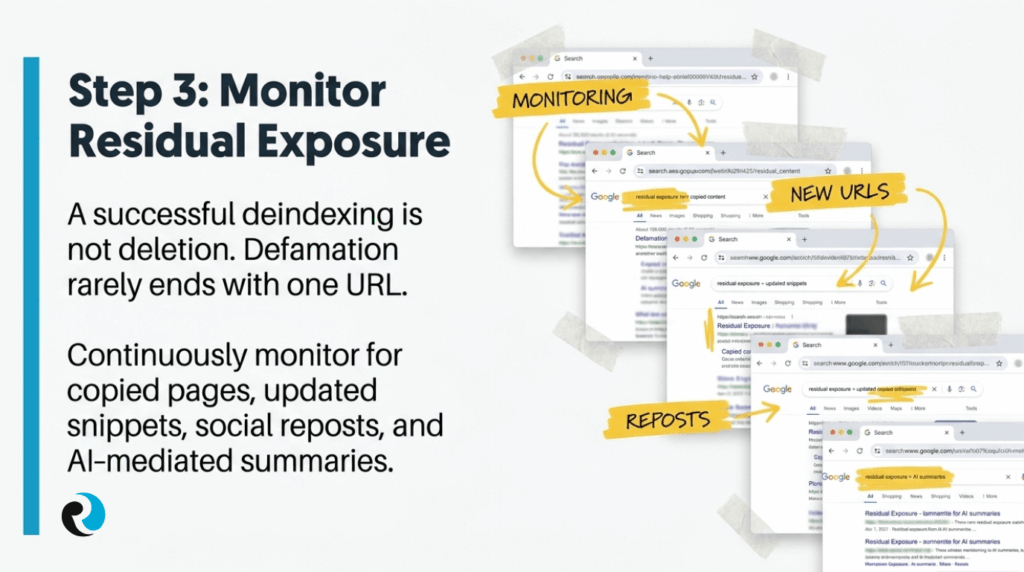
Monitoring should also cover images, PDFs, other search engines and AI-mediated summaries. A successful correction is not always enough, a successful deindexing is not deletion, and a source removal does not automatically remove copies.
Residual exposure is therefore part of remediation, not an afterthought. The objective is to understand what the first action solved and what reputational surfaces still need attention.
What to do — and what to avoid
Preserve the source and search result first, then classify the exact statement and build a proof file that an external reviewer can understand.
Choose the remedy only after distinguishing source control, search visibility and stakeholder risk.
Avoid guaranteed-removal promises, vague complaints and public escalation before amplification risk has been assessed. Do not treat search visibility as proof of illegality, and do not use suppression as a substitute when unlawful content has a stronger direct remedy.
The executive decision framework
Before acting, leadership should answer six questions: what exactly is defamatory, where is it indexed and what proves falsity? Those answers define the evidence problem and show whether the risk originates at the source, in search, or both.
The next questions are who controls the relevant layer, which remedy is proportionate and what will remain visible afterward.
Removal, correction, deindexing, suppression and containment should be treated as separate outcomes in both strategy and reporting.
The controlled conclusion
When defamatory content becomes searchable, the harm can travel further than the original publication. It becomes easier to discover, repeat and incorporate into decisions about trust.
The strongest response does not begin with a promise to make the result disappear. It begins with evidence, classification and a realistic choice between correction, source removal, deindexing, suppression, containment or formal legal action.
Search visibility extends the damage, but a controlled response can limit how far that damage travels. The goal is to manage both the source and the visibility layer without allowing the remediation effort to become a second crisis.