
Managing a media attack isn’t about issuing a hasty defense or trying to delete any inconvenient content. It’s about assessing the damage, deciding on the right course of action, and reconstructing the context before a hostile narrative becomes the dominant version of events surrounding a brand, company, or individual.
Today the problem is not just about news: it’s about Google, social media, screenshots, stregregators, AI systems, and brand searches.
The European Commission, through the Digital Services Act, also requires platforms to have warning and action mechanisms against illegal content, which confirms that reputation management can no longer be separated from the digital regulatory environment.
The difference between negative coverage and a real crisis appears when the content ceases to be an isolated piece and begins to shape public perception.
That is the moment when reputation stops depending on what was published and starts depending on how it is interpreted, how much it is replicated, and what gets fixed in search engines.
At this point, management can no longer be limited to a one-off reaction: it requires diagnosis, narrative strategy, monitoring of the digital environment, and strengthening of existing assets —precisely the type of intervention that ReputationUP develops in approaches such as SEO and AI Overview and Strategic PR in the Age of AI. Visibility and reputation are no longer separate issues.
When negative coverage becomes a media attack
Not every critical publication is a media attack. Nor does every harsh news story justify a legal response. The problem begins when three factors coincide: a hostile narrative, rapid amplification, and persistence.
If the content starts ranking by brand name, attracts sensitive searches, is reused on social networks, or appears associated with screenshots and comments, you are no longer facing a communication incident: you are facing a structural reputational risk.
That distinction matters because many organizations respond too quickly and too poorly. They treat a verifiable falsehood, a leak of personal data, a truthful but decontextualized piece of information, or a smear campaign all the same. And each of those scenarios requires a different approach.Therefore, before any statement, a reputational diagnostic phase is needed, such as the one that ReputationUP works on in Fake News and online reputation and in Defamation on social networks.
The first correct step: classify the damage before responding
Responding without classifying the content is the most costly mistake in a crisis. Professional management begins by distinguishing what is false, what violates privacy, what may be illegal, and what, even if uncomfortable, falls within the realm of legitimate information.
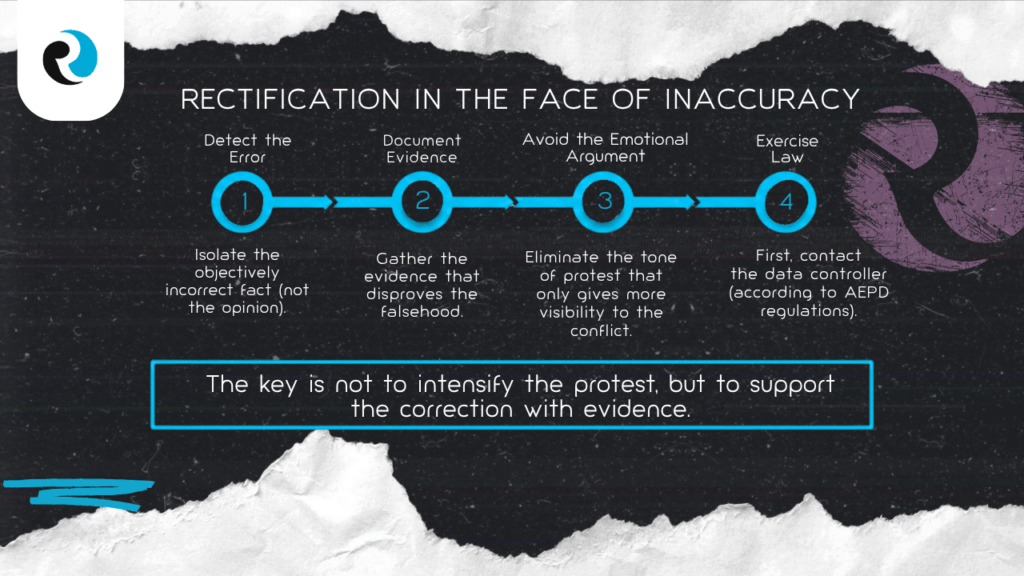
When there is inaccurate data, the correct course of action is to rectify it.
If the harm stems from a misattributed name, an incorrect date, a false accusation, or objectively incorrect information, the most effective response is not an emotional retort.
Here is not to protest louder, but to substantiate the inaccuracy with evidence. A well-structured correction clarifies the erroneous claim, provides evidence, and prevents the complaint from becoming an emotional outburst that only draws more attention to the conflict.
When personal data is exposed, the priority is to contain the dissemination.
If the content includes addresses, phone numbers, emails, official identification, bank details, medical records, or credentials, the problem is no longer just reputational. It becomes a matter of privacy, security, and personal exposure. Google allows users to request the removal of search results that include sensitive personal information or information exposed with malicious intent, and requires the exact URLs to be provided in order to review the request.
In this scenario, intervention must combine reporting, evidence, and follow-up. Simply requesting removal once is insufficient. It’s necessary to monitor whether the content reappears on other URLs, is replicated in forums, or changes format.
This is where a stable monitoring layer comes in , consistent with the logic of Search Everywhere Optimization : the damage no longer travels through a single channel.
When illegality may exist, the response must be formal.
If the content may be illegal, the crisis is not resolved with a simple “denial.”Google clearly distinguishes between complaints regarding content policies and complaints based on legal grounds, and warns that one does not replace the other.
The DSA, for its part, requires platforms to offer warning and action mechanisms against illegal content and to communicate decisions and resources to the user.
This necessitates a system of traceability: screenshots, dates, URLs, profiles disseminating the information, reach, and legal basis. A crisis worsens when reputation, communications, and legal departments each work with different evidence or without a unified case file.
What a brand should do during the first 48 hours
The first few hours are not for “saying something right away.” They are for avoiding mistakes that will only make things worse.
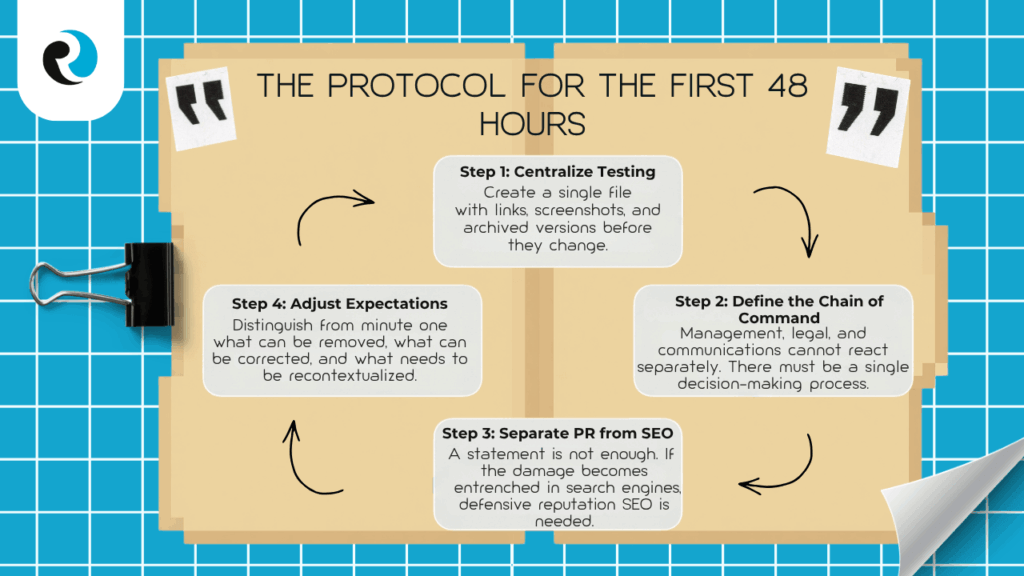
First, centralize evidence.
Every organization should open a file with links, screenshots, archived versions, headlines, accounts that amplify the message, and affected searches. Without that foundation, any retraction, complaint, or public response will be weak.
Second, it establishes a single decision-making chain.
Management, legal, communications, and marketing cannot react separately. A unified process is needed to decide what to respond to, what to correct, what to report, and what not to amplify.
Third, separate public response from reputational strategy.
A press release can be helpful, but it’s not enough. If the damage is already taking hold in search engine rankings, you also need a broader intervention: monitoring results, strengthening your own assets, organizing your digital presence, coordinating reputation and legal compliance, and a reputation SEO strategy that reduces ambiguity and prevents third parties from defining the narrative on their own.
That is the terrain in which ReputationUP works: not as a simple sender of messages, but as a strategic operator of context, visibility and reputational control.
Fourth, don’t act as if everything can be erased.
A mature crisis requires distinguishing between what can be removed, what can be corrected, and what must be recontextualized.
Google can help, but it doesn’t replace a reputation strategy.
One of the biggest mistakes in a reputational crisis is thinking that Google works like a general delete button. It doesn’t.
Google does allow you to request the removal of certain results for reasons of privacy, harmful exposure of personal data, sensitive personal content or in certain circumstances related to the Right to be Forgotten.
You can also check if information is inaccurate, inadequate, irrelevant, or excessive in searches associated with a person’s name, always under specific criteria and with clear limits.
But Google doesn’t diagnose a crisis, classify the type of damage, design a response narrative, reorganize a brand’s digital assets, or build a strategy to regain reputational control . Nor does it replace the work of monitoring, prioritizing, visibility, and contextual reconstruction that a complex crisis demands.
Furthermore, Google clarifies that these mechanisms are usually applied primarily to individuals, and that corporations and other legal entities do not normally have the same type of delisting right for searches by their corporate name.
That point is crucial. When the affected party is a company, the solution rarely involves simply “disappearing” from Google. Effective intervention usually requires something much broader: analyzing the risk, containing the spread, coordinating the response, strengthening internal assets, organizing results, and reconstructing the context.
That’s where a specialized firm like ReputationUP adds real value, because it doesn’t depend on a single withdrawal method, but on a comprehensive strategy of reputation, visibility, and narrative control.
Right to erasure, right to be forgotten, and realistic expectation
The right to erasur and the right to be forgotten are not synonymous with “erasing the internet”.
The Spanish Data Protection Agency (AEPD) distinguishes between these two concepts and explains that the right to be forgotten in search engines aims to prevent the dissemination of personal information when it has lost relevance or public interest, even if the original publication may have been legitimate. It also reminds users that the exercise of these rights should first be directed to the relevant data controller.
In professional reputation management, a healthy expectation is worth more than a grandiose promise. In many cases, success lies not in “making everything disappear,” but in reducing dissemination, correcting inaccuracies, and preventing a hostile narrative from becoming the dominant reference point.
The most neglected part: reconstructing the context
A crisis doesn’t end when the noise subsides. It ends when the brand once again has a solid, coherent, and defensible digital ecosystem.
This requires strengthening our own assets: corporate pages, executive profiles, FAQs, explanatory pieces, and content that allows third parties to better understand the context.
This is where it makes sense to connect with SEO and AI Overview and with AI and Reputation Overview: today, it’s not enough to influence the original page or media coverage. What search engines and AI can understand about your brand from the available signals also matters.
Reputational rebuilding also requires editorial discipline. It’s not about publishing in bulk. It’s about publishing pieces that clarify, organize, and lend authority. That difference is what separates a serious strategy from a panicked reaction.
What a brand should not do under media pressure
There are mistakes that turn a manageable crisis into a prolonged one:
- Don’t confuse criticism with illegality.
Not all hard content can be removed. - Avoid responding emotionally when evidence is lacking.
Outrage without proof worsens perceptions. - Don’t promise impossible deletions.
Credibility is broken when you promise more than you can deliver. - Don’t focus solely on media and forget about search engines.
If Google continues to prioritize hostile narratives, the crisis will persist. - Don’t let your guard down too soon.
Reputational damage resurfaces when an organization stops monitoring searches, rebuttals, and associations.
Strategic conclusion
Managing a media attack requires method, composure, and a structured approach. First, the damage is assessed. Then, the appropriate course of action is determined: retraction, privacy, legal channels, public de-escalation, or reputational reconstruction. And finally, the context is reinforced so that a hostile narrative no longer single-handedly defines the brand.
The difference between a crisis that is contained and a crisis that becomes chronic is not usually found in the initial headline. It usually lies in the quality of the response.
Brands that document quickly, activate the right channels, and work with a professional strategy of monitoring, reputation SEO, narrative reconstruction, and strengthening their own assets have a better chance of regaining visibility, credibility, and narrative control. That is precisely the value of a specialized intervention: not just reacting, but recovering structure, context, and digital authority.
Frequently Asked Questions (FAQ)
Requests to Google can be useful in specific cases involving privacy, personal data, or limited deindexing, but they don’t replace a comprehensive reputational strategy. A media crisis requires diagnosis, monitoring, organization of the digital context, reinforcement of internal assets, and sustained narrative control, especially when the damage affects a company or extends beyond a single URL.
It’s advisable to request a correction when there is a specific, verifiable, and inaccurate fact . If the problem is a hostile opinion or a questionable editorial interpretation, a poorly worded correction can actually increase the visibility of the conflict. The key is to distinguish between a factual error and an error of interpretation.
Not usually with the same logic as an individual. Google explains that the Right to be Forgotten framework focuses on individuals and searches associated with their name, not on companies or corporate entities in general.
Activate the process for removing personal information as soon as possible and preserve evidence. Google reviews requests related to contact information, identifiers, banking details, credentials, medical records, and harmful exposure of personal data, but requires specific URLs to evaluate the request.
If the information is truthful and retains public interest or relevance, it’s not advisable to promise automatic deletion. In such cases, it’s usually more effective to focus on context, accuracy, visibility, and your own assets than to sell a solution for total erasure.
The best defense combines protocol, evidence, monitoring, visibility, and legal judgment . In practice, that means responding effectively, monitoring the digital ecosystem, and strengthening your own assets before the next crisis catches the brand out of context.