
An online store can invest for years in product, logistics, customer service and positioning, but lose trust in a matter of hours when fake reviews, unfounded accusations or content designed to discredit it appear.
The impact is not limited to image: it can affect the purchase decision, conversion, the perception of security and the relationship with platforms, suppliers and customers.
An e-commerce business’s digital reputation is built through multiple signals: reviews, ratings, mentions, public responses, product pages, business profiles, and external conversations. When any of these signals are manipulated, the response shouldn’t be impulsive. It’s essential to distinguish between legitimate criticism, a fake review, and content that violates a platform’s policies or the company’s rights.
The digital reputation of an e-commerce business is the public perception formed from reviews, content, results, and online experiences that directly influence trust and purchasing decisions.
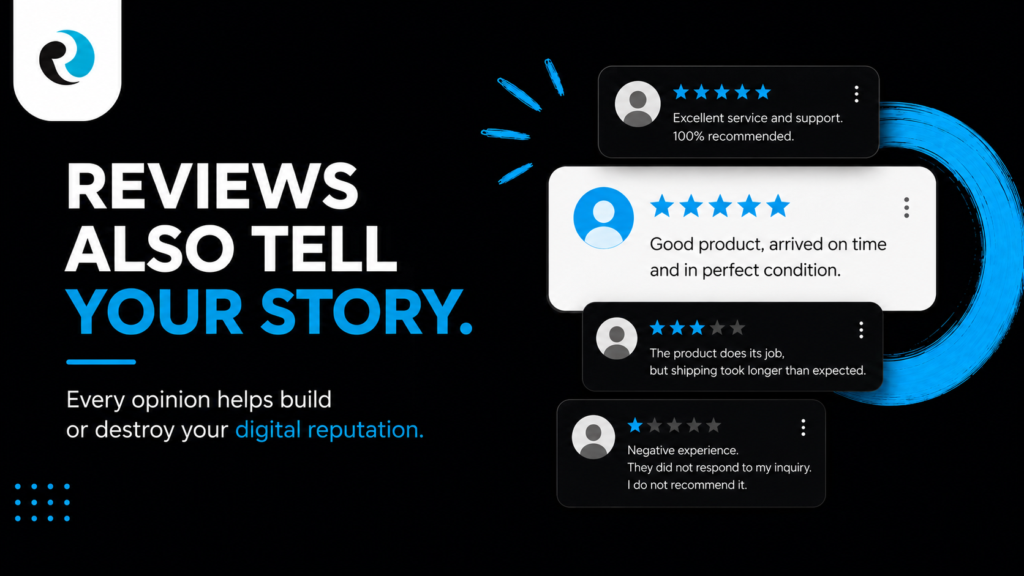
Why fake reviews do more damage than legitimate criticism
A genuine negative review can reveal an issue, a delay, or an unmet expectation. While uncomfortable, it provides valuable information and demonstrates how the company responds. A fake review operates differently: it creates an experience that never happened, artificially inflates the rating, and can influence business decisions based on misleading information.
The European Commission continues to highlight fake reviews as one of the risks affecting digital consumers. Its 2025 Consumer Conditions Scoreboard warns that online shoppers are significantly more likely to experience problems than those who shop offline. This reinforces a stark reality: trust remains one of the main weaknesses of e-commerce.
For an e-commerce business, the damage manifests on several levels. Fake reviews can reduce pre-purchase trust, increase page abandonment, and lower the average rating. They also put more pressure on customer service teams and can fuel doubts about the store’s authenticity, deliveries, returns, or payment security.
The problem worsens when accusations are replicated on social media, comparison sites, or forums. An isolated false opinion can become a seemingly valid reference if other users cite it without verifying its source.
How to tell if a review is fake, manipulated, or simply negative
Not every negative review should be reported. Trying to remove genuine criticism can create a bigger problem than the review itself, especially if the customer can prove that the company tried to silence them.
The difference must be established through evidence. A review may be suspicious when there is no order associated with the information provided, it describes products that the store does not sell, or it exactly reproduces the text of other reviews published within a very short period.
It’s also worth checking the profile from which the post is made, its age, and its previous activity. Newly created accounts, serious accusations without verifiable details, and minimal ratings posted simultaneously may reveal a coordinated pattern.
These signs alone do not prove that a review is fake. They serve to initiate an internal review, check business records, and gather documentation before filing a complaint.
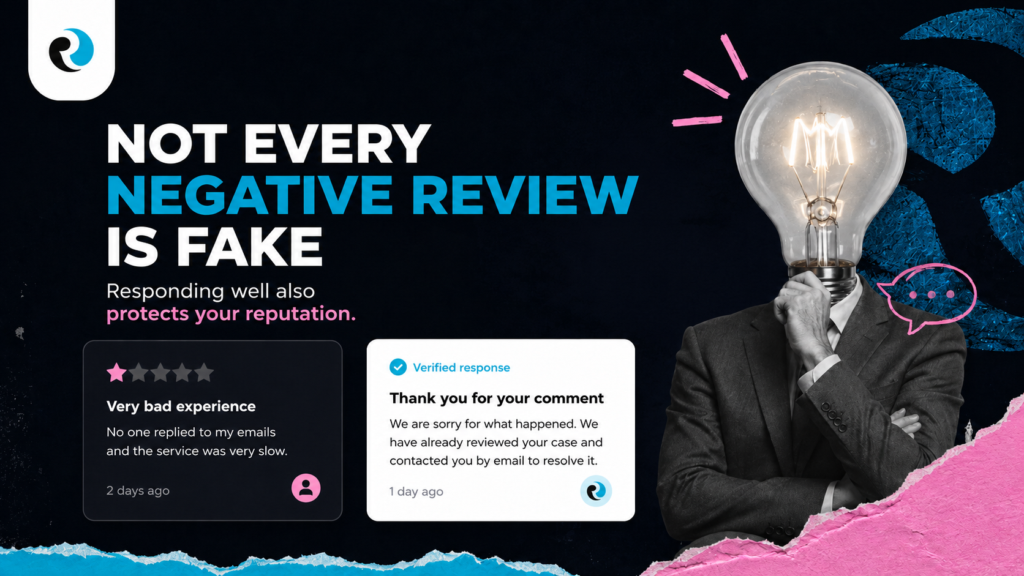
Legitimate criticism also needs a response.
A genuine review can be harsh, inaccurate, or emotional without necessarily being false. In these cases, the goal shouldn’t be to delete it, but to respond professionally.
A helpful response acknowledges the issue, avoids public arguments, and offers a concrete solution. This allows other shoppers to evaluate not only the problem itself, but also the store’s ability to resolve it.
Proper management begins with understanding that a credible reputation is not a reputation without criticism, but a reputation capable of responding with transparency and sound judgment.
What platforms and regulators prohibit
The main platforms distinguish between negative reviews and manipulated content. Google states that it does not allow reviews that do not stem from a genuine experience, ratings posted from multiple accounts to skew a score, or comments obtained through payments, discounts, or conditional free products.
Furthermore, their policies include restrictions for profiles that engage in manipulative practices. Possible measures include temporarily limiting the receipt of new reviews, hiding existing ratings, or displaying warnings when fake reviews have been removed.
In the United States, the Federal Trade Commission reinforced this policy through its Consumer Review Rule. The rule prohibits buying or selling fake reviews, conditioning incentives on positive or negative ratings, and concealing certain relationships between the company and the person posting the review.
In December 2025, the FTC again warned several companies about potential violations and reminded them that civil penalties can accumulate for each infraction. For any e-commerce business operating in international markets, this demonstrates that manipulating reviews is not an aggressive marketing strategy: it’s a reputational, commercial, and regulatory risk.
How to remove a fake review from an e-commerce site
Removal does not depend on whether the content is unfair. It depends on whether it violates a policy, a rule, or a demonstrable right.
1. Document the review before reporting it
Before starting any action, it is advisable to keep:
- Full screenshot of the review.
- Date, time, URL and profile name.
- Punctuation and full text.
- Subsequent responses.
- Data that proves there is no related purchase.
Documentation is essential because a review can be modified or disappear before the review is completed.
2. Compare the content with the platform’s policies
The complaint must specify the exact violation. It is not enough to simply state that the opinion harms the business.
A violation may occur when content describes a fabricated experience, includes spam, impersonates another person, reveals private information, or is part of a conflict of interest. It can also be reported when it contains threats, harassment, third-party promotion, or clear signs of coordinated manipulation.
ReputationUP’s guide on how removing negative reviews explains the differences between a legitimate review and a review that may be removed.
3. Submit a precise request
An effective complaint should be brief, verifiable, and focused on the applicable law. Emotional messages or accusations that cannot be proven should be avoided.
The request must identify the review, specify the violated policy, describe the available evidence, and explain why the content does not reflect a real experience. The closing statement must include a specific request for review and removal.
4. Record each action
Save the incident number, the date of the complaint, and the response received. If the platform rejects the request, check if there is an appeals process.
An organized record makes it possible to detect whether the problem is isolated or part of a larger campaign.
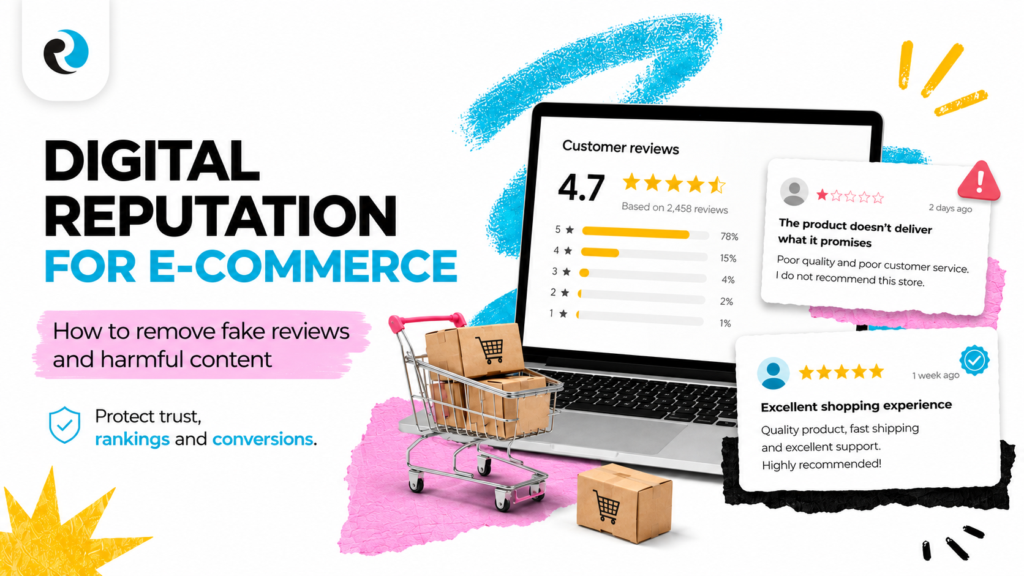
What to do when harmful content appears outside of reviews
The risk isn’t always in a business listing. It can also appear in forums, social media, blogs, videos, comparison sites, complaint pages, or posts created to attack a brand.
In these cases, the answer depends on the type of content, its veracity, and where it is published.
False or defamatory content
When a publication attributes false facts and causes demonstrable harm, it may be necessary to request its removal, contact the page administrator, or consider legal intervention.
The ReputationUP article on removing online content details different technical and reputational ways to deal with harmful materials.
True but outdated content
Not all harmful content is false. An old incident may continue to appear even if the company has fixed the problem, compensated the customer, or changed its procedures.
The response may include a request for an update, the publication of explanatory documentation, or the reinforcement of official information that provides context. It is also advisable to review whether current policies, guarantees, and processes are sufficiently visible to the consumer.
Coordinated campaigns
A sudden drop in score, multiple recent profiles, or nearly identical messages may indicate organized action.
The company should avoid responding emotionally to each individual. First, it needs to identify the pattern, preserve evidence, and determine which accounts, platforms, and messages are part of the attack. Only then can it decide whether to report the incident, respond publicly, or escalate the case.
Respond or report: the decision that protects credibility
A bad decision can amplify the problem.
It’s best to respond when the experience seems genuine, there’s an identifiable order, and the customer raises a specific issue. The public response should offer a solution and demonstrate that the store isn’t shirking its responsibilities.
The complaint is most appropriate when there is no verifiable business relationship, the content appears automated or coordinated, verifiable false data is published, or the platform’s policies are violated.
In some cases, both approaches are necessary. A brief public response can protect public perception while the platform reviews the complaint.
The response does not accuse the author of lying, does not reveal personal data, and states that the company is taking action.
How to prevent a review crisis in an online store
Prevention depends less on reacting quickly than on having a stable system.
Verify the shopping experience
Stores should make it easier for reviews to come from real buyers. Post-purchase invitation systems, order IDs, and verified purchase labels reduce ambiguity and improve trust.
Monitor brands, products, and executives
Reputation monitoring allows you to detect reviews, mentions, and content before they gain greater visibility.
Monitoring should cover the brand name, its spelling variations, main products, business profiles, and the names of founders or executives. It’s also advisable to look for combinations with sensitive terms such as fraud, scam, refund, or breach of contract.
Create an internal protocol
The protocol should define who reviews the reviews, what criteria justify a complaint, and who responds publicly. It should also establish when the legal team intervenes, how cases are documented, and what internal timeframe exists for action.
Without a clear assignment of responsibilities, the company risks responding late, duplicating efforts, or publishing contradictory messages.
Don’t buy positive reviews
Buying reviews, rewarding only positive ratings, or asking employees to hide their relationship with the company can lead to penalties and destroy the credibility you were trying to build.
Reputation isn’t protected by creating unanimity. It’s protected by improving the experience, facilitating authentic opinions, and acting swiftly against demonstrable manipulation.
What metrics should an e-commerce business monitor?
Average ratings are not enough. An online store should consider:
- Volume and evolution of reviews.
- Sudden changes in rating.
- Proportion of verified reviews.
- Average response time.
- Issues resolved.
- Most affected products.
- Evolution of feeling.
- Impact on conversion.
These metrics should be interpreted together. A stable score may mask an increase in serious allegations, while a temporary drop may reflect an operational problem that has already been fixed.
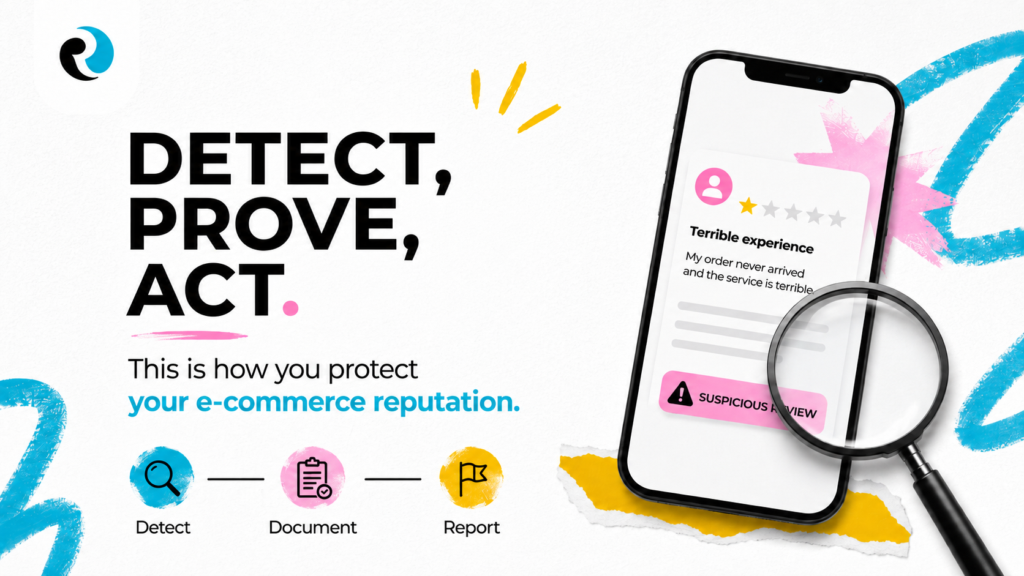
Phrases and facts for visual resources
Image caption: “A fake review doesn’t just change a rating: it can change a purchase decision.”
Visual insight: “The reputation of an e-commerce business depends on detecting, demonstrating and responding, not on eliminating all criticism.”
Image caption: “Authentic reviews build trust; manipulated reviews destroy the market.”
Visual insight: “Responding to a genuine critique and denouncing a false opinion are different decisions.”
Image caption: “Buying positive reviews can become a regulatory and reputational risk.”
Protecting trust requires method, not improvisation.
An e-commerce business’s digital reputation doesn’t depend solely on getting more positive reviews. It depends on consumers being able to distinguish an authentic experience from manipulation, and on the company knowing how to act without confusing criticism with attack.
Removing a fake review requires evidence, policy knowledge, and follow-up. Responding to a genuine experience requires listening, resolving issues, and consistency. Harmful content posted outside of review platforms needs a different strategy, one that combines removal, context, monitoring, and protecting results.
Professional reputation management allows you to connect these actions and avoid isolated responses. For an e-commerce business, protecting credibility also means protecting conversion rates, customer loyalty, and the ability to compete.
Frequently asked questions about digital reputation for e-commerce
No. Platforms typically remove reviews that violate their policies, not simply unfavorable opinions. A review based on a genuine experience can remain published even if the company disagrees. Removal is more likely when there is evidence of falsehood, spam, impersonation, conflict of interest, threats, or manipulation.
The company must gather verifiable evidence: absence of an order, references to nonexistent products, coordinated profiles, duplicate texts, or data inconsistent with the store’s operations. The company must present this evidence without disclosing the customer’s private information or making public accusations that it cannot substantiate.
Yes, when the review is visible and could influence other buyers. The response should be brief, neutral, and fact-focused. You can indicate that the transaction could not be located and that a review has been requested, avoiding calling the author a liar or sharing personal information.
Yes. Reviews are part of the decision-making process, especially when the shopper is unfamiliar with the store. A sharp drop in ratings, accusations of fraud, or concerns about deliveries and returns can increase shopping cart abandonment and shift sales to competitors perceived as more reliable.
It depends on the jurisdiction and how the incentive is designed. Conditioning a reward on a positive review can violate rules and policies. Incentives must allow for honest reviews and be clearly stated. Some platforms prohibit any reviews obtained through compensation.
You should document the pattern, keep screenshots, identify profiles and posting times, report in bulk when the platform allows it, and centralize the response. You should also monitor networks and forums to determine if the attack is spreading to other channels.
No. It can lead to penalties, platform restrictions, and a further loss of trust. Furthermore, artificial ratings often exhibit detectable patterns. Sustainable recovery depends on addressing real problems, soliciting genuine reviews, and only removing content that violates rules or rights.
When the volume of content exceeds internal capacity, there is a coordinated campaign, platforms reject documented complaints, or the damage affects sales and trust. It is also advisable when technical, reputational, and legal actions need to be coordinated.