
Receiving a WhatsApp message from a stranger can be surprising, especially when the sender uses a nickname chosen for Instagram, a forum or a gaming platform. How did they connect that name to our telephone number?
The relationship between WhatsApp and nicknames concerns precisely this connection. Information shared in different environments can be used to build a personal profile, make unwanted contact seem credible or prepare phishing attempts. Protecting your online privacy also means understanding which data other people can associate with your identity.
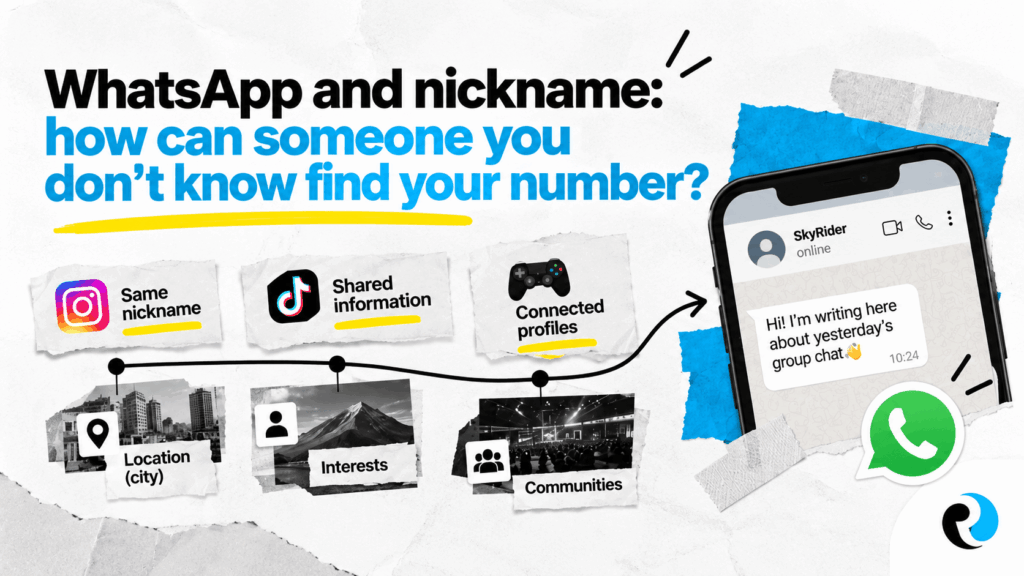
WhatsApp and nicknames: how can a stranger know your online name?
A nickname is an identifier used on a digital platform: it may be a pseudonym, a combination of characters or a name linked to personal interests. If it is reused across several services, it becomes easier to connect profiles that appear to be independent.
A user might adopt the same name on Instagram, TikTok and a forum. If one of these profiles displays a photograph, a city or contact details, someone carrying out a search may be able to reconstruct further connections.
The telephone number could come from information shared voluntarily, previous interactions, shared contacts or data exposed in a security breach. Knowing the nickname does not, by itself, prove that the WhatsApp account has been compromised: a connection between data must be distinguished from unauthorised access.
WhatsApp privacy: what information can be used?
The risk often arises from combining details available in different contexts. A nickname, a photograph and a professional reference can help make a person identifiable even without immediately revealing their full name.
In June 2026, Meta announced the introduction of usernames on WhatsApp, designed to allow users to connect without necessarily sharing their telephone number. Username reservations preceded the gradual rollout of the feature, planned during 2026.
The update shows why limiting the circulation of a telephone number can reduce exposure to unwanted contact. However, a username reused publicly across several platforms can facilitate new links between digital identities. Changing an identifier is therefore no substitute for checking the information visible on your profiles.
From a nickname to phishing: how psychological manipulation works
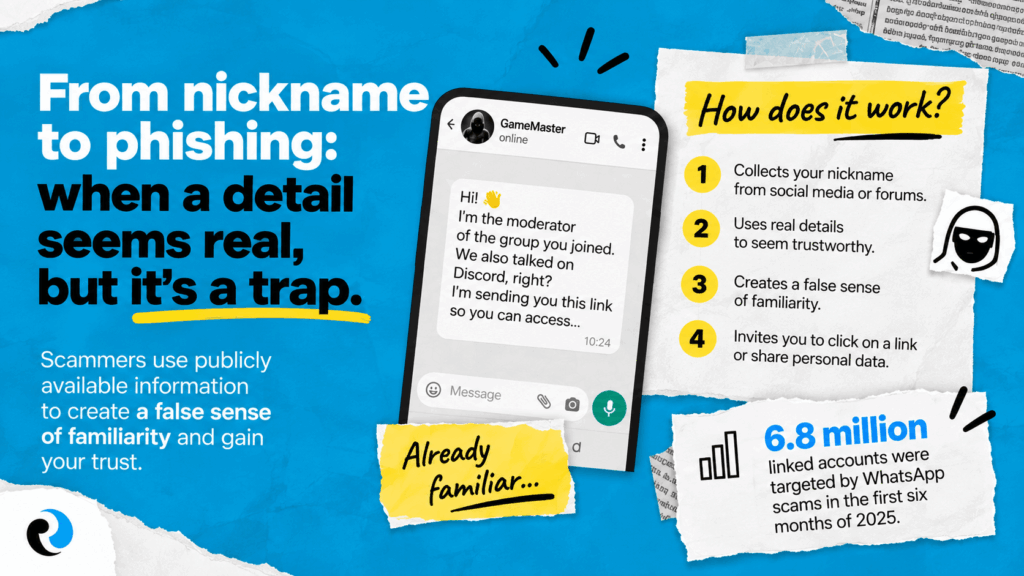
A personal detail can make a conversation seem more credible. Imagine that a stranger uses our nickname and mentions a community in which we participate. They might claim to be the group administrator or someone with whom we have interacted before.
The aim may be to create false familiarity and encourage us to share information or open a link. This mechanism is part of social engineering: manipulation techniques that exploit trust to induce risky behaviour.
In August 2025, WhatsApp reported that it had identified and blocked more than 6.8 million accounts linked to organised scam centres during the first six months of the year. The figure also helps explain how these operations work: Meta describes strategies that begin on one platform and continue on another, eventually directing the victim towards requests for money or external services.
In a similar scenario, a scammer could collect a nickname from a social network and use it in a later WhatsApp message to appear already known. The correct detail does not verify the sender’s identity: it may simply be information collected online. The risk therefore concerns the sequence of contacts, not only the individual message.
The main risks of suspicious WhatsApp contact
Not every message from an unknown number is dangerous. Some requests, however, deserve attention.
Phishing and credential theft. A link may lead to a page that imitates a familiar service and requests passwords or personal data.
Account theft. A request to provide a verification code or link an unknown device may conceal an attempt to gain access to WhatsApp.
Impersonation. Photographs and public information can be used to pretend to be someone you know or a trusted organisation.
Digital identity manipulation. The data collected can be used to create fake profiles or content wrongly attributed to someone. The risk is connected to online image manipulation: a public photograph can be reused out of context to construct a misleading representation.
How to recognise a phishing attempt on WhatsApp
A suspicious message may have a professional tone and contain genuine personal details. For this reason, knowing our name or nickname does not prove that the sender is trustworthy.
In April 2025, the Federal Trade Commission published guidance on recognising and preventing phishing, drawing attention to messages that impersonate familiar organisations in order to obtain confidential information. Precautions include verification through official channels, multi-factor authentication and caution with unexpected links.
On WhatsApp, particular care should be taken when a stranger:
- asks for verification codes, passwords or banking details;
- insists that a link be opened immediately;
- offers easy earnings or requests advance payments;
- asks you to scan an unverified QR code;
- uses personal information to create urgency or familiarity.
No single signal automatically proves that something is a scam. However, the request should be verified without using contact details or links supplied by the suspicious sender.
How to protect your nickname and digital identity
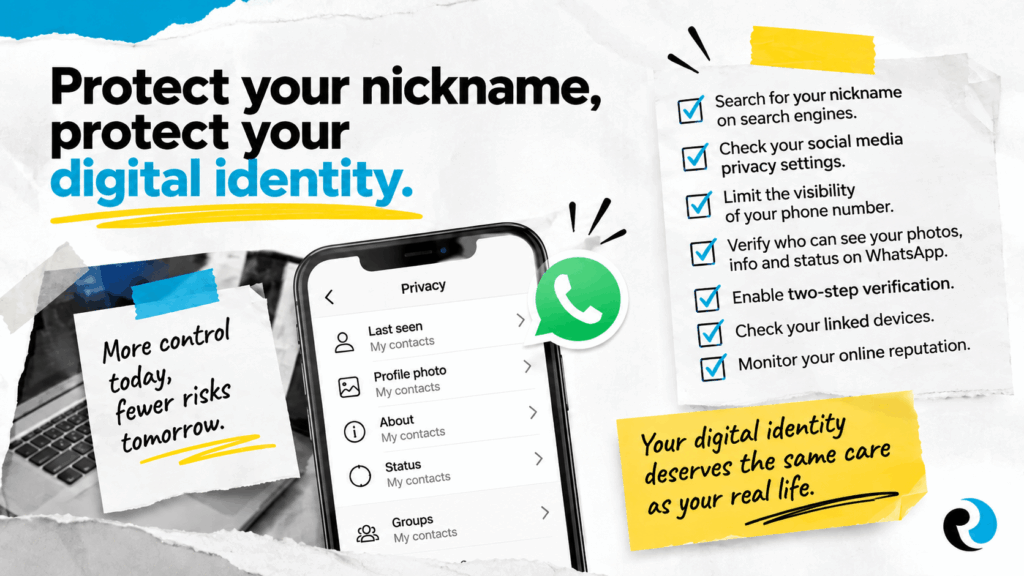
The first step is to search for your nickname on search engines and check which profiles, photographs and contact details are associated with that identifier. It is useful to review social media privacy settings and limit publication of your telephone number.
On WhatsApp, you should check who can see your photograph, profile information and status updates, as well as the settings for being added to groups. Two-step verification and periodic checks of linked devices provide additional protection.
Reputation monitoring can also help identify inauthentic profiles, misuse of your name and content that connects personal information to unauthorised identities.
What to do if a stranger contacts you using your nickname
If you receive an unexpected message, avoid confirming any additional personal details. Do not share codes, open suspicious links or make payments based solely on statements you have received.
If the sender claims to represent an organisation, contact it using details you have found independently. Keep relevant messages and use the blocking and reporting features when necessary. If there are fake profiles or impersonation, document the available evidence before considering further action.
Digital security also depends on the connections that others can build between information published at different times and in different places.
Frequently asked questions about WhatsApp and nicknames
They may have found it on a public profile, through previous interactions or by connecting information available across different platforms. It does not necessarily mean that they have breached your account.
Not necessarily, but it can make it easier to connect different profiles and reconstruct personal information.
A nickname alone does not provide access to an account. The risk increases if verification codes or authorisations to link devices are obtained.
Do not share confidential information, verify the sender’s identity through an independent channel, and use the blocking and reporting features when necessary.
Search for it on search engines, check the associated public profiles, and identify which data could connect it to your name, telephone number or other identifying information.