
The internet has changed the relationship between past and present. A news story published years ago, an old controversy, a photograph or a piece of personal content may continue to appear in search results long after the situation it described has changed.
This is one of the most sensitive aspects of the relationship between the past and online reputation: what remains accessible on the web can continue to shape a person’s digital identity, even when it no longer accurately represents their present.
The issue does not concern Google alone. The relationship between AI and reputation has become central because public information can now also be retrieved, synthesised and reprocessed by artificial intelligence systems. An outdated digital trace can therefore gain new visibility and influence personal, professional or financial assessments.
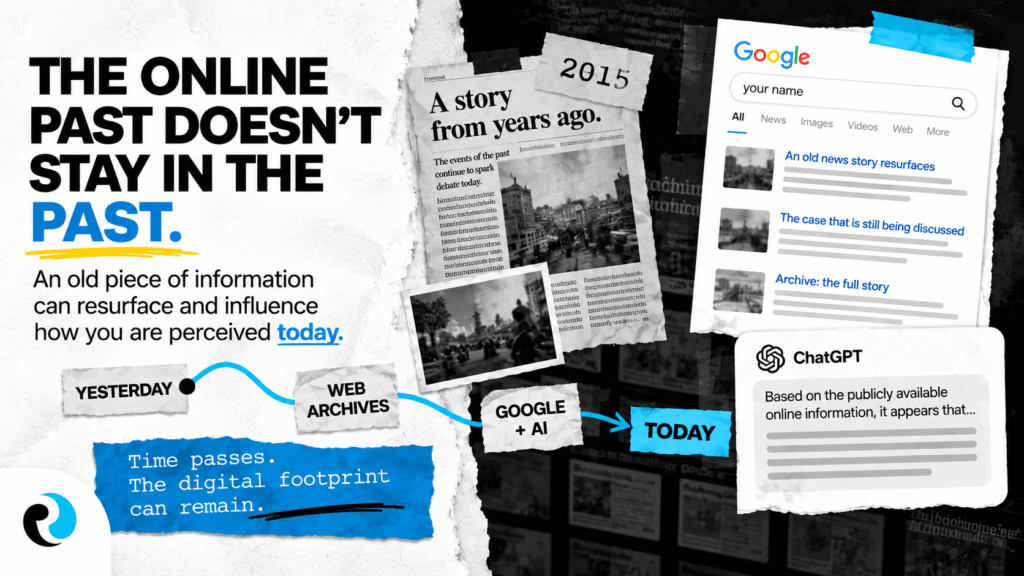
Why does the internet make the past so persistent?
Before the web, a news story often had a life cycle tied to the medium that published it. A newspaper article could remain in an archive, but it would gradually become harder to find.
Search engines have changed this dynamic. Content published many years earlier can be retrieved in seconds by entering a first name and surname. Consequently, the current relevance of information and its online visibility do not necessarily coincide.
An old article may still be historically accurate yet provide an incomplete picture if it does not include subsequent developments. Likewise, a photograph or post may be authentic but belong to a phase of life that no longer describes the person.
This is where online privacy also takes on a reputational dimension: understanding which personal information remains easily accessible means analysing the identity presented to anyone who performs a search.
When past content becomes a reputational problem
Not all outdated content causes harm. The problem arises when old information acquires disproportionate weight in relation to the current situation.
This can happen, for example, when a search predominantly returns a controversy that has long since been resolved, or when a court-related news story remains visible while subsequent developments receive far less prominence.
In 2025, the Italian Data Protection Authority addressed precisely the complexity of this balance in a decision concerning a request for delisting. In the case examined, the Authority considered factors such as the time elapsed, the public interest, the role of the person concerned and the development of the matter.
The principle is important: the mere passage of time does not automatically make the online presence of a news story unlawful. Each situation requires an assessment of the context, the currency of the information and the public interest that may still justify its discoverability.
The right to be forgotten: can the past really be erased?
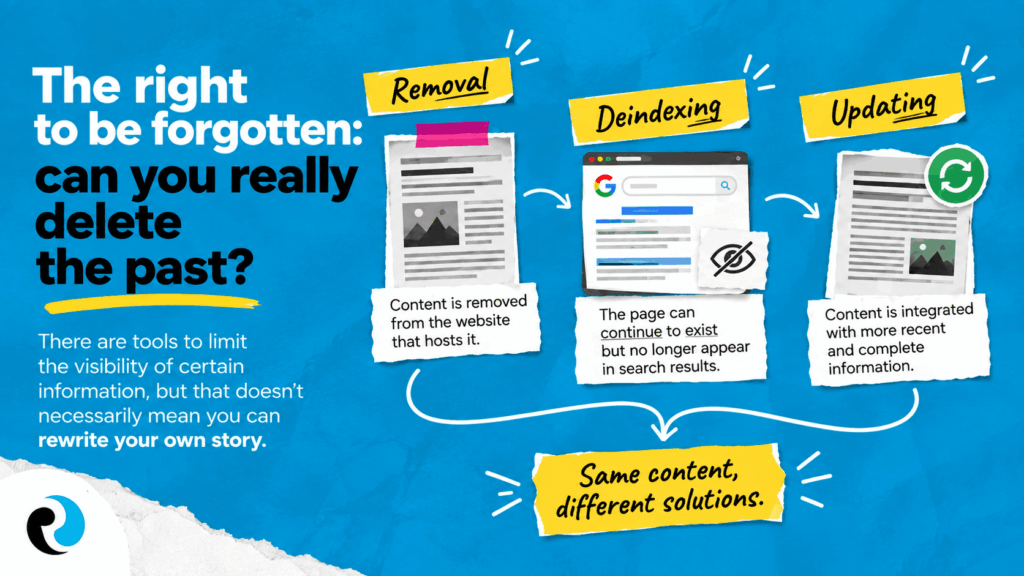
The right to be forgotten is one of the tools available to limit the discoverability of certain personal information when the legal requirements are met.
However, the right to be forgotten does not mean the right to rewrite one’s history.
A distinction must be made between removal, delisting and deletion. Removing a page at its source means deleting the content from the website that hosts it. Delisting, by contrast, means limiting its appearance in search-engine results associated with particular queries, while the page may continue to exist online.
In other cases, updating may be the most appropriate solution. A historically legitimate article can in fact become reputationally misleading when it tells only the beginning of a story and not what happened afterwards.
Another decision by the Italian Data Protection Authority from June 2025 shows why updating and delisting must be assessed separately. In the case examined, the publisher had updated the story and later delisted it, while the Authority nevertheless assessed whether the public interest remained.
Personal reputation can affect professional opportunities
The past and online reputation intersect above all when someone has to make a decision. A prospective employer, client, partner or investor may search for a person’s name before starting a professional relationship.
At that point, the available results become part of the context through which the person is interpreted. This does not mean that one negative story automatically determines a decision. It does mean, however, that an information ecosystem dominated by old, incomplete or decontextualised content can create a gap between a person’s real identity and digital identity.
The phenomenon is even more sensitive for entrepreneurs and executives because personal reputation can overlap with that of the organisation. Financial reputation can also have a temporal dimension: professional history, corporate information and publicly available content contribute to the context in which the reliability of a person or company is assessed.
Google is increasing control over personal information
Search engines are also developing tools that allow users to take action more easily regarding certain information.
In February 2025, Google updated “Results about you”, the tool that identifies results containing personal information such as a telephone number or address and allows users to request their removal from Search. The update also made it easier to submit removal requests and report outdated results.
The distinction remains fundamental: removing a result from Google does not necessarily remove the information from the web. The original content may continue to exist on the page that hosts it.
For this reason, managing the digital past first requires understanding where the information is located, why it is visible and what action is actually possible.
How to manage a digital past that no longer represents the present
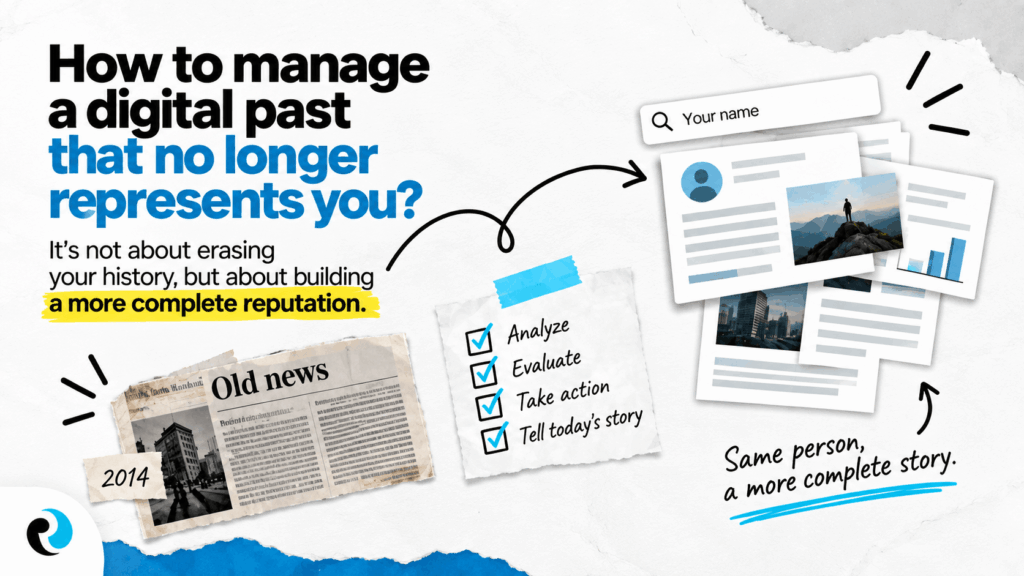
A reputational strategy should not begin with the desire to indiscriminately erase everything negative. The goal is to reconstruct an accurate, up-to-date and proportionate digital representation.
The first step is to map the results associated with one’s name, identifying content that is outdated, inaccurate, duplicated or particularly prominent. The next step is to distinguish what can be corrected, updated, removed or delisted from what legitimately remains a matter of public interest.
When removal is not possible, it becomes important to work on the current digital presence as well. Reputation management is not about erasing history, but about building an information ecosystem capable of representing more fully what a person has become over time.
The past does not disappear, but it can be contextualised
The web has a far more accessible memory than existed before search engines. For this reason, the past and online reputation are now closely connected.
Not everything old should be deleted, and not everything true should necessarily retain the same visibility forever. There is a balance between freedom of the press, privacy, the public interest and reputational protection that must be assessed case by case.
Managing reputation therefore also means this: ensuring that the past does not become the only lens through which the present is interpreted.
Frequently asked questions about the past and online reputation
It may be possible to request delisting when the requirements established by law are met. The assessment depends on the content, the time elapsed and the public interest.
Not necessarily. Deletion at the source and delisting from search results are different measures.
Yes. A story may be authentic but become incomplete or disproportionate in relation to the current situation, especially when later updates are missing.
No. Removal from Search may limit its discoverability through Google, while the original content can remain available on the website that hosts it.
The results associated with one’s name should be analysed, the accuracy and currency of the information verified, and updating, removal, delisting or the strengthening of authoritative and current sources considered.