
A celebrity recommends an investment. A professional appears in a promotional video. A familiar face describes the benefits of a product. Everything looks authentic, but that person may never have taken part in the campaign.
Advertising deepfakes make it possible to artificially reproduce faces, voices and statements, creating fake commercial endorsements. The risk goes beyond deceived consumers: people who are impersonated may find themselves associated with products, services or activities with which they have no connection.
This form of manipulation is part of the phenomenon of fake news and online reputation, but it has a distinctive feature: it turns a person’s identity into a tool for commercial persuasion, without necessarily having obtained their consent.
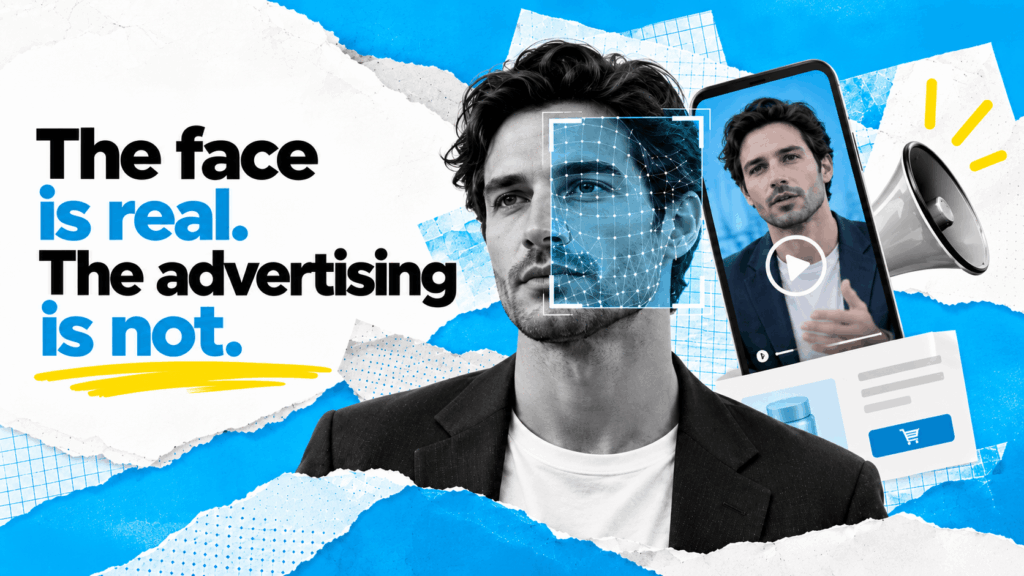
What are advertising deepfakes and how do they work?
An advertising deepfake is promotional content in which artificial intelligence is used to generate or alter images, videos or audio recordings, making a person appear to support a message they have never actually delivered.
These technologies can reproduce facial expressions, lip movements and vocal characteristics, combining them with images or recordings already available online.
The result may be a video in which a business owner appears to recommend a financial platform, or a doctor seemingly promotes a treatment.
However, not all advertising content created with AI is deceptive. An explicitly artificial avatar or an authorised reconstruction may serve legitimate purposes.
The problem arises when a real person’s likeness is used to suggest an endorsement that was never given.
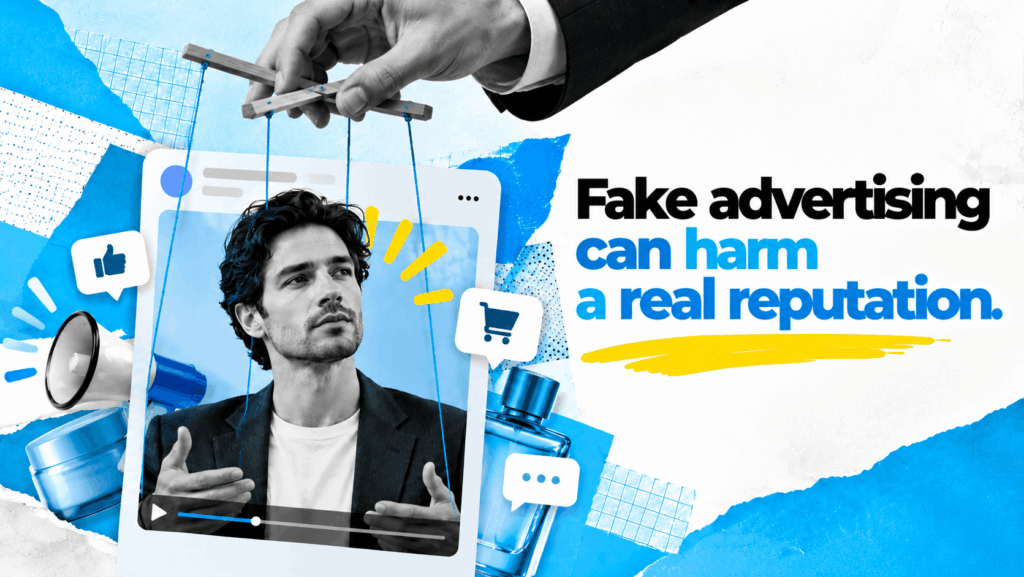
Why can a fake endorsement damage reputation?
In marketing, an endorsement works because it transfers some of the endorser’s credibility to the product.
When a professional or public figure voluntarily associates their name with a brand, that choice helps shape their image.
An advertising deepfake distorts this relationship: the association is created artificially, without the person being able to assess the product, approve the message or control its distribution.
The consequences can affect three areas.
1. Professional credibility. An expert may appear to recommend products that conflict with their expertise or public positions.
2. Personal trust. People who recognise the endorser’s face may hold them responsible for misleading advertising.
3. Public identity. Repeated false commercial associations can create an image far removed from the one built over time.
Brand identity is not limited to companies: professionals and public figures also develop a recognisable identity based on their values, expertise and communication choices.
When others can manipulate it, reputational risk arises even before any financial loss has been demonstrated.
Fake endorsements are already a documented problem
The phenomenon is more than theoretical.
In September 2026, the Bank of Italy published a warning about deepfake videos reproducing the face and voice of its Governor, Fabio Panetta, to falsely promote investment platforms.
In the Bank of Italy’s official statement, the institution clarified that the content was not authentic and urged the public not to make payments or share personal data. It also stated that it was requesting the content’s removal and reporting it to the relevant authorities.
The case shows how a fake endorsement can exploit both a person’s credibility and that of the institution they represent.
The scale of the issue becomes even clearer when looking at UK figures.
In February 2026, the Advertising Standards Authority reported receiving 2,589 reports of potential advertising scams in 2025, sending 169 alerts to platforms. The authority identified the use of AI-generated images and deepfake videos to simulate celebrity and public figure endorsements of investments and commercial products as a recurring trend.
These figures do not relate exclusively to deepfakes, but they confirm the significance of misleading advertisements that exploit recognisable identities.
Why is a denial not always enough?
Imagine a fake video being viewed by thousands of people before it is removed.
Some users may already have bought the product. Others may have shared the content, saved images or posted negative comments about the supposed endorser.
When a denial is issued, it may not reach the same audience.
This mechanism makes deepfakes particularly insidious: the falsity of a piece of content and the reputational harm it causes unfold on different timescales.
Even when a person proves that they did not authorise the campaign, copies of the video or references to the supposed partnership may continue to circulate.
In some circumstances, impersonation can even lead to cases of online defamation, fuelled by users convinced that the endorser knowingly took part in the promotion.
Reputation is therefore exposed to a double risk: the unlawful use of identity and the subsequent attribution of responsibility for actions never taken.
What do European rules say about advertising deepfakes?
Since 2 August 2026, the transparency obligations under Article 50 of the AI Act have applied, covering certain types of artificially generated or manipulated content.
Article 50 of the AI Act, published on the European Union’s official portal, sets out specific transparency obligations for those using artificial intelligence systems to generate or manipulate audiovisual content that falls within the definition of a deepfake. Where required by the rules, the content’s artificial origin must be disclosed.
This does not mean that simply adding a label makes every use of another person’s likeness legitimate.
Transparency and consent are separate issues. Stating that a video is artificial does not amount to obtaining the depicted person’s permission, nor does it rule out potential breaches of advertising, data protection or personal identity protection rules.
The relationship between online privacy and AI and reputation therefore becomes central: generative technologies create new ways to use identity, but also new responsibilities for those who produce and distribute content.
How can you recognise a deepfake advertisement?
A professional-looking video does not guarantee that the message is authentic. Nor does a familiar face prove that the person actually took part in the campaign.
When assessing a suspicious advertisement, it is useful to check whether the partnership appears on the endorser’s official channels, verify the advertiser’s identity and look for inconsistencies between the product and the depicted person’s usual activities.
Promises of extraordinary returns, time-sensitive offers and payment requests through unfamiliar websites deserve particular attention.
Even small flaws in lip synchronisation or voice can suggest manipulation, but the absence of visible anomalies does not prove that the content is authentic.
Verification should therefore focus primarily on the source of the message, rather than its realism alone.
How can reputation be protected against fake endorsements?
For professionals, creators and public figures, eliminating the risk entirely is difficult. Photographs, interviews and videos are often an essential part of their digital presence.
Protection therefore requires a strategy combining prevention, verification and the ability to respond.
Social media monitoring tools can help identify suspicious mentions, unauthorised campaigns and content that improperly associates an identity with products or services.
When a fake endorsement emerges, it is important to preserve evidence, identify the accounts responsible for distributing it and promptly report the material to the platforms.
Public communication must be equally precise: a denial should clarify which content is fake, why it is unauthorised and which channels genuinely belong to the person involved.
In more serious cases, legal remedies may also need to be considered.
The aim is not only to have the advertisement removed, but to prevent the artificial association from continuing to influence public perception.
When identity becomes a reputational liability
Advertising deepfakes change one of the fundamental dynamics of commercial communication: the ability to recognise who genuinely endorses a product.
Credibility built over years of work can be artificially exploited to lend authority to messages that have nothing to do with the person depicted.
That is why protecting reputation cannot be limited to monitoring what a professional publishes directly. It must also consider what others may publish using their face, voice and identity.
In the age of artificial intelligence, protecting reputation also means preserving the ability to distinguish a genuine choice from an endorsement that was never given.
FAQs on advertising deepfakes
They are promotional content generated or manipulated using artificial intelligence that can simulate a person’s likeness or voice, making them appear to be involved in an advertisement.
It depends on the circumstances and the applicable rules. Unauthorised use of another person’s identity may violate rights and legal provisions, even when its artificial origin is disclosed.
It is advisable to verify the partnership through the official channels of the person, the brand and the advertiser, rather than relying solely on the advertising video.
It can undermine credibility, trust and professional relationships, associating a person with products, services or statements they have never approved.
Preserve evidence and report the content to the platforms, publicly clarify that no permission was given when necessary, and consider the legal remedies available.